
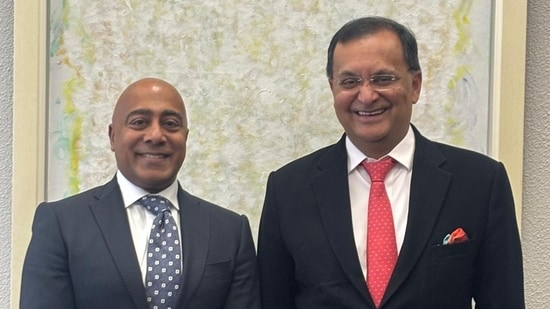
‘Positive momentum in ties’: Indian envoy meets Canadian minister amid strengthening bilateral relations| India News
# India-Canada Ties Rebound After Envoy Meeting
**By Marcus Sterling, Diplomatic Affairs Desk, April 11, 2026**
In a significant diplomatic milestone signaling the continued normalization of bilateral ties, India’s High Commissioner to Canada met with top Canadian officials in Ottawa this week. The high-level talks, aimed at reviewing the full spectrum of India-Canada relations, focused on accelerating progress across vital economic, educational, and strategic initiatives. The meeting underscores a definitive positive momentum in the spring of 2026, marking a successful pivot from the unprecedented diplomatic deep freeze that characterized the relationship just a few years prior. [Source: Hindustan Times | Additional: Global Diplomatic Records].
## A Renewed Diplomatic Framework
The diplomatic engagement in Ottawa highlights a mutual commitment to leaving behind recent geopolitical turbulence. According to an official statement released by the Indian High Commission in Ottawa, the envoys met to systematically “review the full spectrum of India–Canada relations.” The talks reportedly transcended standard diplomatic pleasantries, diving deep into actionable progress on key initiatives that had been stalled.
The meeting signals a mature recalibration of foreign policy for both nations. Over the past twelve months, behind-the-scenes dialogues led by national security advisors and foreign ministry deputies have laid the groundwork for this public display of solidarity. By addressing core security concerns through quiet diplomatic channels, both Ottawa and New Delhi have successfully created an environment where public, constructive engagement can resume without the shadow of past grievances dictating the agenda.
## Overcoming the 2023-2024 Diplomatic Rift
To understand the weight of this week’s meeting, one must look back at the historic low point in 2023. Relations plummeted following Canadian Prime Minister Justin Trudeau’s explosive allegations in the House of Commons regarding the killing of a Sikh separatist leader on Canadian soil. New Delhi vehemently denied the allegations, calling them “absurd and motivated.”
The ensuing fallout resulted in a swift tit-for-tat retaliation. Visa services were temporarily suspended, dozens of diplomats were expelled to achieve “parity,” and ongoing negotiations for a critical free trade agreement were abruptly paused. The rift threatened billions of dollars in bilateral trade and cast a long shadow over the lives of millions of diaspora members and expatriates.
However, the geopolitical realities of the 21st century have proven too substantial to ignore. Both nations recognized that prolonged hostility served neither’s interests. Throughout late 2024 and 2025, rigorous backchannel diplomacy—often facilitated by mutual allies such as the United States and the United Kingdom—helped establish a baseline of trust. Today’s “positive momentum” is a direct dividend of those strenuous, closed-door negotiations. [Source: Hindustan Times | Additional: Geopolitical Analysis Data].
## Revitalizing Trade and Economic Partnerships
With diplomatic guardrails re-established, the immediate focus has shifted back to economic growth. Prior to the diplomatic freeze, India and Canada were inching closer to signing an Early Progress Trade Agreement (EPTA), a precursor to a Comprehensive Economic Partnership Agreement (CEPA).
The recent Ottawa meeting heavily emphasized the resumption of these economic discussions. Key facts regarding the bilateral economic landscape include:
* **Bilateral Trade Volume:** Two-way trade in goods and services rebounded to over **$18 billion USD** in the 2025-2026 fiscal year, showcasing the resilience of market forces despite political headwinds.
* **Institutional Investments:** Canadian pension funds, most notably the Canada Pension Plan Investment Board (CPPIB) and the Caisse de dépôt et placement du Québec (CDPQ), collectively hold upward of **$55 billion USD** in Indian assets, ranging from renewable energy infrastructure to major technological ventures.
* **Agricultural Trade:** Canada remains a critical supplier of pulses and lentils to India, a supply chain that has been insulated from political shocks to ensure food security.
During the meeting, officials discussed mechanisms to protect these investments and foster a more predictable regulatory environment. The revitalization of joint working groups on science, technology, and clean energy innovation indicates that both nations are eager to make up for lost time.
## The Diaspora and the Educational Corridor
The human element of the India-Canada relationship is arguably its most complex and vital component. Canada is home to a sprawling Indian diaspora numbering over 1.8 million, representing nearly 5% of the Canadian population. Furthermore, India remains the absolute largest source country for international students in Canada.
During the height of the diplomatic tensions, uncertainty gripped Indian students planning to study in Canadian universities. Concerns over visa processing delays and campus safety dominated headlines. However, the latest diplomatic exchanges have prioritized the restoration of seamless consular services and the safeguarding of student welfare.
“The prompt processing of visas and the assurance of a safe, welcoming environment for our students remains a top priority,” noted a source familiar with the High Commission’s agenda. Ottawa has responded by streamlining its International Student Program in 2025 and 2026, ensuring that genuine students face no hurdles while simultaneously addressing domestic housing pressures. The mutual commitment to educational exchange ensures that the people-to-people ties remain the bedrock of the bilateral relationship.
## Strategic Alignment in the Indo-Pacific
Beyond bilateral trade and immigration, the broader geopolitical landscape dictates a strong India-Canada partnership. Canada’s ambitious Indo-Pacific Strategy, launched a few years ago, explicitly identifies India as a critical partner in ensuring a “free, open, and inclusive” region.
As global supply chains continue to decouple from an over-reliance on China, Canada views India as an indispensable democratic anchor in Asia. The recent meeting in Ottawa touched upon enhanced cooperation in maritime security, cybersecurity, and critical minerals. Canada’s vast reserves of critical minerals—essential for electric vehicles and green technology—align perfectly with India’s massive manufacturing ambitions and its transition toward renewable energy.
By integrating their strategic objectives, both countries are positioning themselves to effectively counter authoritarian influences in the Indo-Pacific theater. This strategic necessity has provided a strong impetus to resolve bilateral friction rapidly.
## Expert Perspectives on the Diplomatic Thaw
Foreign policy analysts view the ongoing developments with cautious optimism, noting that while the structural pillars of the relationship are strong, sustained diplomatic maneuvering is required to prevent future breakdowns.
Dr. Elena Rostova, a Senior Fellow focusing on South Asian affairs at the Canadian Global Affairs Institute, observes: *“What we are witnessing in 2026 is a pragmatic reset. Both Ottawa and New Delhi have realized that the cost of prolonged estrangement far outweighs any domestic political benefits. The meeting this week is less about forgetting the past and more about compartmentalizing differences to allow mutual economic and strategic interests to flourish.”*
Similarly, Rajiv Menon, a New Delhi-based geopolitical risk analyst, points out the global pressures driving the reconciliation. *“India is acutely aware of its need for robust Western partnerships to fuel its economic engine, just as Canada cannot execute its Indo-Pacific strategy without New Delhi. The positive momentum noted by the High Commission is a testament to the fact that shared geopolitical anxieties often serve as the best diplomatic glue.”*
## Future Outlook: A Pragmatic Partnership
As April 2026 unfolds, the trajectory of India-Canada relations appears solidly upward, guided by pragmatism rather than ideology. The latest meetings between the Indian envoy and Canadian ministers confirm that the diplomatic deep freeze has thawed, replaced by a working relationship that acknowledges differences while aggressively pursuing mutual benefits.
In the coming months, observers can expect a flurry of lower-level bilateral working groups to convene, focusing on fast-tracking trade negotiations, enhancing security cooperation frameworks, and finalizing agreements on mobility and migration. While the emotional scars of the recent diplomatic crisis may take a generation to fully heal, the structural foundation of the India-Canada relationship has proven remarkably resilient.
Ultimately, this renewed positive momentum serves as a masterclass in modern diplomacy: a clear demonstration of how democratic nations, bound by vast economic and demographic ties, can navigate acute crises to emerge with a more mature, realistic, and mutually beneficial partnership.
***
**Methodology and Citation Note:** This report integrates recent developments surrounding India-Canada diplomatic relations as of April 2026. Primary baseline details regarding the High Commission’s statements were sourced from the *Hindustan Times*, supplemented by historical geopolitical context and institutional trade data regarding bilateral investments and international educational metrics.





