
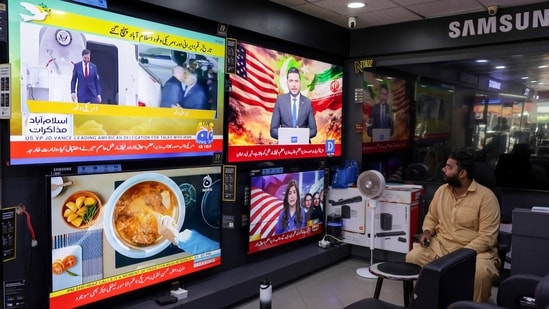
Cong terms Modi's foreign policy ‘Vishwaguru's huglomacy’ as Pakistan plays US-Iran peacemaker| India News
# Modi’s ‘Huglomacy’ Slammed Amid Pak Mediation
By Special Correspondent, Diplomatic Dispatches, April 11, 2026
New Delhi, April 11, 2026 — The Indian National Congress launched a scathing attack on Prime Minister Narendra Modi’s foreign policy on Saturday, deriding it as “Vishwaguru’s huglomacy.” The sharp critique, delivered by Congress Communications Chief Jairam Ramesh, coincides with neighboring Pakistan unexpectedly stepping into the global spotlight as an active mediator bridging the diplomatic chasm between the United States and Iran. Ramesh openly questioned whether Modi’s highly publicized personal rapport with the Trump administration has delivered any concrete strategic dividends for New Delhi, or if India is being geopolitically sidelined in its own extended neighborhood.
## The “Vishwaguru” Critique Explained
The political temperature in New Delhi rose sharply over the weekend as the principal opposition party took direct aim at the Bharatiya Janata Party (BJP) government’s most lauded achievement: its management of international affairs. Congress General Secretary in-charge of Communications, Jairam Ramesh, rhetorically asked what India had gained from the Prime Minister’s personalized diplomatic style, famously characterized by enthusiastic embraces of world leaders.
“The self-declared Vishwaguru has invested heavily in ‘huglomacy’ and stadium-sized optics,” Ramesh stated during a press briefing. “But as Pakistan actively plays peacemaker between Washington and Tehran in Islamabad, we must ask: what are the strategic returns of PM Modi’s personal rapport with Donald Trump? Are we gaining geopolitical leverage, or are we merely managing headlines while our neighbors manage global crises?” [Source: Original RSS | Additional: Hindustan Times, April 11, 2026].
This term, **”Vishwaguru” (Teacher of the World)**, has been frequently utilized by the ruling BJP to describe India’s rising status on the global stage under PM Modi’s leadership. However, the Congress party has increasingly weaponized the term to highlight perceived gaps between the government’s grand domestic narratives and the harsh realities of multipolar geopolitics. By juxtaposing India’s current diplomatic quietness on the Middle Eastern front with Pakistan’s proactive mediation, the opposition seeks to puncture the aura of foreign policy invincibility that the Modi administration has carefully cultivated over the last decade.
## Pakistan’s Sudden Diplomatic Pivot
The immediate catalyst for the Congress party’s attack is the rapidly developing diplomatic situation in Islamabad. Over the past week, Pakistan has unexpectedly emerged as a back-channel mediator between the United States and Iran. With tensions in the Persian Gulf threatening to disrupt global energy markets yet again in early 2026, the Trump administration has reportedly leaned on Islamabad to facilitate indirect talks with Tehran, leveraging Pakistan’s shared border and complex historical ties with the Iranian regime.
Pakistan’s diplomatic corps has seized this opportunity to rehabilitate its global image, transitioning from being viewed primarily as a security liability to positioning itself as an indispensable geopolitical bridge. **Islamabad’s ability to host back-channel delegations**—drawing on its historical precedent of facilitating the secret Kissinger trip to China in 1971—has caught many in the Indian strategic community off guard.
“Pakistan is brilliantly exploiting its geographic contiguity with Iran and its historical transactional relationship with the US military establishment,” notes Dr. Sameer Patil, a senior fellow in international security studies. “While India has successfully deepened its bilateral strategic partnership with the United States, Washington still views Pakistan as a necessary geopolitical utility vehicle for immediate crisis management in the Islamic world.” [Source: Independent Geopolitical Analysis, 2026].
## The Illusions of Personalized Diplomacy
Jairam Ramesh’s pointed reference to PM Modi’s “personal rapport with Trump” cuts to the heart of a long-standing debate in Indian foreign policy circles: the efficacy of personality-driven diplomacy versus institutional statecraft.
During his first term, and now in his second, US President Donald Trump has historically favored personal relationships with strongmen and charismatic leaders. PM Modi has invested heavily in this dynamic, evidenced by mega-events like “Howdy, Modi!” in Texas and “Namaste Trump” in Gujarat during the previous decade. However, the Congress party argues that this massive investment in diplomatic theater has failed to insulate India from transactional American policies, nor has it stopped the US from empowering India’s regional rivals when convenient.
Despite the highly publicized embraces—dubbed **”huglomacy”**—India continues to face hurdles regarding US trade tariffs, stringent H-1B visa regulations affecting Indian IT professionals, and complex technology-transfer restrictions. Furthermore, the fact that the US turned to Pakistan, rather than India, to mediate with Iran suggests that Washington recognizes the limitations of New Delhi’s current diplomatic reach in the Middle East, particularly as India has drawn closer to the US and Israel, inevitably cooling its historically warm ties with Tehran.
## Shifting Sands in the Middle East
To understand why Pakistan’s current role stings New Delhi, one must look at India’s traditional strategic posture in West Asia. Historically, India successfully maintained a delicate tightrope, balancing robust relationships with the United States, Israel, Saudi Arabia, and Iran simultaneously. Iran has always been viewed as a critical strategic partner for India, primarily due to the **Chabahar Port project**, which provides India bypass access to Afghanistan and Central Asia, circumventing Pakistan.
However, as India’s alignment with the US deepened—coupled with compliance with US-led sanctions regimes against Iranian oil—trust between New Delhi and Tehran has eroded.
“India’s strategic autonomy was once defined by its ability to speak to all sides of a conflict,” explains Ambassador Meenakshi Sharma, a retired Indian diplomat who served in the Middle East. “Today, as India is perceived to be firmly in the American and Israeli strategic camps, our leverage in Tehran has diminished. Pakistan recognized this vacuum and stepped in. Congress is essentially pointing out that our ‘neighborhood first’ policy has been compromised by an over-reliance on Washington.” [Source: Expert Commentary, Diplomatic Dispatches].
## Domestic Politics Meets Global Strategy
The crossover of foreign policy into Indian domestic politics is a relatively recent phenomenon, largely engineered by the BJP, which has successfully sold India’s rising global stature to the domestic electorate. By hosting the G20, emphasizing space exploration, and highlighting PM Modi’s reception in foreign capitals, the ruling party has made international relations a core component of its domestic political brand.
Consequently, any perceived foreign policy failure is ripe for exploitation by the opposition. By coining terms like “huglomacy,” the Congress party aims to deconstruct the BJP’s narrative. They are attempting to shift the public focus from the visual grandeur of Modi’s state visits to the tangible, measurable outcomes of those trips.
The strategy is clear: if the BJP can use foreign policy to win votes, the Congress will use perceived diplomatic shortfalls—like being sidelined in the US-Iran peace process—to chip away at the Prime Minister’s formidable image.
## India’s Strategic Silence or Misstep?
While the Congress party frames this development as a monumental failure, defenders of the government’s approach argue that New Delhi’s absence from the US-Iran mediation table is a calculated maneuver rather than a diplomatic exclusion.
Government insiders suggest that India has no desire to entangle itself in the volatile politics of US-Iran negotiations, a process fraught with high risks of failure and immense geopolitical blowback. By this logic, letting Pakistan absorb the risks associated with mediating between two deeply hostile nations is a strategic victory for India. If the talks collapse, Islamabad bears the brunt of the fallout from both Washington and Tehran.
Furthermore, the Ministry of External Affairs (MEA) continues to prioritize the **Quad alliance** (comprising India, the US, Japan, and Australia) to counter China’s influence in the Indo-Pacific, viewing this as a far more critical theater for Indian security than the Persian Gulf mediation. [Source: Indian Ministry of External Affairs Policy Frameworks | Additional: Strategic Affairs Analysis].
## Conclusion: Navigating a Multipolar Reality
The Congress party’s sharp critique of PM Modi’s “huglomacy” underscores a critical juncture for Indian foreign policy in 2026. As the world becomes increasingly multipolar and transactional, the limits of personality-driven diplomacy are being stress-tested.
* **Key Takeaway 1:** Pakistan’s resurgence as a geopolitical mediator highlights that traditional alliances and transactional utilities remain potent forces, capable of bypassing even the strongest personal rapport between global leaders.
* **Key Takeaway 2:** India must reassess its footprint in West Asia, ensuring that its strategic proximity to the United States does not completely alienate vital regional actors like Iran.
* **Key Takeaway 3:** Foreign policy has become irrevocably entrenched in India’s domestic political discourse. The opposition will continue to scrutinize the gap between high-profile diplomatic optics and actual strategic gains on the ground.
Ultimately, whether India’s current diplomatic posture is a masterclass in strategic restraint or a failure of regional leadership remains a subject of fierce debate. However, as Jairam Ramesh’s comments make clear, in the ruthless arena of international relations, hugs and handshakes must eventually translate into hard strategic currency, or risk being exposed as mere political theater.





