
Vrindavan boat tragedy: Video shows passengers chanting ‘Radhe Radhe’, had no safety vests| India News
# Vrindavan Boat Tragedy: Fatal Safety Failures
By Staff Correspondent, India News Desk, April 11, 2026
A devastating boat tragedy on the Yamuna River in Vrindavan has claimed multiple lives after an overcrowded vessel capsized on Friday evening. A chilling video recorded moments before the disaster shows pilgrims joyfully clapping and chanting “Radhe Radhe,” entirely oblivious to the impending danger. Notably, the footage reveals a glaring absence of safety vests among the passengers. Local authorities and the National Disaster Response Force (NDRF) immediately launched rescue operations. However, the tragic incident has ignited massive outrage over systemic regulatory lapses, overcrowding, and the absolute disregard for essential inland water safety protocols in major Indian pilgrimage centers.
## A Devotional Journey Turned Tragic
The holy city of Vrindavan, a massive magnet for Hindu devotees globally, witnessed an unthinkable tragedy when a routine boat ride across the Yamuna River ended in disaster. The incident occurred near one of the prominent ghats, an area traditionally bustling with pilgrims seeking spiritual solace.
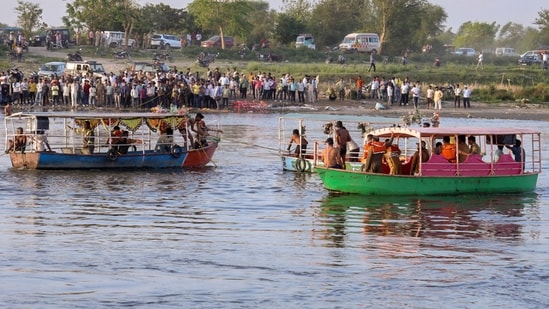
A mobile phone video that surfaced on social media early Saturday morning has become the defining, heartbreaking image of the catastrophe. In the 45-second clip, dozens of men, women, and children are seen crammed onto a traditional wooden boat. The atmosphere is undeniably festive and deeply devotional. Passengers are seen clapping in unison and chanting “Radhe Radhe,” a traditional greeting and prayer in the Braj region. [Source: Hindustan Times].
Seconds before the video cuts off, the boat noticeably tilts to one side, prompting sudden shouts of alarm. What followed was a chaotic struggle for survival in the murky, fast-flowing waters of the Yamuna. Because the passengers were deeply engrossed in their prayers and songs, the sudden capsize caught them completely off guard, drastically reducing their reaction time and ability to swim to safety.
## The Glaring Absence of Life Jackets
Perhaps the most damning revelation from the pre-tragedy footage is the absolute lack of life jackets. Not a single passenger in the crowded vessel was wearing a safety vest, a direct violation of basic inland water navigation rules.
Inland waterway regulations strictly mandate the provision and wearing of life jackets for all passengers on commercial and tourist ferry services. Yet, on the ground at the Vrindavan ghats, these rules are routinely flouted. Boatmen often view life jackets as an unnecessary expense, while pilgrims—often unaware of the depth and undercurrents of the Yamuna—do not demand them.
“The visual evidence is a heartbreaking indictment of our localized safety enforcement,” notes Dr. Ramesh Trivedi, an independent maritime safety consultant and former official with the Inland Waterways Authority of India. “Life jackets are not mere accessories; they are the fundamental difference between a frightful dip in the river and a mass casualty event. The fact that dozens of people were allowed to board without basic buoyancy aids highlights a complete breakdown of municipal oversight.” [Additional: Expert Analysis on Inland Waterway Safety].
## Overcrowding and the Economics of Risk
The root causes of the Vrindavan boat tragedy extend far beyond the absence of life vests. Overcrowding remains a chronic issue across India’s unregulated tourist boating sector. Initial reports suggest that the capsized boat was carrying nearly double its permitted capacity.
For local boatmen, the economic incentives often outweigh safety concerns. Fares for a brief ride along the ghats are relatively low, meaning operators must pack in as many passengers as possible per trip to make a viable daily wage. During peak pilgrimage seasons—such as festivals or auspicious weekends—the rush of devotees creates immense pressure on the limited number of boats available.
Furthermore, the wooden country boats (often referred to as ‘nauka’) used in these waters are frequently handcrafted by local artisans without strict adherence to naval architectural standards. They lack clearly defined load lines or capacity plates. When passengers shift to one side of the boat to view a particular ghat or take a photograph, the compromised center of gravity easily leads to capsizing.
## Government Response and Rescue Operations
Following the capsize, panic spread rapidly along the riverbank. Local boatmen were the first responders, diving into the water to pull thrashing victims to safety. Within an hour, personnel from the State Disaster Response Force (SDRF) and the National Disaster Response Force (NDRF) were deployed to the scene, equipped with motorized inflatable boats and underwater floodlights.
Rescue operations continued late into the night, hampered by low visibility and the muddy banks of the Yamuna. Specialized divers were brought in to search for those swept away by the river’s undercurrents.
Local administration officials have swiftly cordoned off the specific ghat where the boat originated, halting all river excursions indefinitely pending an inquiry. The Mathura district administration has announced ex-gratia compensation for the families of the deceased and free medical treatment for the survivors admitted to local hospitals. However, for many grieving families, financial compensation offers little solace in the face of preventable loss.
## Regulatory Lapses Under the Scanner
The tragedy in Vrindavan is raising serious questions about the enforcement of the Inland Vessels Act. While India updated its maritime framework with the Inland Vessels Act, 2021—designed to bring uniformity in the application of safety standards across states—the implementation at the district level remains incredibly weak.
In places like Mathura, Varanasi, and Prayagraj, river tourism exists in a gray area of administration. The municipal corporation, local police, and the state tourism department often pass the buck when it comes to patrolling the waterways.
**Key regulatory failures identified include:**
* **Lack of Licensing:** Many boats operate without official fitness certificates from maritime engineers.
* **No Enforcement Kiosks:** Absence of mandatory checkpoints at the ghats to ensure passengers are wearing life vests before boarding.
* **Inadequate Marine Police:** A severe shortage of river patrol boats to intercept and penalize overloaded vessels in real-time.
* **Ignored Weather/Current Warnings:** Operations continuing regardless of sudden changes in river flow or water release from upstream barrages.
“We have modern laws on paper, but a medieval approach to enforcement on our riverbanks,” states Meera Sanyal, a public policy advocate focusing on urban disaster management. “Until the local administration treats river safety with the same urgency as highway safety, pilgrims will continue to be sitting ducks.” [Additional: Urban Policy Institute Reports].
## A Grim Historical Context
Unfortunately, the Vrindavan boat tragedy is not an isolated incident in India’s recent history. The country’s inland waterways have frequently been the site of mass casualty events, almost all sharing the same fatal characteristics: overcrowding and no life jackets.
In May 2023, a tourist boat capsized in Tanur, Malappuram district in Kerala, killing over 20 people. Investigations there revealed the boat was a converted fishing vessel operating without a valid license, packed beyond capacity. Similarly, the Godavari river boat capsize in Andhra Pradesh in 2019 claimed over 50 lives, primarily because tourists were trapped inside an enclosed deck without easy access to life preservers.
The recurring nature of these incidents points to a systemic apathy toward the lives of domestic tourists and pilgrims. While international tourist hubs in India are increasingly subjected to rigorous safety audits, religious and domestic tourism circuits are often left to self-regulate, relying entirely on the local boatmen’s traditional, yet fallible, judgment.
## The Path Forward for Pilgrim Safety
If the Vrindavan tragedy is to be the catalyst for real change, local and state governments must adopt a zero-tolerance policy toward inland waterway safety violations. Experts recommend a multi-pronged approach to overhaul the sector:
1. **Mandatory Centralized Ticketing:** Shifting from cash-based, ad-hoc boat rides to a centralized digital ticketing system at the ghats. This would naturally cap the number of tickets sold per boat to its legally registered capacity.
2. **Subsidized Safety Gear:** The government or temple trusts could subsidize the cost of high-quality, comfortable life jackets for boatmen, removing the financial barrier to safety.
3. **CCTV and Drone Monitoring:** Utilizing technology to monitor the ghats. Drones can easily spot overloaded boats drifting away from the banks, allowing river police to intervene before a disaster occurs.
4. **Boatmen Sensitization Programs:** Recognizing that boatmen are an integral part of the local economy, authorities should invest in training them as certified lifeguards and first-responders, shifting their mindset from mere transport operators to custodians of passenger safety.
## Conclusion
The Vrindavan boat tragedy serves as a grim and agonizing reminder of the fragile line between joyous devotion and sudden disaster. The harrowing video of pilgrims chanting “Radhe Radhe” just moments before fighting for their lives in the Yamuna will likely remain etched in the public memory for years to come. [Source: Hindustan Times].
While rescue operations conclude and the immediate mourning begins, the focus must ruthlessly pivot to accountability. The absence of safety vests and the undeniable overcrowding were not acts of God, but acts of gross human negligence. Moving forward, the mandate for the Uttar Pradesh government and local municipal bodies is crystal clear: enforce stringent maritime safety laws, deploy visible river patrols, and ensure that a pilgrim’s quest for spiritual peace does not cost them their lives. Until the systemic rot in local river tourism is addressed, the dark waters of India’s holy rivers will remain a hidden hazard for millions of faithful devotees.





