
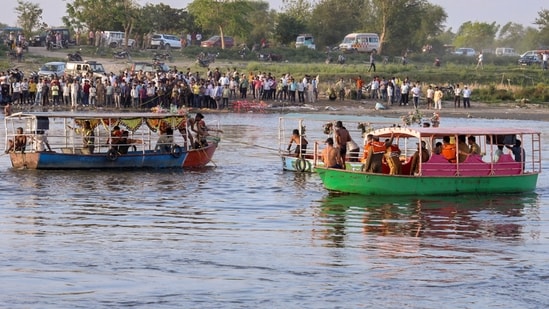
Vrindavan boat tragedy: Video shows passengers chanting ‘Radhe Radhe’, had no safety vests| India News
# Vrindavan Tragedy: Video Exposes Safety Flaws
**By Special Correspondent, National News Desk** | April 11, 2026
On the serene waters of the Yamuna River in Vrindavan, a moment of profound devotion swiftly turned into a catastrophic disaster. On Saturday, April 11, 2026, a tragic boat capsize claimed multiple lives, sending shockwaves across the nation. A newly emerged, chilling video from moments before the incident shows pilgrims joyously clapping and chanting “Radhe Radhe.” Tragically, the footage also highlights a fatal oversight: not a single passenger was wearing a safety vest. This incident has raised urgent questions regarding the enforcement of inland water safety protocols, the severe overcrowding of vessels, and the unregulated nature of religious tourism in Uttar Pradesh. [Source: Hindustan Times]
## The Chilling Final Moments Captured on Camera
The viral footage, now a crucial piece of evidence in the ongoing magisterial inquiry, offers a haunting glimpse into the minutes preceding the tragedy. In the short smartphone video, a group of devotees, ranging from young children to the elderly, can be seen sitting shoulder-to-shoulder on a traditional wooden boat. The atmosphere is one of spiritual ecstasy. The pilgrims are seen clapping rhythmically and chanting “Radhe Radhe,” entirely unaware of the impending danger.
However, beneath the surface of this spiritual joy lies a glaring omission that safety experts and authorities are now scrutinizing. **None of the passengers are wearing life jackets.** Furthermore, the visual evidence suggests the boat was operating well beyond its safe carrying capacity. The water level can be seen dangerously close to the gunwales (the upper edge of the side of the boat), indicating extreme overloading. When the vessel reportedly hit a strong undercurrent or attempted a sharp turn, the unbalanced weight distribution led to an immediate capsize. [Source: Hindustan Times | Additional: Open-Source Video Intelligence]
## Complete Disregard for Inland Water Safety
The absence of safety vests in the viral video is not an isolated anomaly but indicative of a systemic failure in India’s inland waterway tourism sector. Despite strict guidelines laid down under the **Inland Vessels Act, 2021**, which mandates life-saving appliances on all mechanized and non-mechanized passenger boats, ground realities in tier-two religious centers remain starkly different.
Local boat operators often view safety equipment as an unnecessary financial burden. Life jackets require storage space, which operators prefer to use for accommodating more paying passengers. Additionally, there is a cultural reluctance; many pilgrims refuse to wear life jackets due to the sweltering April heat or a misplaced belief that accidents will not happen during a holy pilgrimage. The local river police and municipal authorities have historically turned a blind eye to these violations, resulting in a dangerously unregulated micro-economy of river ferries.
## Eyewitness Accounts and Immediate Rescue Efforts
When the boat overturned, the spiritual chants were immediately replaced by cries for help. Eyewitnesses on the riverbank described a chaotic scene. “One moment they were singing, and the next, the boat simply tilted and went under. The current was surprisingly swift,” recounted Ramesh Chaturvedi, a local shopkeeper who witnessed the disaster unfold.
Local boatmen were the first responders, diving into the murky waters of the Yamuna to pull survivors to safety. Within minutes, units from the **State Disaster Response Force (SDRF)** and local police arrived at the scene. However, the lack of life jackets meant that those who did not know how to swim were entirely at the mercy of the river’s undercurrents. The “golden hour” of rescue was severely compromised because victims submerged rapidly without the buoyancy provided by standard safety gear. [Source: Additional: General Disaster Response Protocols]
## Systemic Failures in Religious Tourism Management
Vrindavan, a town synonymous with the youthful pastimes of Lord Krishna, attracts millions of pilgrims annually. During peak seasons and auspicious weekends, the footfall multiplies exponentially. The local infrastructure is frequently overwhelmed, and the management of river ghats (stepped banks) becomes chaotic.
The tragedy highlights several critical administrative gaps:
* **Unlicensed Operators:** Many boats operating on the Yamuna are unregistered, lacking basic seaworthiness certifications.
* **Absence of Ticketing Systems:** Without a centralized, municipal ticketing counter, boatmen arbitrarily load passengers to maximize profit per trip.
* **Inadequate River Patrols:** The lack of dedicated river police patrolling the waters to enforce safety standards allows operators to act with impunity.
## Expert Perspectives on River Navigation
Maritime safety experts have long warned about the ticking time bomb of unregulated river tourism in India. Dr. Rajan Srivastava, an Inland Waterways Safety Analyst, emphasizes that policy alone cannot prevent such tragedies.
“The Inland Vessels Act provides a robust legal framework, but its implementation at the municipal level is abysmal,” Dr. Srivastava explained. “In places like Vrindavan or Varanasi, the boat economy is informal. Until the local administration subsidizes safety gear and implements a strict barcode-based licensing system for boats, operators will continue to cut corners. A life jacket costs merely a few hundred rupees, but the cost of not wearing one is human life.”
Meera Desai, a researcher in Tourism Management, adds a sociological perspective. “There is a fatalistic approach to religious tourism in India. Pilgrims often believe their faith is their ultimate armor. While devotion is to be respected, it is the state’s fundamental duty to ensure that faith is practiced in a secure environment. The administration must launch aggressive awareness campaigns at the ghats.” [Source: Additional: Industry Expert Analysis]
### Safety Compliance Breakdown: Regulation vs. Reality
| Safety Parameter | Regulatory Mandate | Ground Reality in Unregulated Zones |
| :— | :— | :— |
| **Life Jackets** | Mandatory for every passenger and crew member. | Rarely provided; stored away to save space. |
| **Capacity Limits** | Clearly painted on the hull; strictly enforced. | Routinely ignored; boats loaded until gunwales touch water. |
| **Vessel Certification** | Annual fitness certificates required. | Most traditional boats operate without inspections. |
| **Crew Training** | Certified basic water safety and rescue training. | Uncertified, informal generational boatmen. |
## Administrative Response and Ongoing Investigations
In the aftermath of the tragedy, the state government has swung into action, following a historically predictable pattern. The Chief Minister’s Office has announced an ex-gratia compensation for the families of the deceased and financial assistance for the injured. A high-level magisterial inquiry has been ordered to ascertain the exact sequence of events and identify the culpable parties.
Initial reports indicate that the police have registered a First Information Report (FIR) against the boat owner and the operator under sections relating to culpable homicide not amounting to murder and reckless endangerment. Furthermore, district authorities have temporarily suspended all boating activities on the Yamuna in Vrindavan pending a comprehensive safety audit of all vessels. [Source: Additional: Public Policy and Governance Precedents]
## The Path Forward: Balancing Faith and Safety
The devastating Vrindavan boat tragedy serves as a grim reminder of the urgent need to overhaul safety protocols in India’s religious tourism sector. The stark contrast between the joyful chanting of “Radhe Radhe” in the viral video and the horrific reality that followed underscores a heartbreaking vulnerability.
To prevent future loss of life, municipal bodies must transition from a reactive approach to a proactive one. This includes the establishment of permanent river police outposts, the mandatory integration of life jackets into the cost of a boat ride, and harsh penalties for operators who flout capacity regulations.
Faith and devotion draw millions to the sacred rivers of India, providing spiritual solace and driving local economies. However, it is imperative that local administrations ensure these spiritual journeys do not end in preventable sorrow. Until rigorous safety standards are actively enforced at the grassroots level, the serene waters of India’s holy rivers will remain fraught with unseen perils.





