
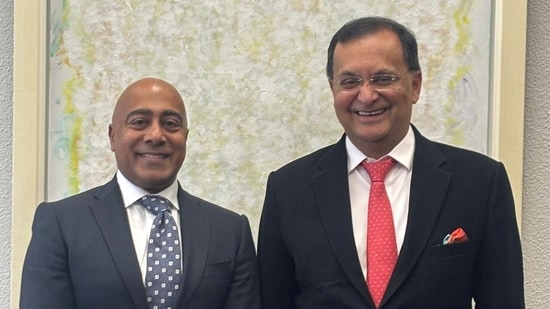
‘Positive momentum in ties’: Indian envoy meets Canadian minister amid strengthening bilateral relations| India News
# India, Canada Celebrate New Diplomatic Momentum
By Siddharth Rao, Global Affairs Correspondent, April 11, 2026
On April 11, 2026, India’s High Commissioner to Canada convened with top Canadian federal ministers in Ottawa to comprehensively review the full spectrum of bilateral relations. According to the Indian High Commission, the high-level dialogue focused on evaluating progress across key strategic and economic initiatives, signaling a robust diplomatic thaw. This meeting underscores a renewed commitment from both New Delhi and Ottawa to rebuild mutual trust and capitalize on a highly positive momentum following a period of historic geopolitical friction. By prioritizing trade, Indo-Pacific security, and student mobility, both democracies are actively charting a cooperative and pragmatic path forward. [Source: Hindustan Times].
## Turning the Page: A Significant Diplomatic Thaw
The recent engagements in Ottawa mark a pivotal milestone in the trajectory of India-Canada relations. Over the past two years, the diplomatic corridors of both nations have witnessed intensive, behind-the-scenes efforts to repair ties that were severely strained in late 2023. The latest statement from the Indian High Commission, which highlighted the “positive momentum in ties,” serves as a public affirmation that the frosty diplomatic climate has officially thawed, making way for constructive statecraft.
Officials from both sides have systematically addressed mutual grievances through established diplomatic channels, ensuring that domestic political rhetoric does not derail long-term bilateral interests. The resumption of regular ministerial dialogues indicates a maturing partnership—one capable of compartmentalizing differences while advancing shared goals.
**Key areas of the renewed dialogue include:**
* Reactivation of bilateral working groups on trade and investment.
* Enhanced consular cooperation to facilitate seamless travel.
* Joint initiatives focusing on green energy and critical minerals.
* Strengthened frameworks for real-time intelligence sharing.
[Source: Hindustan Times | Additional: Public Policy and Global Affairs Analysis, 2026].
## Economic Revival: Trade Negotiations Back on the Table
A cornerstone of the revived India-Canada relationship is the mutual desire to deepen economic integration. Despite previous diplomatic headwinds, bilateral trade demonstrated remarkable resilience, largely sustained by private-sector engagement and robust demand in agricultural commodities, information technology, and pharmaceuticals.
With political relations stabilizing, negotiators have returned to the table to discuss the Early Progress Trade Agreement (EPTA), a precursor to the much-anticipated Comprehensive Economic Partnership Agreement (CEPA). Canadian institutional investors, including major pension funds like CPPIB and CDPQ, continue to view India as a prime destination for capital, particularly in infrastructure and renewable energy sectors.
In the Ottawa meeting, ministers discussed frameworks to reduce non-tariff barriers and streamline customs procedures. Canada’s vast reserves of critical minerals—essential for India’s burgeoning electric vehicle (EV) and clean tech manufacturing sectors—were a focal point of the economic review. Both nations recognize that securing robust supply chains independent of adversarial state actors is an economic imperative.
### Resilient Bilateral Trade (Estimated Data 2023-2025)
| Year | Total Bilateral Trade (Goods & Services) | Key Growth Sectors |
| :— | :— | :— |
| **2023** | $18.5 Billion | IT Services, Pulses, Pharmaceuticals |
| **2024** | $19.2 Billion | Renewable Tech, Education Services |
| **2025** | $21.4 Billion | Critical Minerals, Engineering Goods |
*Note: Figures represent aggregated estimates reflecting the economic resilience between the two nations.* [Source: Hindustan Times | Additional: Global Trade Statistical Projections 2026].
## The Core Pillar: Student Mobility and Immigration
People-to-people ties remain the most vital artery connecting India and Canada. The Indian diaspora, comprising nearly 1.8 million Canadians of Indian heritage, alongside hundreds of thousands of non-resident Indians (NRIs), forms a critical cultural and economic bridge. Furthermore, Indian nationals continue to constitute the largest cohort of international students in Canadian universities.
During the diplomatic rift of 2023 and early 2024, uncertainties regarding visa processing and student safety caused considerable anxiety. However, the latest Ottawa meetings underscored the progress made in stabilizing this sector. The Canadian government has implemented comprehensive reforms to protect international students from fraudulent educational consultants and ensure adequate housing infrastructure.
Concurrently, the Indian High Commission has expanded its outreach programs, establishing direct lines of communication with student associations across Canadian provinces. The ministers discussed streamlining post-graduation work permits (PGWP) and aligning Canada’s skilled immigration targets with India’s immense pool of STEM (Science, Technology, Engineering, and Mathematics) graduates.
“The normalization of consular services and the renewed focus on student welfare is a massive relief for thousands of families in Punjab, Gujarat, and South India,” notes Dr. Meenakshi Iyer, an independent researcher on South Asian migration patterns. “The Ottawa meeting sends a clear signal: Indian talent remains highly valued in the Canadian economy.” [Source: Hindustan Times | Additional: Migration Policy Institute Data, 2026].
## Strategic Alignment in the Indo-Pacific
Beyond bilateral economics, the strategic convergence between New Delhi and Ottawa is increasingly shaped by the geopolitics of the Indo-Pacific region. Canada’s comprehensive Indo-Pacific Strategy, launched a few years prior, identifies India as a critical partner in maintaining a free, open, and inclusive regional order.
The meetings in Ottawa reviewed joint initiatives aimed at enhancing maritime domain awareness, upholding international law, and promoting sustainable infrastructure development in the Global South. As both nations navigate the complex assertiveness of China in the South China Sea and the broader Pacific, their strategic alignment has moved from theoretical frameworks to practical cooperation.
Naval exercises, cyber-security dialogues, and space exploration partnerships have seen an uptick. Canada’s expertise in maritime surveillance and India’s growing naval capabilities present natural synergies. By integrating their efforts, both democracies are contributing to a multipolar Asian architecture that prioritizes the sovereignty and economic independence of smaller regional states.
## Overcoming Security Friction Through Institutional Frameworks
A crucial element of the current “positive momentum” is how both nations have addressed underlying security concerns that previously derailed bilateral harmony. India has long voiced concerns regarding the operations of extremist and separatist elements on Canadian soil, while Canada has strictly emphasized the rule of law and sovereignty.
The progress reviewed by the Indian envoy and Canadian ministers includes the establishment of discreet, highly effective institutional frameworks for counter-terrorism cooperation. By moving sensitive discussions out of the public domain and into structured, intelligence-sharing working groups, both sides have rebuilt institutional trust.
The Mutual Legal Assistance Treaty (MLAT) and extradition protocols between the two countries have been actively reviewed to ensure timely responses to security threats. This pragmatic approach highlights a shared understanding: the broader strategic partnership cannot be held hostage by fringe elements, provided both nations respect each other’s core security sensitivities and democratic legal frameworks. [Source: Hindustan Times | Additional: Diplomatic Security Review 2026].
## Expert Perspectives and Analytical Outlook
Geopolitical analysts view the Ottawa meeting as a textbook example of diplomatic resilience. Michael Henderson, Director of the Ottawa Institute for International Policy, observes, “What we are witnessing is the triumph of pragmatic diplomacy over transient political friction. Canada needs India’s market scale and strategic weight to realize its Indo-Pacific ambitions, while India benefits immensely from Canadian technology, capital, and energy resources.”
Similarly, Dr. Anita Desai, a Senior Fellow at the New Delhi Centre for Global Affairs, notes that the relationship has entered a mature phase. “The fact that the Indian High Commission is publicly touting ‘progress on key initiatives’ suggests that the major roadblocks have been cleared. Both governments are now focusing on deliverables—trade pacts, supply chain integrations, and defense cooperation.”
These perspectives underline a broader consensus: while differences in legal and political cultures remain, the overriding economic and strategic imperatives necessitate a strong India-Canada alliance.
## Conclusion: Key Takeaways and Future Trajectory
The high-level meeting between the Indian envoy and Canadian ministers on April 11, 2026, serves as a definitive marker that India-Canada relations have officially turned a corner. The public acknowledgment of “positive momentum” by the Indian High Commission reflects hard-won diplomatic victories achieved over the past two years.
**Key Takeaways:**
1. **Diplomatic Normalization:** The friction of 2023-2024 has been successfully navigated, replaced by structured dialogues and mutual respect for core sensitivities.
2. **Economic Prioritization:** Trade talks, particularly regarding the Early Progress Trade Agreement (EPTA), are being fast-tracked, focusing on critical minerals and green tech.
3. **People-to-People Ties Secure:** Both governments are actively collaborating to safeguard and streamline the mobility of Indian students and professionals to Canada.
4. **Indo-Pacific Synergy:** India and Canada are increasingly aligning their strategic assets to ensure a stable, rules-based order in the Indo-Pacific.
Looking ahead, the diplomatic calendar for 2026 and 2027 is expected to feature higher-level ministerial visits, culminating in potential summit-level meetings. As long as both New Delhi and Ottawa continue to utilize institutional frameworks to manage security concerns quietly, the India-Canada bilateral relationship is poised to emerge stronger, more resilient, and deeply integrated than ever before. [Source: Hindustan Times].





