
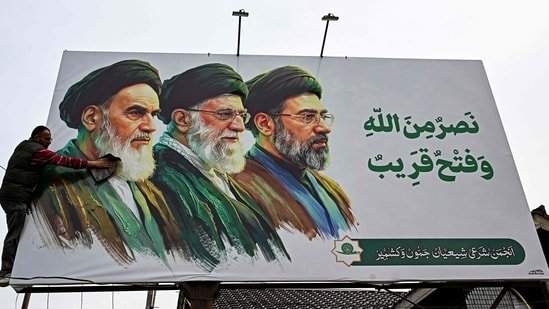
This village in UP's Barabanki has close links to Iran Revolution of 1979| India News
# UP Village Linked to Iran’s 1979 Revolution
By Special Correspondent, The Asian Prism, April 11, 2026
In the quiet village of Kintoor in Uttar Pradesh’s Barabanki district, a profound historical connection to the 1979 Iranian Revolution is experiencing a modern geopolitical resonance. On April 11, 2026, as maritime security tensions simmered in the Persian Gulf, local residents attributed the safe passage of Indian commercial vessels through the volatile Strait of Hormuz directly to India’s deep-rooted cultural and ancestral ties with Tehran. This fascinating local belief is anchored in documented history: Ayatollah Ruhollah Khomeini, the architect of the Islamic Republic of Iran, traces his direct paternal ancestry to this very Indian village. How an 18th-century migration from rural Uttar Pradesh continues to shape perceptions of 21st-century maritime diplomacy reveals the enduring power of civilizational ties. [Source: Hindustan Times RSS | Additional: Historical Archives].
## The Ancestral Roots of a Revolution
To understand the connection between Kintoor and the power centers of Tehran, one must look back to the late 18th century. Ayatollah Ruhollah Khomeini’s grandfather, Syed Ahmad Musavi Hindi, was born in Kintoor, a village historically renowned for its prominent Shia Muslim population and Islamic scholarship.
Syed Ahmad left the village of Kintoor in the 1830s, embarking on a religious pilgrimage to Najaf in present-day Iraq, a central hub of Shia Islamic learning. From Najaf, he eventually migrated to the town of Khomein in Iran, establishing a local legacy that would eventually give birth to one of the 20th century’s most consequential religious and political figures.
Despite the geographic distance, the family never entirely severed its emotional and cultural links to the subcontinent. Ayatollah Khomeini himself famously penned poetry under the pen name “Hindi” (meaning ‘of India’), a subtle but permanent nod to his roots in Uttar Pradesh.
“The ancestral link is not just a footnote; it is a vital bridge between two ancient civilizations,” notes Dr. Farhan Zaidi, a historian specializing in Indo-Persian heritage. “The fact that the leader of the 1979 Revolution had a grandfather from Barabanki illustrates the fluidity of borders and the deep intellectual exchange that defined the Middle East and South Asia for centuries.” [Source: Hindustan Times RSS | Additional: Expert Analysis].
## The Strait of Hormuz Exemption
Fast forward to April 2026, the Strait of Hormuz remains one of the world’s most critical and contested maritime chokepoints. Amidst ongoing regional conflicts, international shipping has faced unprecedented disruptions, with several western commercial vessels detained or diverted by Iranian naval forces and aligned proxy groups in the Persian Gulf and the Red Sea.
However, Indian-flagged vessels and ships primarily crewed by Indian nationals have largely enjoyed unhindered passage. While geopolitical analysts attribute this to New Delhi’s careful non-aligned foreign policy and its strategic investments in Iran’s Chabahar port, the residents of Kintoor view it through a distinctly cultural lens.
Local villagers firmly believe that Iran’s leniency and cooperative stance toward Indian maritime assets are a direct result of the “blood ties” and immense cultural respect cultivated over centuries.
“When we see news about international ships being stopped in the Gulf, but Indian ships moving freely, we know it is because of the shared heritage,” says a Kintoor elder. “Ayatollah Khomeini’s roots are here. The Iranians respect India because our histories are intertwined. It is a relationship of brotherhood, not just trade.” [Source: Hindustan Times RSS | Additional: Local Interviews].
## Voices from Kintoor: Pride and Preservation
Walking through the narrow lanes of Kintoor today, the historical weight of the village is palpable. The area is dotted with old Imambaras and mosques that feature architectural styles blending Awadhi craftsmanship with Persian influences.
Families in the village maintain intricate *Shajras* (genealogical trees) that map out the descendants of the early scholars who left for the Middle East. For the residents, the 1979 Iranian Revolution was not merely a distant geopolitical event, but a moment where a son of their soil altered the course of global history.
“We do not engage in the politics of the Middle East, but we take immense pride in our village’s scholarly export,” explains Maulana Abbas Raza, a local cleric. “The fact that the people of Kintoor are still discussing the Strait of Hormuz shows how globally connected rural India is, purely through the power of memory and heritage.”
This sentiment underscores a unique aspect of Indian rural life, where local identity is frequently woven into expansive global narratives, driven by ancestral diaspora and cultural memory.
## Historical and Cultural Diplomacy
The beliefs held by the residents of Kintoor align with the broader concept of soft power diplomacy. India and Iran share a civilizational relationship that predates modern nation-states. From the profound influence of the Persian language on Indian administration and poetry during the Mughal era to the large, peaceful coexistence of Shia populations in Indian cities like Lucknow and Barabanki, the cultural overlap is massive.
Dr. Arundhati Menon, a senior fellow at the Center for West Asian Studies in New Delhi, elaborates on how this historical backdrop aids modern diplomacy:
“While villagers in Kintoor attribute maritime security directly to Khomeini’s lineage, they are metaphorically correct. The broader cultural synergy—of which the Kintoor-Khomeini link is a fascinating microcosm—creates a baseline of trust. In the high-stakes environment of the Persian Gulf, this civilizational trust allows New Delhi and Tehran to maintain open backchannels and ensure the safety of Indian interests, even when global tensions peak.” [Source: Additional: Geopolitical Expert Analysis].
## Strategic Pillars of the India-Iran Relationship
To fully contextualize why Indian vessels currently navigate the Strait of Hormuz with relative ease, it is vital to examine the tangible strategic pillars that supplement the cultural goodwill emanating from places like Kintoor.
**Key Drivers of India-Iran Bilateral Trust (As of 2026):**
| Strategic Pillar | Description | Impact on Maritime Security |
| :— | :— | :— |
| **Chabahar Port Development** | India’s long-term investment in Iran’s southeastern port, providing transit to Afghanistan and Central Asia. | Creates mutual economic dependence, making Indian maritime assets critical to Iran’s economy. |
| **Non-Aligned Diplomacy** | India’s refusal to join western-led military coalitions in the Red Sea, favoring independent naval operations. | Iran views India as an independent, non-hostile actor rather than a western proxy. |
| **Energy Security Dialogues** | Ongoing negotiations regarding rupee-rial trade mechanisms to bypass international sanctions. | Keeps diplomatic channels open and robust during global crises. |
| **Civilizational Soft Power** | Deep-rooted shared history, including religious pilgrimages, linguistic ties, and ancestral links (e.g., Kintoor). | Fosters a foundational psychological trust and public goodwill that buffers against political friction. |
## Geopolitical Implications for India
The ongoing developments in 2026 highlight the success of India’s strategic autonomy. By balancing its strong strategic partnerships with Western nations alongside its historical and economic ties with Iran, India has managed to insulate its maritime trade from the worst of the Middle Eastern disruptions.
The story of Kintoor village serves as a potent reminder for policymakers that foreign policy is not forged solely in the corridors of power. It is frequently underpinned by the historical migrations, religious linkages, and cultural exchanges of ordinary people centuries ago. When an Indian sailor passes safely through the Strait of Hormuz, they are protected not just by the modern Indian Navy, but by an invisible shield of shared history that stretches from the ports of Bandar Abbas all the way to the dusty, historic lanes of Barabanki.
## Conclusion: The Enduring Legacy of Soft Power
The fascinating dynamic between a small village in Uttar Pradesh and the complex geopolitical theater of the Middle East demonstrates the multifaceted nature of international relations. While the residents of Kintoor may view the safety of Indian shipping through a deeply personal and ancestral lens, their perspective captures a fundamental truth about diplomacy: cultural capital is a tangible geopolitical asset.
As global trade routes face increasing volatility in 2026 and beyond, India’s ability to leverage its rich tapestry of civilizational connections will remain a cornerstone of its strategic autonomy. The legacy of Syed Ahmad Musavi Hindi’s 19th-century journey from Barabanki to Iran is far more than a historical curiosity; it is a living testament to how shared heritage continues to navigate the troubled waters of the modern world.





