
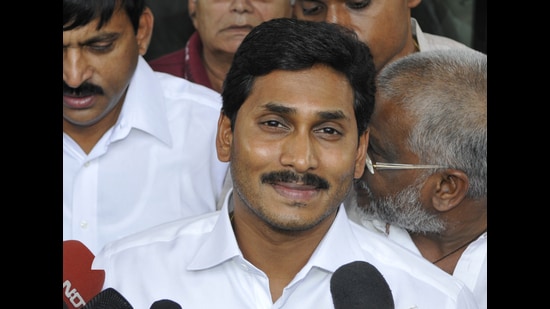
YSRCP push ‘Mavigun’ capital proposal aggressively| India News
# YSRCP Pushes Mavigun Capital Plan for 2029
By Senior Political Correspondent, The India Policy Desk, April 12, 2026
The Yuvajana Sramika Rythu Congress Party (YSRCP) has aggressively pivoted its political and economic strategy by promoting the “Mavigun” (Machilipatnam-Vijayawada-Guntur) corridor as Andhra Pradesh’s ideal capital model. Unveiled mid-2026 as a counter-narrative to the officially approved Amaravati greenfield project, the opposition party aims to leverage this port-led, decentralized urban cluster to stimulate regional economic growth and regain lost political ground in the coastal delta region ahead of the crucial 2029 state assembly elections. [Source: Hindustan Times | Additional: Regional Policy Analysis].
## Decoding the ‘Mavigun’ Megaregion Strategy
Following its defeat in the 2024 assembly elections and the subsequent reinstatement of Amaravati as the sole capital of Andhra Pradesh by the ruling Telugu Desam Party (TDP) alliance, the YSRCP has spent the last two years recalibrating its approach to regional development. The result is the “Mavigun” proposal—an acronym representing the geographic and economic integration of **Ma**chilipatnam, **Vi**jayawada, and **Gun**tur.
Unlike the controversial and legally embattled “Three Capitals” plan (which sought to divide executive, legislative, and judicial powers across Visakhapatnam, Amaravati, and Kurnool), the Mavigun model represents a contiguous, localized economic corridor. It focuses on integrating existing urban infrastructure (brownfield development) rather than building a multi-billion-dollar metropolis from scratch.
The strategy relies heavily on three distinct pillars:
* **Machilipatnam:** Envisioned as the logistics and maritime anchor, capitalizing on the deepwater port expansion to handle bulk cargo and establish coastal economic zones.
* **Vijayawada:** Positioned as the commercial, transit, and administrative nerve center, utilizing its existing robust railway junctions and commercial real estate.
* **Guntur:** Highlighted as the agricultural processing, educational, and light-manufacturing hub.
By promoting a unified corridor, the YSRCP argues that the state can achieve the administrative focus of a single capital region while ensuring that economic benefits permeate across three diverse districts, thereby preventing wealth concentration in a single real-estate zone.
## The Shift from Decentralization to Contiguous Growth
The transition from the three-capital theory to the Mavigun corridor is a significant ideological shift for Y.S. Jagan Mohan Reddy’s party. Analysts suggest this is a calculated response to the logistical and legal hurdles that plagued their previous tenure.
“The three-capital model failed to resonate broadly because the distances between Vizag, Amaravati, and Kurnool created anxieties about administrative inefficiency and bureaucratic paralysis,” notes Dr. V. Nageswara Rao, a Senior Fellow at the Institute of Regional Economic Studies in Hyderabad. “The Mavigun corridor, however, operates within a 100-kilometer radius. It is fundamentally an agglomeration economy model, similar to the National Capital Region (NCR) around Delhi or the Mumbai Metropolitan Region (MMR). It is far more defensible from an urban planning perspective.” [Source: Independent Urban Planning Analysis].
This pivot allows the YSRCP to abandon the heavily criticized fragmentation of state machinery while still critiquing the current government’s hyper-focus on Amaravati. By framing Amaravati as an exclusive “siloed development,” the opposition is positioning Mavigun as an inclusive, ready-to-use economic engine.
## Economic Blueprint: Port-Led Development vs. Greenfield Urbanization
At the heart of the Mavigun proposal is a critique of the capital expenditure required to complete Amaravati. Despite securing substantial central government backing and multilateral funding in recent years, Amaravati requires continuous, massive capital infusion for foundational infrastructure—roads, drainage, power grids, and civic buildings.
The YSRCP’s economic blueprint argues that Andhra Pradesh, still grappling with high public debt, cannot afford to sink all its capital expenditure into a greenfield city. Instead, they propose diverting a fraction of those funds into upgrading the NH-65 highway connecting Machilipatnam to Vijayawada, expanding the Guntur railway freight terminals, and creating Special Economic Zones (SEZs) along the corridor.
### Comparative Vision: Amaravati vs. Mavigun
| Feature | Amaravati (TDP Model) | Mavigun Corridor (YSRCP Proposal) |
| :— | :— | :— |
| **Core Concept** | Greenfield smart city, centralized power. | Brownfield regional megacity, integrated hubs. |
| **Primary Economic Driver** | Real estate, IT, government services. | Logistics, maritime trade, agro-processing. |
| **Capital Requirement** | Extremely High (Foundational infrastructure). | Moderate (Upgrading existing infrastructure). |
| **Geographic Spread** | Concentrated in the Tullur region. | Spread across a 100km coastal/delta triangle. |
| **Time to Maturity** | 10–15 years for full economic realization. | 3–5 years (leveraging existing urban centers). |
According to party insiders, the proposal relies heavily on the operationalization of the Machilipatnam port. “A capital city without direct access to global trade routes is merely an administrative enclave,” a senior YSRCP spokesperson stated during a recent rally in Guntur. “Mavigun integrates governance with global commerce.” [Source: Hindustan Times].
## Political Calculus Targeting the 2029 Elections
While presented as an economic and urban planning solution, the Mavigun corridor is undeniably a strategic political weapon designed for the 2029 state elections. The coastal delta region—comprising Krishna, NTR, Guntur, Bapatla, and Palnadu districts—holds a massive concentration of assembly seats. In 2024, the YSRCP faced heavy losses in this very belt, as farmers and the middle class rallied behind the TDP’s promise to revive Amaravati.
By proposing the Mavigun corridor, the YSRCP is attempting a complex demographic and electoral balancing act:
1. **Appeasing the Delta Voters:** Offering Vijayawada and Guntur tangible, immediate growth prospects without dismantling the capital structure entirely.
2. **Capturing the Coastal Belt:** Elevating Machilipatnam promises massive job creation for the local youth and fishing communities, segments that have felt marginalized by the agrarian focus of Amaravati.
3. **Countering the Real Estate Narrative:** The YSRCP continues to push the narrative that Amaravati primarily benefits specific land-owning demographics. Mavigun is being marketed as a “working-class capital model” that prioritizes factories, ports, and logistics over luxury real estate.
P. Srilakshmi, an independent political analyst based in Vijayawada, observes: “The YSRCP realized that opposing Amaravati outright in the delta region was electoral suicide. The Mavigun concept is their middle ground. They aren’t saying ‘move the capital away from the delta’ anymore. They are saying, ‘expand the capital to include your towns, your ports, and your businesses.’ It is a highly potent pitch for 2029.”
## Infrastructure Realities: Feasibility and Challenges
Despite the political enthusiasm, independent economists and urban planners point out significant hurdles in realizing the Mavigun vision.
**1. Traffic and Congestion:** Vijayawada is already one of the most densely populated and traffic-congested cities in Andhra Pradesh. Integrating it as the central node of a massive economic corridor requires sweeping—and expensive—upgrades to its internal road networks and public transit systems, including a long-delayed metro rail project.
**2. Environmental Concerns:** The corridor sits on the fertile Krishna River delta, an ecologically sensitive zone prone to flooding and cyclones. Industrializing the stretch between Vijayawada and Machilipatnam will require stringent environmental safeguards, massive drainage overhauls, and climate-resilient infrastructure to prevent seasonal inundation.
**3. The Entrenched Amaravati Reality:** By April 2026, the current state government has already restarted major construction works in Amaravati. The High Court, the Secretariat, and legislative complexes are fully functional, and private investments are returning. Reversing this momentum, or significantly diluting it in favor of a new corridor post-2029, could invite fresh rounds of litigation and investor panic, a scenario the state can ill afford.
## Conclusion and Future Outlook
The YSRCP’s aggressive promotion of the “Mavigun” corridor marks the beginning of a prolonged ideological and political battle for the soul of Andhra Pradesh’s development trajectory. As the state moves steadily toward the 2029 elections, the discourse has shifted from the mere location of the capital to the very philosophy of its urban development: the concentrated, visionary greenfield model of Amaravati versus the decentralized, port-integrated, brownfield pragmatism of Mavigun.
For the electorate, the choice over the next three years will dictate the flow of thousands of crores in infrastructure investment. If the YSRCP can successfully communicate the economic viability of the Machilipatnam-Vijayawada-Guntur corridor to the rural and semi-urban masses, it may well disrupt the ruling party’s narrative. However, overcoming the structural momentum of a legally approved and currently under-construction Amaravati will require more than just a catchy acronym—it will demand a foolproof economic masterplan that guarantees immediate, tangible dividends for the people of Andhra Pradesh.





