
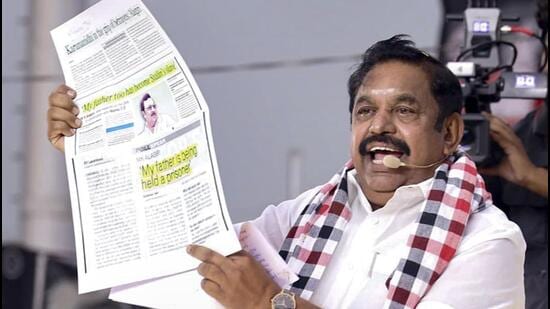
Not even 20% of 525 promises fulfilled by DMK: Palaniswami to HT| India News
# EPS Slams DMK: Unfulfilled Promises & High Debt
**By Chief Political Correspondent, The National Ledger | April 13, 2026**
With Tamil Nadu gearing up for the high-stakes 2026 Assembly elections, AIADMK General Secretary Edappadi K. Palaniswami has launched a scathing attack on the ruling Dravida Munnetra Kazhagam (DMK) government. In an exclusive pre-election interview on Monday, April 13, 2026, Palaniswami asserted that the M.K. Stalin-led administration has fulfilled less than 20% of the 525 promises detailed in its 2021 electoral manifesto. Speaking to the Hindustan Times, the former Chief Minister also raised alarming concerns regarding Tamil Nadu’s fiscal health, accusing the current administration of reckless spending that has violently accelerated the state’s debt crisis over the past five years. [Source: Hindustan Times].
## The Broken Manifesto: 525 Promises Under Scrutiny
The core of Palaniswami’s critique centers on the DMK’s voluminous 2021 election manifesto, a document that played a pivotal role in sweeping M.K. Stalin to power. The manifesto contained **525 specific promises**, ranging from welfare schemes to infrastructure development and state autonomy rights.
According to the AIADMK leader, the ruling party’s success rate is dismal. “They made grandiose announcements to capture power, but the reality on the ground is starkly different. Not even 20% of those 525 promises have been fulfilled,” Palaniswami stated. [Source: Hindustan Times].
Key unfulfilled or partially fulfilled promises highlighted by the opposition include:
* **NEET Exemption:** The DMK heavily campaigned on securing an exemption for Tamil Nadu from the National Eligibility cum Entrance Test (NEET). Despite passing resolutions in the state assembly, the central government has not granted the exemption, leaving a major poll plank unachieved.
* **Old Pension Scheme (OPS):** Government employees, a crucial voting bloc, were promised a return to the Old Pension Scheme. Citing financial constraints, the state government has continually deferred this move.
* **Monthly Electricity Billing:** The promise to switch from a bi-monthly to a monthly electricity billing cycle to save consumers from higher tariff slabs remains largely unimplemented across the state.
* **Fuel Subsidies:** While partial cuts were made early in the tenure, the opposition argues they fall short of the dramatic reductions promised during the 2021 campaign trails.
Dr. R. Srinivasan, a Chennai-based political analyst, notes, *”The DMK did implement flagship schemes like the Kalaignar Magalir Urimai Thittam (₹1,000 monthly assistance for women) and free bus travel for women. However, the opposition is strategically capitalizing on the systemic promises that require structural or central approval, which the DMK has failed to deliver.”* [Source: Additional Expert Commentary].
## The Escalating Debt Crisis in Tamil Nadu
Beyond broken promises, Palaniswami’s most severe allegation was directed at the financial mismanagement of the state. He drew a sharp historical contrast to emphasize the gravity of the current situation.
**”The state, which had accumulated a debt of ₹5 lakh crore over 73 years, has seen reckless spending over the past five years,”** Palaniswami emphasized. [Source: Hindustan Times].
Tamil Nadu currently boasts one of the largest Gross State Domestic Products (GSDP) in India, driven by a robust manufacturing sector and IT services. However, its fiscal deficit and outstanding liabilities have been a persistent worry for economists. While the COVID-19 pandemic severely battered state coffers globally, the AIADMK attributes the recent surge in debt entirely to the DMK’s populist policies and alleged administrative inefficiencies.
The state’s outstanding debt is projected to cross critical thresholds by the end of the 2025-2026 financial year. The opposition argues that heavy borrowing is being utilized not for capital expenditure—which generates future revenue and infrastructure—but for revenue expenditure, primarily to fund freebies and service existing debt.
*”Borrowing to fund welfare isn’t inherently disastrous if revenue receipts are growing proportionately,”* explains Dr. Vikram Chandrasekar, a professor of public finance. *”However, Tamil Nadu’s interest payments as a percentage of revenue receipts are climbing. Palaniswami is tapping into the anxiety of the middle class, who fear that this debt will eventually be passed down to them through higher local taxes and utility tariffs.”* [Source: Public Economic Data / Independent Analysis].
## Palaniswami’s Strategy Ahead of 2026 Polls
The timing of this interview is not coincidental. As Tamil Nadu prepares for the Assembly elections, Palaniswami is working aggressively to position the AIADMK as the only viable, fiscally responsible alternative to the DMK.
Since consolidating his position as the undisputed single leader of the AIADMK—effectively sidelining his former co-coordinator O. Panneerselvam—EPS has been trying to rebuild the party’s grassroots machinery. By attacking the DMK on two fronts: **trust (unfulfilled promises)** and **competence (economic mismanagement)**, he aims to sway the crucial swing voters.
The AIADMK’s campaign narrative is actively drawing attention to frequent hikes in property taxes, electricity tariffs, and milk prices under the DMK regime. Palaniswami argues these hikes are a direct consequence of the “reckless spending” and subsequent debt trap created by the ruling party.
## The DMK’s Defense: The “Dravidian Model” of Welfare
The ruling DMK vigorously disputes the AIADMK’s narrative. Chief Minister M.K. Stalin and his cabinet have continuously championed the “Dravidian Model” of governance, which heavily prioritizes inclusive growth, social justice, and immediate economic relief for marginalized communities.
DMK leaders argue that assessing the manifesto fulfillment at “less than 20%” is a gross misrepresentation. According to the ruling party’s own metrics, they claim to have initiated or completed over 80% of their promises.
Key achievements cited by the DMK government include:
* **Kalaignar Magalir Urimai Thittam:** The rollout of the ₹1,000 monthly honorarium for over 1.1 crore eligible women heads of families.
* **Chief Minister’s Breakfast Scheme:** A pioneering initiative providing free nutritious breakfasts to primary school children across state-run schools, which has significantly boosted attendance and nutrition levels.
* **Pudhumai Penn Scheme:** Providing ₹1,000 per month to girl students pursuing higher education.
Furthermore, the DMK attributes much of the state’s fiscal strain to the Union Government. State Finance Ministry officials have repeatedly pointed out that Tamil Nadu receives a disproportionately low share of central tax devolution compared to what it contributes. Additionally, they cite the denial of adequate disaster relief funds—particularly following the devastating Chennai and Thoothukudi floods in late 2023—as a major catalyst for state borrowing. [Source: Tamil Nadu State Assembly Records].
## Economic Implications of “Reckless Spending” Claims
Whether classified as “reckless spending” or “necessary welfare,” the economic reality of Tamil Nadu is complex. The state remains an industrial powerhouse, successfully attracting billions in foreign direct investment (FDI) through initiatives like the Global Investors Meet.
However, Palaniswami’s critique highlights a genuine macroeconomic tightrope. If a state relies too heavily on borrowing to fund operational expenses and welfare schemes, it risks crowd-out effects, where funds for critical infrastructure projects—such as roads, ports, and industrial parks—dwindle.
**Capital expenditure (CapEx)** is the lifeblood of long-term economic growth. The AIADMK’s core argument is that the Stalin administration has compromised long-term state infrastructure development to fund short-term electoral promises, thereby endangering the state’s future economic competitiveness compared to rapidly growing states like Gujarat and Maharashtra.
## Voter Sentiment and Ground Realities
As the election rhetoric heats up, the ultimate judges will be the voters of Tamil Nadu. The electorate in the state has historically shown a strong affinity for robust welfare schemes, often rewarding parties that deliver tangible, immediate benefits over abstract macroeconomic stability.
However, the urban middle class in cities like Chennai, Coimbatore, and Madurai is showing signs of fatigue over rising costs of living. Increased electricity bills and property taxes are tangible pain points. Palaniswami is acutely aware of this and is directing his message specifically at these demographics, while also trying to convince rural voters that the DMK’s welfare schemes are a smokescreen for administrative failure.
## Conclusion: A Referendum on Governance and Fiscal Policy
Edappadi K. Palaniswami’s recent interview with the Hindustan Times marks a definitive escalation in the AIADMK’s 2026 electoral strategy. By aggressively framing the DMK government as one that has simultaneously broken 80% of its promises and plunged the state into unprecedented debt, the opposition is attempting to dismantle the aura of the “Dravidian Model.”
The impending 2026 Tamil Nadu Assembly elections will effectively serve as a referendum. Voters will have to choose between the DMK’s narrative of social justice, extensive welfare distribution, and alleged victimization by the central government, versus the AIADMK’s accusations of unchecked populism, unfulfilled promises, and severe financial mismanagement.
As the campaign trails widen, both parties will be forced to present not just critiques, but concrete, fiscally viable roadmaps for the future of one of India’s most economically vital states.





