
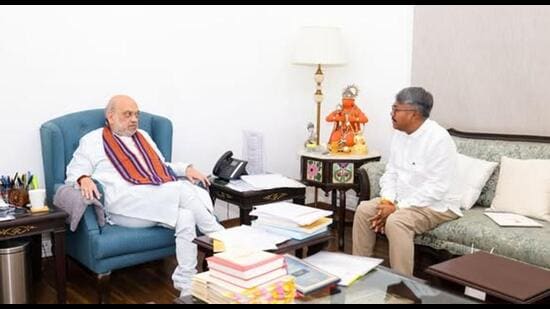
Manipur home minister meets Shah after fresh violence in ethnic violence-hit state| India News
# Manipur Minister Meets Shah Amid Fresh Violence
By Regional Desk, India News Observer | April 13, 2026
**New Delhi/Imphal** — Manipur’s Home Minister held an urgent, high-level meeting with Union Home Minister Amit Shah in New Delhi on Monday following a deadly resurgence of unrest in the ethnic violence-hit northeastern state. The emergency talks were prompted by severe clashes on Tuesday, which resulted in the deaths of two individuals. Tensions escalated sharply after a civilian mob allegedly stormed a paramilitary camp, prompting security forces to open fire to prevent a breach of the armory. Consequently, a strict curfew has been re-imposed across vulnerable districts to prevent further escalation and maintain public order. [Source: Hindustan Times].
## The Inciting Incident: Breach of Paramilitary Camp
The fragile peace in Manipur was shattered once again on Tuesday afternoon when a large, agitated mob converged on a paramilitary encampment situated near a volatile buffer zone. According to preliminary reports, the crowd—armed with crude weapons and incendiary devices—attempted to overrun the facility’s perimeter.
Security personnel, initially relying on non-lethal crowd-control measures such as tear gas and water cannons, were forced to escalate their response when the mob breached the outer defensive wall, threatening the camp’s armory. In the ensuing chaos, security forces allegedly opened fire, resulting in two civilian fatalities and several injuries.
Following the incident, the district administration immediately declared a curfew under Section 144 of the CrPC (now BNSS), heavily restricting the movement of individuals in the affected areas. Mobile internet services were temporarily suspended in specific zones to prevent the dissemination of inflammatory content and unverified rumors that could ignite retaliatory violence in neighboring districts. [Source: Hindustan Times | Additional: General Public Knowledge].
“The situation was highly volatile. The primary objective of the security forces was to secure the installation and prevent a mass looting of firearms, which has been a recurrent nightmare since the conflict began,” a senior state police official noted under the condition of anonymity.
## High-Stakes Meeting in New Delhi
Recognizing the potential for this localized incident to spiral into a broader state-wide conflagration, the Manipur Home Minister rushed to the national capital to confer with Union Home Minister Amit Shah. The meeting, which lasted for nearly two hours, was attended by top officials from the Ministry of Home Affairs (MHA), the Intelligence Bureau, and the Central Reserve Police Force (CRPF).
**Key Agendas of the Meeting Included:**
* **Deployment Reassessment:** Evaluating the current positioning of Central Armed Police Forces (CAPF) and the Assam Rifles to fortify buffer zones separating the Meitei-dominated Imphal Valley and the Kuki-Zo-dominated hill districts.
* **Rules of Engagement (RoE):** Reviewing the operational protocols of central forces when confronted by civilian mobs, aiming to minimize civilian casualties while protecting critical infrastructure.
* **Intelligence Sharing:** Enhancing the coordination between state intelligence units and federal agencies to pre-emptively identify and defuse mass mobilizations.
* **Political Outreach:** Developing a renewed strategy to engage civil society leaders from both communities to restore calm.
Political analysts emphasize the critical timing of this intervention. Dr. Vikram Sharma, a conflict resolution expert at the Center for Policy Research, explained, “The central government is acutely aware that any incident involving civilian deaths at the hands of security forces can act as a massive catalyst for renewed insurgency. The immediate priority for Amit Shah and the MHA is to demonstrate accountability while maintaining the morale of the forces deployed in an impossibly complex operational theater.”
## A State Fractured: The 2026 Context
To understand the gravity of Tuesday’s incident, it is essential to view it against the backdrop of a crisis that is now approaching its third year. Ignited in May 2023 over disputes regarding Scheduled Tribe (ST) status, land rights, and political representation, the conflict has fundamentally altered the demographic and administrative landscape of Manipur.
By April 2026, the state remains informally partitioned. High-security “buffer zones”—manned by federal paramilitary troops—serve as hard borders between the valley and the hills. Cross-community movement remains virtually non-existent, and economic interdependence has collapsed.
Despite numerous peace committees and interventions by the central government over the past three years, a deep-seated trust deficit persists. The looting of thousands of state armory weapons during the initial months of the conflict in 2023 continues to haunt the state, as highly armed radical groups occasionally circumvent security cordons to launch attacks. Tuesday’s mob action is viewed by intelligence officials as a localized manifestation of this enduring, unaddressed socio-political trauma.
## The Security Dilemma: Policing a Divided Society
The paramilitary forces stationed in Manipur—including the Assam Rifles, the CRPF, and the Border Security Force (BSF)—face one of the most challenging internal security mandates in India’s modern history. They are tasked with keeping the peace between deeply entrenched, hostile factions while frequently being accused of bias by both sides.
When mobs—often heavily featuring women at the forefront in a tactic locally known as “Meira Paibi” or similar community shield strategies—approach military installations, standard crowd control becomes exceptionally difficult.
“The tactical dilemma is profound,” states Lt. Gen. (Retd.) Arun Sahni, former General Officer Commanding-in-Chief. “When a mob numbers in the thousands and is suspected to harbor armed militants using civilians as shields, commanders on the ground have seconds to make decisions. If they do not fire, the camp is overrun, weapons are stolen, and the broader conflict worsens. If they do fire, they risk civilian casualties, which triggers a massive socio-political backlash.”
The MHA has reportedly initiated a Court of Inquiry (CoI) into the Tuesday firing to ascertain whether standard operating procedures were strictly followed before lethal force was authorized.
## Socio-Economic Toll of Prolonged Conflict
Beyond the immediate loss of life, the continuing unrest has devastated Manipur’s socio-economic fabric. What was once viewed as India’s burgeoning gateway to Southeast Asia under the “Act East” policy has suffered severe economic contraction.
**Impact Metrics (Estimated Data as of Early 2026):**
| Sector | Estimated Impact |
| :— | :— |
| **Internally Displaced Persons (IDPs)** | Over 50,000 individuals still residing in relief camps. |
| **Education** | Higher education institutions suffer from erratic schedules; an estimated 30% drop in out-of-state enrollments. |
| **Agriculture** | Thousands of hectares of arable land in buffer zones remain uncultivated due to sniper fears. |
| **Economy** | Daily wage earners and local logistics networks operate at less than 60% of pre-2023 capacity due to highway blockades. |
The psychological toll is equally staggering. A generation of children in relief camps has grown up amidst systemic violence, separated from their traditional homes, fostering an environment ripe for radicalization. The state government, with central assistance, has initiated various rehabilitation packages, but the delivery is frequently hampered by logistical hurdles and localized violence.
## Political Repercussions and the Search for Peace
The central government’s strategy moving forward involves a delicate balancing act. Following the meeting between the state Home Minister and Amit Shah, sources indicate that New Delhi will push for a more robust integration of civil administration and security operations.
There is an increasing realization that a purely militarized approach cannot solve a fundamentally political and social crisis. Back-channel diplomacy, which had stalled in late 2025, is expected to be revived. The MHA is reportedly looking to bypass traditional, polarized political leadership and directly engage with neutral community leaders, religious figures, and youth organizations to build a grassroots peace initiative.
However, the state government faces intense local pressure. In Imphal, opposition parties and civil rights groups have demanded the immediate suspension of the security personnel involved in the Tuesday shooting, alongside calls for heightened compensation for the victims’ families. Conversely, security analysts argue that overly punitive actions against central forces could lead to defensive posturing, rendering them ineffective in preventing future clashes.
## Conclusion: Key Takeaways and Future Outlook
The deadly events on Tuesday and the subsequent emergency talks in New Delhi underscore a harsh reality: Manipur remains perched on a knife’s edge.
**Key Takeaways:**
1. **Immediate Crisis Management:** The reimposition of curfews and the emergency MHA meeting demonstrate a swift administrative response intended to prevent a domino effect of retaliatory violence.
2. **Vulnerability of Infrastructure:** The storming of the paramilitary camp highlights the ongoing threat of weapon-looting and the immense pressure placed on central security forces.
3. **Need for Accountability:** The pending inquiry into the security forces’ firing will be a critical litmus test for the central government’s ability to maintain public trust while upholding law and order.
As Manipur navigates this fresh wave of turbulence, the future outlook depends heavily on the central government’s ability to enforce the rule of law uniformly. Restoring peace will require more than just buffer zones and curfews; it demands a comprehensive, empathetic political dialogue that addresses the root causes of the ethnic divide. Until an inclusive political settlement is reached, the region remains susceptible to these sudden, tragic flare-ups, jeopardizing both regional stability and national security.





