
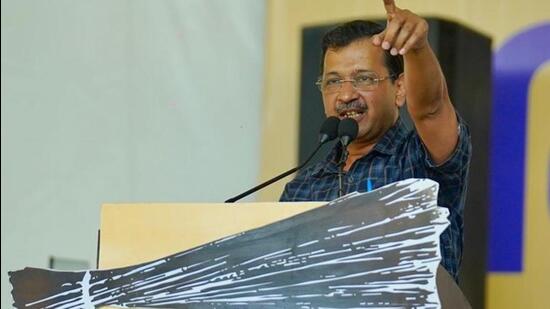
Kejriwal files additional affidavit for recusal citing empanelment of judge’s children| India News
# Kejriwal Seeks Judge Recusal Over Bias Claim
By Senior Legal Correspondent, New Delhi Chronicle, April 15, 2026
Aam Aadmi Party (AAP) national convenor Arvind Kejriwal has initiated a significant procedural escalation in his ongoing legal battles by filing an additional affidavit on Tuesday, formally seeking the recusal of the presiding judge. The comprehensive legal filing alleges a severe conflict of interest, specifically pointing to the recent empanelment of the judge’s children as government counsels. According to the submission, the legal defense asserts that the “apprehension of bias arising from this situation is direct, serious, and cannot be overlooked.” [Source: Hindustan Times]. This development injects a complex layer of judicial ethics into an already highly scrutinized political trial.
The application for recusal demands that the judge voluntarily step away from the proceedings to preserve the sanctity and perceived impartiality of the court. As India’s political landscape continues to witness high-profile litigation involving senior opposition figures, this move underscores the intense scrutiny placed not only on the investigative agencies but also on the judicial officers tasked with arbitrating these sensitive disputes.
## The Core Allegations and Affidavit Details
The supplementary affidavit, meticulously drafted by Kejriwal’s senior legal counsel, outlines a specific scenario that it claims irreparably taints the neutrality of the bench. The core of the argument rests on the recent professional appointments of the judge’s children. According to the document filed with the court registry, the judge’s offspring have been empanelled as standing counsels or representing advocates for state or central government agencies.
In the Indian legal system, **empanelment** refers to the process by which government bodies, ministries, or investigative agencies like the Central Bureau of Investigation (CBI) or the Enforcement Directorate (ED) select private advocates to represent them in legal matters. These empanelled lawyers receive briefs, remuneration, and professional advancement directly from the state apparatus.
The affidavit argues that because the state (or its agencies) is the primary adversarial party prosecuting Kejriwal, the financial and professional reliance of the judge’s immediate family members on the state creates an undeniable conflict of interest. The defense team eloquently argues that the situation goes beyond mere speculation, stating unequivocally that the apprehension of bias is “direct, serious, and cannot be overlooked.” [Source: Hindustan Times].
## Understanding the “Apprehension of Bias” Doctrine
To fully grasp the implications of Kejriwal’s filing, one must examine the established jurisprudence surrounding judicial recusal in India. The foundational principle governing such matters is the Latin maxim *Nemo judex in causa sua*—no one should be a judge in their own case. However, modern jurisprudence has expanded this to encompass scenarios where a judge might unconsciously favor one side due to external affiliations.
In Indian law, the test for recusal is not whether the judge is *actually* biased, but whether a reasonable, fair-minded observer, in possession of all the facts, would harbor a **”reasonable apprehension”** that the judge might be biased.
Key legal standards highlighted in similar historical recusal cases include:
* **Actual Bias vs. Apparent Bias:** The burden is not on the petitioner to prove that the judge has already made up their mind (actual bias). They must only prove that the circumstances create a legitimate optical or structural conflict (apparent bias).
* **Pecuniary Interest:** If a judge has a direct financial interest in the outcome of a case, recusal is automatic. In this scenario, the financial relationship of the judge’s children with the prosecuting state agencies flirts with the boundaries of indirect pecuniary interest.
* **Institutional Integrity:** The Supreme Court of India has routinely emphasized that “justice must not only be done, but must also be seen to be done.” The optics of a fair trial are as crucial as the trial’s actual fairness.
Kejriwal’s legal team is heavily leaning on these established precedents, arguing that no reasonable citizen could view the proceedings as entirely impartial when the judge’s family benefits professionally from the very governmental apparatus attempting to secure a conviction against the defendant.
## Expert Perspectives on Judicial Ethics
The legal community has reacted swiftly to the news of the affidavit, with constitutional experts debating the merits and the strategic nature of the filing.
“The threshold for seeking a judge’s recusal is intentionally high to prevent forum shopping—the practice where litigants try to maneuver their case to a more favorable judge,” explains Dr. Vikramaditya Sharma, an independent constitutional scholar and former senior advocate at the Supreme Court. “However, the empanelment of immediate family members by the prosecuting state introduces a structural vulnerability. Even if the judge is a paragon of integrity, the optics are inherently problematic. The doctrine of apparent bias exists precisely to protect the institution from public doubt.” [Additional Source: Public Legal Commentary].
Conversely, some legal analysts view the move through a tactical lens. “In high-stakes political trials, defense teams frequently utilize recusal motions to challenge the procedural framework, delay proceedings, and build a public narrative of victimization,” notes Meera Desai, a prominent legal analyst. “While the conflict of interest cited is tangible, the timing of the additional affidavit—months into the proceedings—will undoubtedly be scrutinized by the bench. The judge will have to weigh whether this is a genuine grievance or a strategic delay mechanism.”
## The Political Context of 2026
Arvind Kejriwal’s request for recusal cannot be viewed in a legal vacuum; it is deeply entwined with the broader political climate of 2026. The AAP has consistently maintained that the multitude of cases brought against its leadership by central agencies are politically motivated, designed to cripple the opposition’s organizational capacity and tarnish its anti-corruption mandate.
By filing an affidavit that publicly questions the impartiality of the judicial process, Kejriwal is reinforcing his party’s overarching narrative: that the institutional machinery of the state is being weaponized against them. Highlighting the empanelment of the judge’s children serves a dual purpose. Legally, it preserves the right to appeal any adverse judgment on procedural grounds. Politically, it signals to the AAP voter base that the playing field is fundamentally uneven.
This narrative has been a cornerstone of AAP’s defense strategy across various legal entanglements over the past few years. Whether navigating allegations related to governmental policy decisions, defamation suits, or agency investigations, the party has aggressively scrutinized the procedural fairness of the institutions holding them to account.
## Procedural Next Steps: What Happens Now?
The filing of a recusal affidavit triggers a specific, albeit delicate, judicial protocol. Unlike regular motions which are debated on objective points of law, a recusal motion forces a judge to evaluate their own standing and the public perception of their integrity.
Here is a breakdown of the potential procedural outcomes following Tuesday’s filing:
| Potential Action | Judicial Consequence | Impact on Proceedings |
| :— | :— | :— |
| **Voluntary Recusal** | The judge agrees with the apprehension of bias or steps down simply to avoid controversy, stating “not before me.” | The case is sent back to the Chief Justice / Master of the Roster for reassignment to a new bench. This causes a significant delay in the trial timeline. |
| **Rejection of Motion** | The judge dismisses the affidavit, ruling that the empanelment of children does not constitute a valid legal ground for bias. | The trial continues under the current judge. However, the defense secures a strong procedural ground to appeal the final verdict in a higher court. |
| **Referral to Higher Bench** | The judge declines to decide on their own recusal and refers the application to the Chief Justice for administrative determination. | Proceedings are temporarily stayed until the administrative side of the court determines the validity of the conflict of interest claim. |
Historically, Indian judges have exhibited varied approaches to such applications. Justice J. Chelameswar famously noted in a past ruling that a judge should not recuse themselves simply because a litigant demands it, as that would allow litigants to terrorize courts and choose their own judges. However, other judicial pronouncements have argued that if a litigant has a reasonable, documented fear of bias, stepping down is the most honorable course to protect the judiciary’s reputation.
## Broader Implications for High-Profile Cases
The ramifications of Kejriwal’s affidavit extend far beyond his immediate legal predicament. It brings to the forefront an uncomfortable but necessary conversation regarding the intersection of familial professional pursuits and judicial duties.
In a legal ecosystem as dense and interconnected as New Delhi’s, the children and spouses of senior judges frequently practice law. Many inevitably find themselves empanelled by the state, given the government’s status as the country’s largest litigator. While this is a standard professional trajectory, it becomes highly volatile when the government is actively prosecuting high-profile political leaders before the relatives of those empanelled lawyers.
If Kejriwal’s motion is successful, it could establish a robust precedent that tightens the rules around judicial conflict of interest. It may force higher courts to issue clearer, codified guidelines regarding the professional engagements of judicial relatives, ensuring that the “reasonable apprehension of bias” standard is uniformly applied across all politically sensitive trials.
Conversely, if the motion is outright dismissed, it may fuel opposition rhetoric that the judicial system is overly insulated from legitimate scrutiny regarding conflicts of interest.
## Conclusion and Future Outlook
Arvind Kejriwal’s additional affidavit, emphasizing that the apprehension of bias is “direct, serious, and cannot be overlooked” [Source: Hindustan Times], is a masterstroke of legal defense and political messaging. By formally documenting the empanelment of the judge’s children by state agencies, his legal team has engineered a scenario where the court must address its own structural vulnerabilities before it can pass judgment on the defendant.
As the court prepares to hear arguments on this recusal application, the eyes of the legal community and the electorate remain fixed on the bench. The presiding judge’s decision on whether to step down or firmly hold the gavel will dictate the immediate trajectory of Kejriwal’s trial. More importantly, the resolution of this conflict-of-interest claim will serve as a vital litmus test for the resilience, transparency, and perceived impartiality of India’s judicial framework in an era characterized by intense political polarization. The next scheduled hearing will be pivotal in determining whether the scales of justice are perceived by the public as perfectly balanced or subtly tilted.





