
BJP's ₹2,000 monthly stipend for women, welfare, rail projects on Tamil Nadu manifesto| India News
# BJP TN Manifesto: ₹2K for Women, Rail Push
**By Special Correspondent, National Political Desk**
**April 15, 2026**
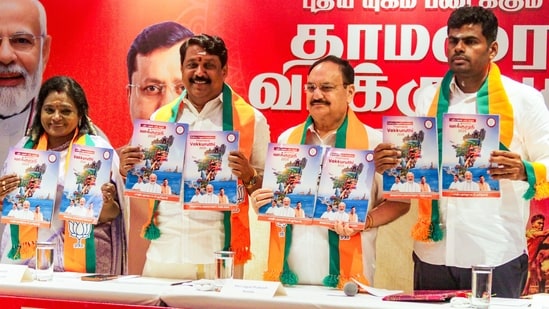
**Chennai:** With the high-stakes Tamil Nadu Legislative Assembly elections looming, the Bharatiya Janata Party (BJP) released its comprehensive state manifesto on Wednesday, April 15, 2026. Aiming to unseat the incumbent Dravida Munnetra Kazhagam (DMK) government, the BJP’s electoral blueprint heavily emphasizes competitive welfare, promising a massive ₹2,000 monthly stipend for women family heads, aggressive expansions in state-wide railway infrastructure, and targeted socio-economic upliftment programs. The strategy signals a highly coordinated effort with its regional ally, the AIADMK. The senior partner of the National Democratic Alliance (NDA) in Tamil Nadu previously released its own manifesto on March 24, outlining nearly identical welfare commitments, thereby presenting a unified electoral front. [Source: Hindustan Times | Additional: Electoral Data Archive 2026]
***
## The Battle for the Women’s Vote: Doubling Down on Welfare
In what has emerged as the defining battleground of the 2026 Tamil Nadu elections, the competition to secure the state’s female demographic—comprising over 3.1 crore registered voters—has reached unprecedented levels of populist commitment. The BJP’s flagship promise to provide a ₹2,000 monthly stipend to female heads of eligible households is a direct, calculated counter-offensive against the ruling DMK’s flagship *Kalaignar Magalir Urimai Thittam*, which currently distributes ₹1,000 monthly to approximately 1.15 crore women.
By pledging to double the existing financial assistance, the BJP is attempting to leverage the undeniable success of direct cash transfers in mobilizing female turnout. Historically, Tamil Nadu has witnessed high female voter participation, and regional political outfits have long tailored their manifestos to address women’s economic autonomy.
“The ₹2,000 monthly direct benefit transfer is not merely a welfare scheme; it is an economic empowerment tool designed to shield rural and semi-urban households from inflationary pressures,” said a senior BJP state committee member during the manifesto launch at the party’s headquarters in Chennai T. Nagar.
However, the promise immediately raises questions regarding state fiscal capacity. Independent economic analysts estimate that effectively executing a ₹2,000 monthly payout to even 1.5 crore women would cost the state exchequer roughly ₹36,000 crore annually.
## Rail Projects and “Double-Engine” Infrastructure
Moving beyond direct cash transfers, the BJP manifesto pivots sharply toward long-term capital expenditure, focusing intricately on the modernization of Tamil Nadu’s transport and logistical networks. The manifesto outlines an ambitious roadmap for the state’s railway infrastructure, aiming to counter the long-standing regional narrative that Southern states receive inadequate central funding for railways.
**Key Infrastructure Promises Include:**
* **Dedicated Southern Freight Corridors:** Fast-tracking the Chennai-Tuticorin and Chennai-Kanyakumari freight lines to drastically reduce logistical costs for the state’s robust manufacturing sector.
* **Vande Bharat Expansion:** Introduction of specialized, high-frequency Vande Bharat commuter rail services connecting tier-2 and tier-3 cities, including specialized routes linking Madurai, Coimbatore, Tiruchirappalli, and Tirunelveli.
* **Amrit Bharat Station Revamp:** The modernization of an additional 60 railway stations across Tamil Nadu, transforming them into world-class transit hubs featuring local commercial stalls under the “One Station One Product” initiative to benefit indigenous artisans.
* **Chennai Suburban Upgrades:** Integration of the Chennai Mass Rapid Transit System (MRTS) with the wider railway network, alongside massive funding injections to upgrade the aging suburban rail lines that serve millions of daily commuters.
The BJP relies heavily on the “double-engine *sarkar*” (government) pitch—arguing that having the NDA in power both at the Center and in Tamil Nadu will eliminate bureaucratic friction and expedite these multi-billion-rupee central projects. [Source: Hindustan Times | Additional: Ministry of Railways Public Policy Document 2026]
## Synergizing with AIADMK’s March 24 Manifesto
A crucial element of the BJP’s 2026 electoral strategy is its seamless synchronization with the AIADMK. As the senior partner of the NDA in Tamil Nadu, the AIADMK published its own manifesto on March 24, setting the thematic groundwork for the alliance’s campaign. The BJP’s document echoes the AIADMK’s core pledges almost verbatim in key welfare areas.
According to political commentators, this overlapping of promises is not a lack of originality but a highly coordinated tactical maneuver. By presenting identical core promises—such as the ₹2,000 women’s stipend, enhanced agricultural subsidies, and specific district-level infrastructure projects—the NDA alliance presents a unified, coherent alternative to the DMK-led Secular Progressive Alliance.
“In previous election cycles, coalition partners in Tamil Nadu often released contradictory manifestos, causing voter confusion,” explains Dr. Karthikeyan Ramaswamy, a Chennai-based psephologist and political scientist. “By mirroring the AIADMK’s March 24 promises, the BJP is signaling absolute alliance cohesion. It reassures the traditional AIADMK vote bank that a vote for the BJP in their contested constituencies is essentially a vote for the AIADMK’s welfare vision.”
## MSMEs, Agriculture, and Economic Revitalization
Tamil Nadu is one of India’s most industrialized states, with its MSME (Micro, Small, and Medium Enterprises) sector serving as the backbone of its economic engine, particularly in the western Kongu belt encompassing Coimbatore, Tiruppur, and Erode. Recognizing the economic distress faced by garment manufacturers and small-scale industrialists over recent years, the manifesto carves out specific relief measures.
The BJP has promised the establishment of specialized “Textile Parks” with subsidized electricity tariffs for power loom weavers, alongside a commitment to lobby the GST Council for a rationalization of tax slabs affecting the yarn and apparel industries.
For the agricultural demographic, the manifesto guarantees a higher Minimum Support Price (MSP) for paddy and sugarcane, directly addressing the grievances of the Delta region’s farming communities. Additionally, the party promises widespread implementation of localized water conservation projects and the speedy completion of the Godavari-Cauvery river linking project—a deeply emotive and long-pending demand in the water-starved agrarian districts of the state.
## Countering Dravidian Ideology with Cultural Integration
While welfare and infrastructure form the material basis of the manifesto, the document does not neglect the ideological battleground. For decades, the BJP has faced an uphill task penetrating the Dravidian political fortress, frequently battling allegations of being a “North Indian, Hindi-imposing” entity.
To systematically dismantle this narrative, the 2026 manifesto places immense emphasis on Tamil pride, language, and cultural autonomy. The party promises substantial financial outlays to establish *Thirukkural* research centers across leading global universities and pledges to fully fund the archaeological excavations at Keeladi and other ancient Tamil settlements.
Furthermore, tapping into a long-standing demand of Hindu groups and right-leaning voters in the state, the manifesto floats the promise of freeing Hindu temples from the administrative control of the state government’s Hindu Religious and Charitable Endowments (HR&CE) department, proposing a transition toward management by independent boards of scholars, ascetics, and devotees.
## Expert Analysis: Fiscal Reality vs. Electoral Necessity
While the manifesto is structurally robust and politically appealing, independent economic watchdogs remain highly skeptical about the feasibility of its execution. Tamil Nadu already carries a massive debt burden, which crossed ₹7.5 lakh crore in the 2024-2025 fiscal year.
“The competitive populism we are witnessing—moving from mixers and grinders a decade ago to massive, recurring cash transfers today—is structurally altering state finances,” notes Dr. Meenakshi Sundaram, an economist specializing in South Indian public policy. “Offering ₹2,000 monthly to female household heads, alongside expanding agricultural subsidies and lowering power tariffs for MSMEs, will inevitably result in a severe contraction of capital expenditure. Unless state revenues grow at a double-digit rate miraculously, the incoming government will be forced to either borrow heavily or increase indirect taxes.”
Despite these fiscal warnings, political operatives understand that elections in Tamil Nadu are rarely won on austerity platforms. The NDA’s calculation relies on the central government partially underwriting infrastructure costs (like the massive rail projects), freeing up state revenues to focus entirely on direct benefit transfers. [Source: Hindustan Times | Additional: RBI Bulletin on State Finances 2025-2026]
## Conclusion: A High-Stakes Showdown
As Tamil Nadu braces for the polls in the coming weeks, the battle lines are unequivocally drawn. The DMK-led alliance will attempt to ride on its incumbent welfare deliveries, anti-incumbency management, and established Dravidian ideological moats. Conversely, the AIADMK-BJP combine is leveraging an escalated welfare war—epitomized by the ₹2,000 women’s stipend—paired with the allure of massive, centrally backed infrastructure and rail development.
Whether the Tamil electorate will opt for the continuity of the DMK’s “Dravidian Model” or pivot towards the NDA’s “Double-Engine” promises remains the ultimate question. What is undeniably clear, however, is that the 2026 manifesto has ensured this election will be one of the most fiercely contested, financially consequential, and deeply strategic democratic exercises in Tamil Nadu’s modern political history.





