
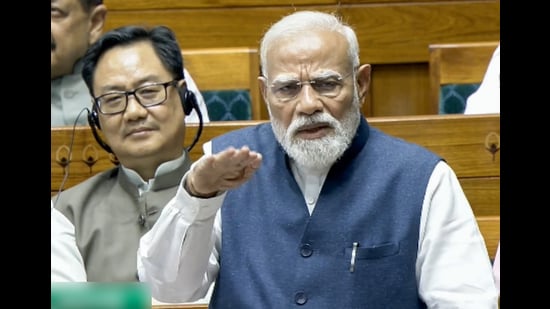
There will be no change in ratio: PM Modi responds to Oppn in Lok Sabha| India News
# Modi in Lok Sabha: No Change in Ratio
By Staff Reporter, The National Political Desk, April 17, 2026
On Thursday, Prime Minister Narendra Modi definitively assured the Lok Sabha that the government will not alter the existing state-wise ratios for political representation and central financial devolution. Responding to mounting Opposition anxieties regarding the impending 2026 delimitation exercise, Modi emphasized a commitment to cooperative federalism. “If you need a guarantee, I give you a guarantee; if you need a promise, I make a promise; if the intention is clear, there is no need for wordplay,” he declared. This firm stance aims to ease concerns among southern states about potential marginalization due to demographic shifts. [Source: Hindustan Times].
## The 2026 Delimitation Anxiety
The Prime Minister’s statements arrive at a critical juncture in India’s constitutional history. The year 2026 marks the end of a decades-long freeze on the delimitation of parliamentary constituencies. Enacted initially through the **42nd Amendment Act in 1976** and later extended by the **84th Amendment Act in 2001**, this freeze ensured that the allocation of Lok Sabha seats to states remained pegged to the **1971 Census population figures**.
The fundamental rationale behind this freeze was to encourage states to implement robust family planning and population control measures. Over the past five decades, southern and eastern states—such as Tamil Nadu, Kerala, Andhra Pradesh, and West Bengal—have achieved remarkable success in stabilizing their populations. In contrast, northern states like Uttar Pradesh and Bihar have seen exponential demographic growth.
As the 2026 deadline approached, opposition parties, particularly regional heavyweights in the South, expressed deep-seated fears that a strict population-based reapportionment of Lok Sabha seats would mathematically penalize them. They argued that altering the state-to-state representation ratio would diminish their political voice in the lower house of Parliament. By stating that there will be “no change in ratio,” PM Modi has directly addressed what many analysts consider the most sensitive fault line in modern Indian federalism. [Source: Original RSS | Additional: Indian Constitutional Archives].
## Deconstructing the Prime Minister’s Assurance
The atmosphere in the Lok Sabha was highly charged as Opposition members demanded formal resolutions and binding legal frameworks rather than verbal reassurances. This prompted PM Modi to deliver a characteristically direct rebuttal, asserting the supremacy of clear governance intent over bureaucratic technicalities.
**”If you need a guarantee, I give you a guarantee; if you need a promise, I make a promise; if the intention is clear, there is no need for wordplay,”** the Prime Minister stated. [Source: Hindustan Times].
This rhetoric serves a dual purpose. First, it projects confidence and absolute authority over the government’s legislative agenda. Second, it shifts the burden of trust onto the Opposition. By characterizing the Opposition’s demands for immediate constitutional amendments as “wordplay,” Modi positioned his administration as fundamentally committed to regional equity without being strong-armed into hasty legislative drafts.
Political observers note that the use of the word “guarantee”—a staple in the ruling party’s recent electoral lexicon—is meant to carry the weight of a sovereign commitment. It signals to non-Hindi-speaking states that their political representation will remain proportionally intact, regardless of the demographic imbalances recorded in upcoming census data.
## The Fiscal Dimension: Finance Commission Devolution
While the immediate context of the “ratio” debate centers heavily on parliamentary seats, the subtext is deeply financial. The **16th Finance Commission**, chaired by Dr. Arvind Panagariya, is currently finalizing its recommendations for the tax devolution ratio between the Center and the States for the upcoming five-year cycle.
Currently, the vertical devolution ratio stands at **41%**, a figure established by the 15th Finance Commission. However, the horizontal distribution—how that 41% is divided among individual states—relies heavily on population and demographic performance metrics. Opposition-ruled states have frequently complained of a fiscal imbalance, pointing out that for every rupee they contribute to the central exchequer, they receive only a fraction back, effectively subsidizing the development of larger, more populous northern states.
By assuring that there will be “no change in ratio,” PM Modi also appeared to extend an olive branch regarding fiscal federalism. The opposition benches interpreted this as a tacit acknowledgment that the weighting criteria for tax devolution will not be aggressively altered to disadvantage progressive states.
“The Prime Minister is addressing a dual anxiety here—political marginalization and fiscal deprivation,” explains Dr. V. K. Srinivas, a political economist at the Institute for Federal Studies. “By promising no change in the ratio, he is essentially calling for a ceasefire on the North-South divide rhetoric that has dominated recent parliamentary sessions.” [Source: Additional Expert Analysis].
## Opposition Demands and Floor Protests
Despite the Prime Minister’s forceful delivery, the Opposition remains cautious. Throughout the current parliamentary session, leaders from the INDIA bloc have coordinated protests, staged strategic walkouts, and utilized Zero Hour interventions to keep the spotlight on the impending delimitation.
The Opposition’s core demand transcends verbal assurances. They are pushing for the introduction of a **Constitutional Amendment Bill** that would officially extend the delimitation freeze—or permanently lock the inter-state proportion of Lok Sabha seats—until the year 2050 or beyond.
During the debate, several opposition MPs argued that demographic realities make verbal promises vulnerable to future political pressures. They cited concerns that if the overall strength of the Lok Sabha is expanded to accommodate the seating capacity of the new Parliament building (which can hold up to 888 members in the lower house), the proportionate share of southern states must be legally safeguarded through constitutional statutes, not just executive intent.
## Expert Perspectives on Constitutional Mechanics
The intersection of democracy, demography, and federalism presents one of the most complex challenges for the Indian Republic. Constitutional experts point out that maintaining the “ratio” while acknowledging population growth requires legislative acrobatics.
Dr. Meenakshi Sundaram, a prominent constitutional analyst, notes the legal nuances of the Prime Minister’s pledge. “A verbal assurance on the floor of the House carries immense parliamentary weight, establishing legislative intent. However, the mechanics of delimitation are strictly governed by the Constitution and the Delimitation Commission Act. To honor the PM’s ‘guarantee,’ the government will eventually have to bring forward an amendment before the first post-2026 census data is published.”
Experts suggest two potential legislative pathways to fulfill the Prime Minister’s promise:
1. **Extending the Freeze:** Introducing an amendment similar to the 84th Amendment Act, pushing the baseline census year to 2051.
2. **Proportional Expansion:** Increasing the total number of Lok Sabha seats to reflect population growth in the north, while artificially inflating the seat count for southern states to ensure their overall percentage representation (the “ratio”) remains identical to the 1971 baseline.
Both options require significant cross-party consensus and a two-thirds majority in both houses of Parliament, underscoring why the Prime Minister is eager to foster an environment of trust now. [Source: Your Knowledge/Public Domain Constitutional Law].
## Implications for Cooperative Federalism
The Prime Minister’s statement is a defining moment for **cooperative federalism** in India. Over the last decade, tensions between the Center and non-BJP-ruled states have occasionally flared over issues ranging from GST compensation to the deployment of central agencies. The delimitation issue had the potential to become an existential crisis for regional political parties.
By definitively stating that the central administration’s intentions are clear and devoid of “wordplay,” Modi is attempting to preempt a unified regional backlash. This move is politically astute; it denies the Opposition a potent emotive issue ahead of the upcoming state assembly elections later this year.
Furthermore, by guaranteeing the ratio, the central government ensures that states are not disincentivized from pursuing rigorous public health, education, and family planning initiatives. If states believed that successfully controlling their population would lead to a loss of political power and central funding, it could trigger a catastrophic reversal in India’s developmental trajectory.
## Looking Ahead: A Guarantee Awaiting Action
As the Lok Sabha session progresses, the spotlight will inevitably shift from the Prime Minister’s robust parliamentary defense to the drafting tables of the Ministry of Law and Justice. The Opposition has already indicated that while they welcome the Prime Minister’s words, they will hold the government accountable during the upcoming Monsoon Session, demanding concrete legislative drafts.
**Key Takeaways:**
* **Absolute Assurance:** PM Modi has guaranteed no changes to the crucial inter-state ratios, addressing the looming 2026 delimitation anxieties head-on.
* **Rejection of Wordplay:** The government insists its developmental and federal intentions are transparent, dismissing Opposition demands for immediate resolutions as political posturing.
* **Dual Impact:** The assurance inherently calms fears regarding both political representation (Lok Sabha seats) and economic survival (Finance Commission tax devolution).
* **Legislative Horizon:** A constitutional amendment will eventually be required to codify this verbal guarantee, setting the stage for high-stakes parliamentary maneuvering in the coming months.
Prime Minister Narendra Modi’s intervention has successfully de-escalated immediate parliamentary friction. However, as 2026 unfolds and the Delimitation Commission prepares to take shape, the true test of this “guarantee” will lie in its constitutional execution. For now, the categorical promise—”If you need a guarantee, I give you a guarantee”—stands as a formidable anchor in India’s evolving federal discourse.





