
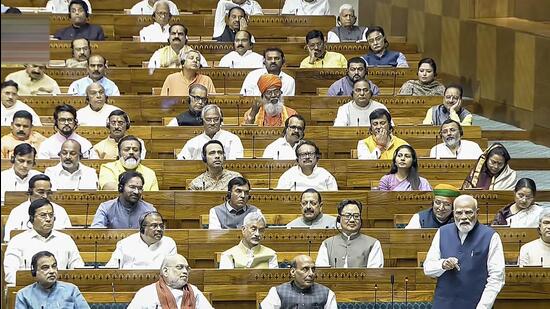
Attendance in focus as Lok Sabha gears up for voting on crucial bills| India News
# Lok Sabha on Edge: Attendance Key for Mega Vote
By Senior Political Correspondent, New Delhi, April 17, 2026
**New Delhi:** The Lok Sabha is bracing for a high-stakes legislative showdown this Friday following the introduction of the contentious 131st Constitution Amendment Bill. Introduced on Thursday with a preliminary vote count of 251 in favor and 185 against, the legislation now faces its ultimate test: a rigorous two-thirds majority requirement for final passage. With parliamentary arithmetic looking incredibly tight, political parties have issued strict three-line whips, making member attendance the defining factor in determining the fate of this landmark constitutional overhaul. [Source: Hindustan Times]
## The Numbers Game: Why Every Single Vote Counts
Passing a constitutional amendment in India is deliberately designed to be an arduous legislative process, ensuring that foundational changes are not subject to the fleeting whims of a simple majority. Under Article 368 of the Indian Constitution, the passage of the 131st Amendment Bill requires a dual mandate: an absolute majority of the total membership of the House, and a majority of not less than two-thirds of the members present and voting.
During Thursday’s introductory phase—which only requires a simple majority of those present—the bill was tabled with 251 Ayes and 185 Noes. This indicates that 436 Members of Parliament (MPs) out of the 543 total members were present and participated in the voice or division vote. Nearly over a hundred MPs were absent.
For the final passage, the mathematical reality becomes daunting. If all 543 members attend the session, the ruling coalition will require a minimum of 362 votes (two-thirds) to pass the bill. Given that only 251 members supported its introduction, the Treasury benches face a monumental gap of over 100 votes. Conversely, if the opposition manages a strategic walkout, it lowers the two-thirds threshold, but the government still fundamentally needs at least 272 votes (absolute majority of the total House) to ensure passage. [Source: Parliamentary Rules of Procedure | Additional: Indian Constitution Article 368]
## Decoding the 131st Constitution Amendment Bill
While the specific clauses of the 131st Constitution Amendment Bill have sparked fierce debate, its primary focus centers on comprehensive electoral restructuring ahead of the deeply anticipated post-2026 delimitation exercise. The year 2026 marks the end of the constitutional freeze on the reallocation of Lok Sabha seats across states, a freeze originally instituted by the 42nd Amendment in 1976 and extended by the 84th Amendment in 2001.
The bill reportedly proposes a new formula for balancing demographic representation without politically disenfranchising southern states that have successfully implemented population control measures. Additionally, it features clauses that establish the foundational framework for synchronized national and state elections—a long-standing policy objective of the current administration.
Because it alters the federal structure and parliamentary representation, the bill will also require ratification by the legislatures of at least half of the states if it clears both Houses of Parliament. The stakes are profoundly high, making the current legislative maneuvering crucial for the nation’s democratic future.
## Whips Issued: The Scramble for Full Strength
Recognizing the precarious nature of the upcoming vote, both the ruling coalition and the opposition blocs have gone into an aggressive mobilization drive.
A “three-line whip” has been issued by major political parties across the spectrum. In parliamentary parlance, a three-line whip is the strictest directive, compelling members to be present in the House and to vote according to the party line. Defiance of such a whip can lead to immediate disqualification under the Anti-Defection Law (Tenth Schedule).
“We have categorically instructed all our MPs to remain in the national capital and be present in the Lok Sabha through the entirety of Friday’s session,” stated a senior floor manager for the ruling coalition. “This amendment is a historical necessity, and we are confident in our floor management.”
Meanwhile, the opposition is equally vigilant. Lawmakers who missed Thursday’s introductory vote citing health or regional commitments have been urgently summoned back to New Delhi. The opposition aims to ensure maximum attendance to artificially inflate the two-thirds threshold, making it statistically impossible for the government to push the bill through. [Source: Hindustan Times | Additional: Public Party Briefings]
## Expert Perspectives on the Impending Clash
The tension surrounding the 131st Amendment represents a defining moment in India’s modern parliamentary history. Political analysts suggest that the government’s decision to introduce the bill despite an uncertain numeric advantage indicates heavy behind-the-scenes negotiations.
“The introduction vote of 251-185 is a preliminary litmus test,” notes Dr. Meenakshi Sanyal, a senior constitutional scholar and political analyst. “The ruling party is 21 votes shy of an absolute majority based purely on the introductory numbers, let alone a two-thirds majority. This implies two things: either they have secured unspoken commitments from regional, non-aligned parties who abstained on Thursday, or they are executing a pressure tactic to expose the opposition’s stance on electoral reforms ahead of the upcoming state elections.”
Dr. Sanyal further emphasizes that parliamentary absenteeism on voting day will be closely scrutinized. “In high-stakes constitutional amendments, absence is a vote in itself. It lowers the two-thirds threshold but makes the absolute majority barrier (272) absolute. The floor managers are currently playing 3D chess.”
## The Opposition’s Stance and Counter-Strategy
The unified opposition, which robustly contested the introduction of the bill, views the 131st Amendment as a threat to the federal spirit. During Thursday’s heated debate, opposition leaders argued that pushing through an overarching delimitation and electoral synchronization framework without an all-party consensus undermines parliamentary democracy.
The 185 members who voted against the introduction represent a consolidated bloc. Their strategy is twofold:
1. **Maintain 100% Attendance:** By ensuring no opposition MP is absent, they keep the two-thirds threshold incredibly high (potentially requiring 362 votes).
2. **Lobbying the Unaligned:** There are roughly a dozen regional parties that maintain an equidistant stance from both the national ruling coalition and the main opposition bloc. The opposition is aggressively lobbying these parties, arguing that the bill will dilute regional autonomy.
“We will not allow the Constitution to be altered through brute force or backroom deals,” a prominent opposition spokesperson declared Thursday evening. “The 185 votes are just our baseline. Come Friday, you will see a united front defending the federal structure.”
## What Happens If the Bill Fails?
Failure to pass a constitutional amendment bill is rare for a majority government, primarily because such bills are usually only introduced when the math is absolutely secure. If the 131st Amendment Bill fails to secure the requisite majority in the Lok Sabha, it will be heavily disruptive for the government’s legislative agenda.
Unlike ordinary bills, a defeated constitutional amendment cannot be sent to a joint sitting of Parliament. Article 368 requires independent passage in both the Lok Sabha and the Rajya Sabha. A failure in the Lower House means the bill is entirely dead, forcing the government to either abandon the policy, redraft the legislation, or wait for a more favorable political climate.
Politically, a defeat would embolden the opposition and serve as a massive psychological blow to the ruling coalition. It would also delay the delimitation preparations, pushing back the timeline for redrawing constituency boundaries.
## Conclusion and Future Outlook
As the Lok Sabha convenes for this crucial vote, the spotlight remains firmly locked on attendance registers. The transition from Thursday’s 251-185 split to a successful two-thirds majority requires a political miracle, meticulous floor management, or a sudden shift in regional alliances.
The impending vote is more than just a procedural hurdle; it is a profound test of the government’s political capital and the opposition’s unity. Whether the 131st Constitution Amendment Bill becomes the catalyst for the next era of Indian electoral politics or fails on the floor of the House, the outcome will significantly reshape the political narrative leading into the next general elections.
Citizens, policy experts, and constitutional observers are watching closely. The numbers will be tallied, the doors of the Lok Sabha will be locked during division, and the ultimate test of Indian parliamentary democracy will unfold live.
**Key Takeaways:**
* **The Bill:** The 131st Constitution Amendment requires an absolute majority of the total House and a 2/3rds majority of those present and voting.
* **Current Standing:** Introduced Thursday with a 251-185 vote, leaving a massive gap required for final passage.
* **The Strategy:** Whips have been issued globally; full attendance makes it harder for the government, while strategic walkouts could alter the math.
* **The Consequence:** Defeat means the bill is dead; joint parliamentary sittings are not permitted for Constitutional Amendments.





