
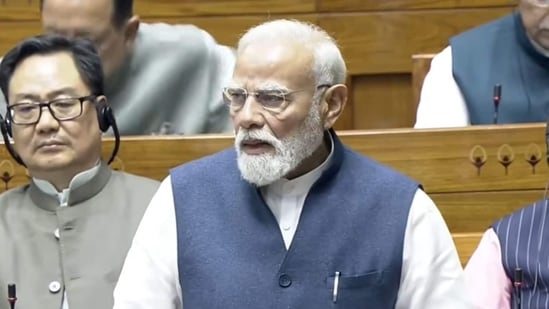
‘No injustice to anyone’: PM Modi assures southern states of no seat loss due to delimitation| India News
# Modi Assures South: No Seat Loss in Delimitation
**By Staff Reporter, The National Desk | April 17, 2026**
Prime Minister Narendra Modi on Friday sought to quell mounting anxieties across Southern India, categorically stating that “no injustice” will be done to any state and assuring that the impending national delimitation exercise will not result in a loss of Lok Sabha seats for the southern region. The intervention comes as opposition parties heavily criticize the Union government over the absence of explicit statutory safeguards in recent parliamentary bills guaranteeing that the proportional representation of states will remain untouched. As the constitutional freeze on parliamentary seat reallocation expires this year, the intersection of demographic shifts, political representation, and federal equity has emerged as the defining political battle of 2026.
[Source: Hindustan Times | Additional: Constitutional Framework of India, Article 82]
## The Core Conflict: Demographics vs. Democracy
The root of the delimitation anxiety lies in a fundamental principle of representative democracy: one person, one vote. In theory, parliamentary constituencies should hold roughly equal populations to ensure equal representation. However, India’s stark demographic divergence over the past five decades has created a unique federal conundrum.
Southern states—notably Kerala, Tamil Nadu, Karnataka, Andhra Pradesh, and Telangana—successfully implemented rigorous family planning and population control measures starting in the 1970s. As a result, their Total Fertility Rates (TFR) dropped below replacement levels years ago. Conversely, several northern and central states, particularly Uttar Pradesh, Bihar, Madhya Pradesh, and Rajasthan, experienced prolonged periods of high population growth.
If Lok Sabha seats are redistributed strictly based on the upcoming census figures, states that successfully managed their population growth would be mathematically penalized by losing parliamentary influence, while states with booming populations would gain disproportionate legislative power.
“The southern states have been the engine of India’s socioeconomic progress, achieving remarkable milestones in healthcare, education, and population control,” explains Dr. Meenakshi Sundaram, a senior fellow at the Institute for Democratic Reforms. “To reduce their political voice as a direct consequence of their governance success is viewed not just as an irony, but as a severe breach of the federal trust.”
## Opposition Demands Statutory Guarantees
The immediate trigger for the Prime Minister’s reassurance was a fiercely debated bill introduced in the ongoing parliamentary session. Opposition leaders from the Congress, Dravida Munnetra Kazhagam (DMK), Trinamool Congress (TMC), and Left parties staged walkouts and protests, questioning the government over the bill’s silence on preserving the existing proportional representation among states.
Opposition spokespersons have argued that verbal assurances, even from the highest office, are insufficient when the constitutional mechanism of Article 82 dictates that a Delimitation Commission must adjust seats based on the latest census data.
“We are not asking for favors; we are demanding constitutional guarantees,” a senior opposition leader stated during the parliamentary debate. “The government has repeatedly sidestepped the issue of embedding a ‘proportionality clause’ in the legislative framework. If the Prime Minister’s intent is truly to ensure no injustice occurs, it must be reflected in the black and white text of the law, not just in political speeches.”
The lack of explicit mention in the bill regarding proportional representation remaining static has amplified fears that the ruling dispensation might use the post-2026 delimitation to consolidate its electoral dominance in the Hindi heartland, further marginalizing the political weight of the south.
[Source: Hindustan Times | Additional: Parliamentary Proceedings Archive, April 2026]
## Decoding PM Modi’s ‘No Injustice’ Assurance
Prime Minister Modi’s assurance of “no injustice to anyone” and his guarantee against “seat loss” require careful political and mathematical decoding. Constitutional experts point out that the Prime Minister’s promise heavily implies a specific strategy: increasing the absolute number of seats in the Lok Sabha.
Currently, the Lok Sabha has 543 elected seats. If this total remains frozen, any proportional gain by northern states absolutely requires a corresponding seat loss for southern states. However, if the total number of Lok Sabha constituencies is expanded, it is mathematically possible to allocate additional seats to populous northern states while ensuring that southern states retain their current absolute number of MPs (e.g., Tamil Nadu keeping its 39 seats, Kerala its 20).
This strategy aligns seamlessly with the architectural capacity of the new Parliament building (Central Vista), inaugurated in 2023, which boasts a Lok Sabha chamber capable of seating 888 members.
“The Prime Minister is likely signaling an absolute baseline rather than a proportional one,” notes political analyst Shekhar Gupta. “By promising ‘no seat loss,’ the government is ensuring that Tamil Nadu will not drop from 39 to 30 seats. However, if the overall size of the house expands to 848 seats, Tamil Nadu’s 39 seats will mathematically represent a much smaller percentage of the total parliamentary power. The South won’t lose absolute numbers, but their proportional clout will inevitably shrink.”
## The Historical Context: The 1976 and 2001 Freezes
To understand the gravity of the 2026 deadline, it is essential to look at the historical precedents that delayed this crisis for half a century.
During the Emergency in 1976, Prime Minister Indira Gandhi’s government passed the 42nd Constitutional Amendment, freezing the allocation of Lok Sabha seats to the states based on the 1971 census. The explicit goal was to encourage states to implement family planning programs without the fear of losing political representation.
This freeze was originally intended to last until the year 2000. However, when the deadline approached, it became clear that the demographic disparity between the North and South had only widened. Recognizing the explosive political fallout that would result from a reallocation, Prime Minister Atal Bihari Vajpayee’s government passed the 84th Amendment in 2001, extending the freeze for another 25 years—until the first census taken after the year 2026.
As of April 2026, the nation has finally arrived at this long-deferred crossroads. The can that was kicked down the road for 50 years has hit a dead end, forcing the current government to engineer a solution that satisfies the democratic principle of equal representation without rupturing the federal structure.
## Projected Demographic Shifts and Representation
To illustrate the scale of the impending shift, demographic projections highlight dramatic disparities. According to population projections leading up to 2026:
**Estimated Population vs. Current Seats (Sample States)**
| State | 1971 Population (Base) | Est. 2026 Population | Current LS Seats | Projected Seats (if 543 total) |
| :— | :— | :— | :— | :— |
| Uttar Pradesh | 88.3 Million | ~240 Million | 80 | ~105 |
| Bihar | 56.3 Million | ~135 Million | 40 | ~55 |
| Tamil Nadu | 41.1 Million | ~78 Million | 39 | ~30 |
| Kerala | 21.3 Million | ~36 Million | 20 | ~13 |
*(Data representation based on demographic growth rates and demographic analysis up to early 2026).*
This table underscores why southern states are panicking. Without an expansion of the Lok Sabha, the purely demographic redistribution would strip Kerala, Tamil Nadu, Andhra Pradesh, and Karnataka of dozens of seats, transferring that power directly to the Hindi belt. Even with an expanded Lok Sabha, the sheer volume of new seats required to balance the northern population boom means the North will dominate legislative voting blocs more heavily than ever before.
## The Economic Dimension and Federal Friction
The delimitation debate is inextricably linked to ongoing grievances regarding fiscal federalism. Southern states have long argued that they contribute disproportionately to the national exchequer while receiving significantly less in tax devolutions from the central government.
For instance, states like Karnataka, Tamil Nadu, and Maharashtra generate immense corporate and income tax revenues. However, under the formulas designated by successive Finance Commissions—which weigh population heavily as a criterion for need—the bulk of these tax revenues are redirected to fund infrastructure and welfare programs in less developed, highly populated northern states.
“The southern narrative is one of double victimization,” says Dr. Aravind Krishnan, an economist at the Centre for Policy Research. “First, they are penalized economically by the Finance Commission formulas. Now, they face being penalized politically by the Delimitation Commission. If a region feels that it is funding the nation but losing its voice in how the nation is governed, it creates highly volatile federal friction.”
By assuring the South of “no injustice,” the Prime Minister is attempting to cool these economic and political grievances. However, regional parties argue that expanding the parliament without preserving voting proportionality still Dilutes their ability to block legislation that might be detrimental to their state’s economic interests.
## Potential Solutions and The Path Forward
As the government prepares the groundwork for the post-2026 census and subsequent delimitation, several expert proposals are reportedly under review to fulfill the Prime Minister’s promise of equity:
1. **The Expansion Model:** Expanding the Lok Sabha to 848 or 888 seats, ensuring that every state retains at least its current number of MPs, while allocating new seats based on updated population metrics.
2. **Federal Balancing in the Rajya Sabha:** To offset the loss of proportional power in the Lok Sabha, some constitutional scholars have proposed reforming the Rajya Sabha (Upper House) to give equal representation to all states, similar to the United States Senate. However, this would require a massive constitutional overhaul.
3. **Decoupling Delimitation from Population:** Implementing a formula where seats are capped, but parliamentary voting weights are adjusted, though this is viewed as democratically untenable and legally complex.
The government faces the monumental task of drafting a Delimitation Act that survives constitutional scrutiny, honors the democratic ethos of equal vote value, and maintains the unity of a vastly diverse nation.
## Conclusion: A Delicate Balancing Act
Prime Minister Narendra Modi’s public assurance on April 17 is a crucial first step in managing the most sensitive federal issue of this decade. By explicitly stating that southern states will face “no injustice” and no seat loss, the administration is signaling its commitment to a negotiated, consensus-driven approach rather than a unilateral, demographic bulldozer.
However, the opposition’s skepticism highlights the need for tangible, statutory mechanisms. Until a comprehensive formula is unveiled and enshrined in law, the anxiety surrounding the 2026 delimitation will persist. The ultimate resolution of this crisis will define the shape of Indian democracy, testing whether the nation can reconcile the arithmetic of population with the ethics of equitable federal representation for decades to come.





