
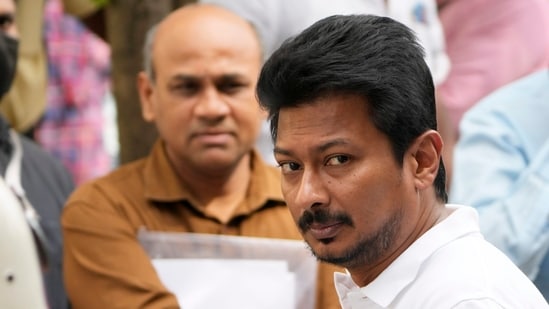
From actor to TN DCM: the rise of Udhayanidhi Stalin as a third-generation political leader in the DMK
# Udhayanidhi Stalin: Actor to TN Deputy CM
**By Political Desk | April 17, 2026**
Udhayanidhi Stalin’s formal elevation to the role of Deputy Chief Minister of Tamil Nadu cements his position as the undisputed third-generation political heir to the Dravida Munnetra Kazhagam (DMK) legacy. Transitioning with remarkable speed from a successful career as a Kollywood actor and film producer to the second-highest executive office in the state, the 48-year-old leader has fundamentally reshaped his public persona. As the son of Chief Minister M.K. Stalin and the grandson of the legendary M. Karunanidhi, Udhayanidhi’s political trajectory—from leading the DMK Youth Wing in 2019 to his current administrative pinnacle in 2026—highlights a carefully orchestrated succession plan ahead of the pivotal state assembly elections. [Source: Hindustan Times | Additional: Public Domain Knowledge]
## Fact 1: The Cinematic Foundations and Red Giant Movies
Long before he was navigating the complex corridors of Fort St. George, Udhayanidhi Stalin was a prominent fixture in Tamil cinema. The Dravidian political movement has historically maintained a deep, symbiotic relationship with the silver screen. Founders like C.N. Annadurai and M. Karunanidhi used scriptwriting as a vehicle for ideological dissemination, while icons like M.G. Ramachandran transformed cinematic popularity into enduring political capital.
Udhayanidhi followed a modern variation of this blueprint. **He established Red Giant Movies in 2008**, initially making his mark as a powerful film distributor and producer. He transitioned into acting with the 2012 hit romantic comedy *Oru Kal Oru Kannadi*. Over the next decade, he built a recognizable, everyman persona across urban and rural Tamil Nadu. While critics often pointed out that his lineage provided him unparalleled access to the film industry’s upper echelons, his cinematic career served a distinct political purpose: it gave him immense grassroots visibility. By the time he decided to pivot to full-time politics, Udhayanidhi was already a household name, bypassing the grueling decades of obscurity that most emerging politicians face. [Source: Hindustan Times]
## Fact 2: The 2019 Catalyst and the Youth Wing Leadership
The true acceleration of Udhayanidhi’s political career began during the 2019 Lok Sabha elections. While he had made sporadic appearances at party events prior, 2019 marked his arrival as a frontline campaigner.
**His masterstroke during the campaign was the “Single Brick” protest.** Holding up a single brick with “AIIMS” written on it, Udhayanidhi traversed the state, visually mocking the central government’s delay in constructing the promised All India Institute of Medical Sciences in Madurai. The imagery was simple, highly viral, and devastatingly effective. It resonated deeply with Tamil voters, helping the DMK-led alliance sweep the state.
Recognizing his impact, the party high command officially appointed him as the Secretary of the DMK Youth Wing in July 2019. This was a highly symbolic move; his father, M.K. Stalin, had held that exact post for over three decades, using it to build his own formidable faction within the party. Udhayanidhi’s appointment signaled to the party cadre that the baton was being prepared for a generational handoff.
## Fact 3: The 2021 Electoral Debut in a Legacy Stronghold
Transitioning from a star campaigner to an elected representative was the necessary next step. In the 2021 Tamil Nadu Legislative Assembly elections, **Udhayanidhi was fielded from the Chepauk-Thiruvallikeni constituency** in Chennai.
The choice of constituency was steeped in political heritage. Chepauk was the political fortress of his grandfather, the late M. Karunanidhi, who had represented the seat multiple times. Udhayanidhi secured a landslide victory, defeating his nearest rival by a massive margin. His entry into the Tamil Nadu Legislative Assembly occurred simultaneously with his father swearing in as Chief Minister for the first time.
During his early days as an MLA, Udhayanidhi focused extensively on his constituency, implementing local welfare schemes and utilizing his star power to bring rapid civic resolutions. This period was crucial for shedding his “actor” image and proving his capability as a hands-on legislator to skeptical political observers. [Source: Hindustan Times | Additional: Public Domain Knowledge]
## Fact 4: Administrative Proving Ground as Sports Minister
A legislator’s role, while important, does not inherently prepare one for state-wide executive leadership. To bridge this gap, Chief Minister M.K. Stalin inducted Udhayanidhi into the state cabinet in December 2022.
**He was appointed as the Minister for Youth Welfare and Sports Development**, alongside Special Programme Implementation. This portfolio was strategically chosen. It allowed him to engage directly with the state’s youth demographic—a critical voting bloc—without immediately burdening him with historically controversial or heavily scrutinized ministries like Home, Finance, or Public Works.
As Sports Minister, Udhayanidhi spearheaded high-visibility initiatives. He was instrumental in bringing major sporting events to Tamil Nadu, including the Asian Champions Trophy hockey tournament and the Khelo India Youth Games. He also championed the creation of mini-stadiums in every assembly constituency. These achievements allowed the DMK machinery to project him as a dynamic, results-oriented administrator, systematically building his resume for higher office.
## Fact 5: The Elevation to Deputy Chief Minister
The culmination of this rapid political maturation was his elevation to the role of Deputy Chief Minister. While M.K. Stalin had to wait until his late fifties to be named Deputy CM under Karunanidhi, Udhayanidhi’s ascent was remarkably swifter.
**His appointment as Deputy Chief Minister served a dual purpose.** First, it allowed M.K. Stalin to share the increasingly heavy administrative and political burdens of running the state, especially as the 2026 assembly elections approached. Second, it formalized Udhayanidhi’s status, legally and politically, as the second-in-command, quelling any internal party murmurs about succession.
However, his time at the top has not been without significant turbulence. He has had to navigate intense national scrutiny, most notably during controversies surrounding his remarks on “Sanatana Dharma,” which sparked fierce debates across the national political spectrum. The DMK’s political opponents, particularly the BJP, have repeatedly cited his rise as a prime example of detrimental dynastic politics. In response, DMK loyalists argue that Udhayanidhi has earned his mandate through grassroots campaigning and measurable administrative success. As Deputy CM, he now operates under the microscope, where every policy decision and public statement is weighed against the impending 2026 electoral battle. [Source: Hindustan Times]
## Expert Analysis: The Dynamics of Third-Generation Leadership
The phenomenon of third-generation political leadership poses unique challenges in Indian politics. Political analysts note that while the first generation builds the ideological foundation and the second generation consolidates the organizational structure, the third generation often battles an inherent “credibility deficit” among neutral voters.
“Udhayanidhi Stalin’s transition was accelerated compared to his father’s grueling, decades-long apprenticeship,” notes Dr. V. Ramanathan, a Chennai-based political scientist. “The primary challenge for a third-generation leader is overcoming the ‘dynasty’ tag. While his lineage guarantees him the loyalty of the party cadre, it also makes him a prime target for opposition narratives. His success as Deputy Chief Minister depends entirely on whether the broader electorate views him as an entitled heir or an effective, modern administrator.”
Furthermore, Udhayanidhi represents a generational shift within the DMK. He brings a modernized, corporate-style approach to political campaigning and party management, heavily utilizing social media and data analytics. This shift is essential for the DMK as it seeks to maintain its relevance among first-time voters who have no living memory of the foundational Dravidian struggles of the 1960s.
## Conclusion: The Road Ahead to the 2026 Elections
The rise of Udhayanidhi Stalin from the sets of Kollywood to the Deputy Chief Minister’s office is a testament to the evolving nature of legacy politics in India. His journey encapsulates five key milestones: leveraging cinematic popularity, executing high-impact grassroots campaigns, securing an electoral mandate in a legacy stronghold, proving administrative competence, and ultimately, assuming executive leadership.
As Tamil Nadu gears up for the critical 2026 Assembly elections, the spotlight is firmly fixed on Udhayanidhi. He is no longer just the star campaigner or the Chief Minister’s son; he is the co-pilot of the state government. The upcoming electoral contest will serve as the ultimate referendum on his rapid ascent. Whether he can successfully carry the weight of his grandfather’s formidable legacy and his father’s administrative record into a new era remains the defining question of contemporary Tamil Nadu politics.





