
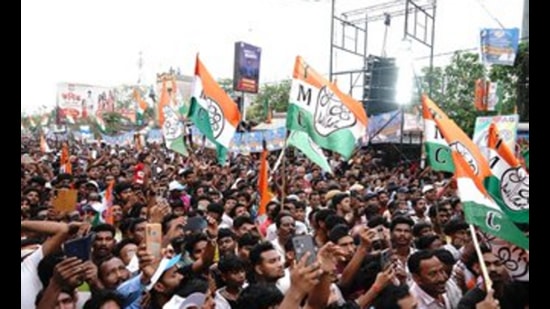
Income Tax Department searches premises of TMC leaders days before Bengal polls| India News
# IT Raids Hit TMC Leaders Before Bengal Polls
By Special Correspondent, India Election Desk
April 17, 2026
**KOLKATA** — Just days before West Bengal voters head to the ballot boxes for the highly anticipated 2026 State Assembly elections, the Income Tax (I-T) Department initiated sweeping, multi-city raids across the residential and commercial premises of several prominent Trinamool Congress (TMC) leaders. Beginning at dawn on Friday, April 17, 2026, central tax enforcement teams, escorted by heavily armed central paramilitary forces, descended upon properties in Kolkata, North 24 Parganas, and Birbhum. Officially described as search and seizure operations targeting unaccounted election funding and tax evasion, the aggressive maneuvers have ignited a political firestorm. The TMC has fiercely condemned the actions, characterizing them as a desperate intimidation tactic by a politically anxious Bharatiya Janata Party (BJP) attempting to manipulate the democratic process.
## Dawn Sweeps Across West Bengal
The operations commenced precisely at 6:00 AM on Friday. According to preliminary reports, coordinated teams of I-T officials simultaneously entered at least twelve locations belonging to mid-level and senior functionaries of the ruling Trinamool Congress. Key locations included high-profile residential complexes in Kolkata’s affluent Salt Lake and Ballygunge areas, as well as multiple rice mills and warehousing facilities in the rural hinterlands of Birbhum and Hooghly districts.
Sources within the Income Tax Department, speaking on the condition of anonymity, indicated that the searches were predicated on “specific intelligence inputs” regarding the alleged hoarding of unaccounted cash intended for illegal distribution during the impending assembly elections. The authorities are reportedly scrutinizing ledgers, digital devices, and financial records linking corporate shell entities to political campaign funding.
While the official figures regarding cash or asset seizures have not been formally declared by the Directorate of Income Tax (Investigation), the visible presence of central forces blockading streets and securing perimeters has dramatically heightened the pre-election tension in the state. The Model Code of Conduct (MCC) is currently in full effect, placing the state’s administrative apparatus under the direct purview of the Election Commission of India (ECI), a factor that makes the deployment of central agencies all the more politically sensitive.
## TMC Cries Foul Over Election Timing
The immediate response from the Trinamool Congress has been one of outrage and vehement condemnation. The party leadership wasted no time in framing the raids as a direct assault on the democratic process, orchestrated directly by the BJP-led Union Government in New Delhi.
**TMC spokesperson Jay Prakash Majumdar firmly questioned the timing of the raids, directly linking them to the lack of people’s support for the BJP in the state.** “These raids are not about rooting out corruption; they are a glaring admission of the BJP’s impending electoral defeat,” Majumdar stated during a hastily convened press conference on Friday morning. “When they realize that the people of Bengal have overwhelmingly rejected their divisive agenda, they deploy their frontal organizations—the ED, CBI, and the Income Tax Department—to harass our leaders and paralyze our election machinery just 72 hours before the first phase of polling.” [Source: Hindustan Times].
The TMC leadership argues that such targeted operations selectively disrupt their campaign logistics, forcing key organizational leaders to deal with interrogations and legal hurdles rather than mobilizing voters. Senior ministers in the Mamata Banerjee cabinet have also pointed to a broader, systemic pattern of central agencies disproportionately targeting opposition leaders nationwide, particularly during crucial electoral cycles.
## The BJP’s Rebuttal: An Anti-Corruption Mandate
In stark contrast, the Bharatiya Janata Party’s state unit has categorically dismissed the TMC’s allegations of political vendetta, asserting instead that the central agencies operate with absolute autonomy and are merely executing their statutory duties to curb black money in elections.
BJP state leadership maintained that corruption remains the central Achilles’ heel of the Mamata Banerjee government. Over the past several years, West Bengal has witnessed numerous high-profile arrests of TMC figures connected to alleged anomalies in teacher recruitment, cattle smuggling, and coal pilferage. The BJP argues that these latest I-T raids are simply the logical continuation of ongoing investigations into systemic financial malfeasance.
“The TMC’s panic is a clear indicator of their guilt,” a senior BJP state committee member noted in a televised debate following the raids. “If their leaders have nothing to hide, they should fully cooperate with the authorities instead of hiding behind the shield of victimhood. The people of West Bengal are exhausted by the institutionalized syndicates, and the recovery of illicit cash only validates our longstanding claims against the ruling dispensation.” [Source: Broad Political Context / Public Statements].
## Contextualizing the 2026 Assembly Elections
To fully grasp the magnitude of these developments, one must look at the immense political stakes of the 2026 West Bengal Assembly Elections. Chief Minister Mamata Banerjee is seeking an unprecedented fourth consecutive term in office. After decisively crushing the BJP’s ambitious push in the 2021 assembly elections with a massive mandate, her government has focused on consolidating its rural base through extensive welfare schemes, particularly cash-transfer programs aimed at women.
However, the political landscape in 2026 presents new challenges. The state government has faced anti-incumbency sentiments fueled by localized corruption scandals and civic grievances. The BJP, eager to avenge its 2021 shortfall and consolidate its gains from previous national elections, views 2026 as a critical frontier in its quest to expand its footprint in eastern India.
The timing of the I-T raids, occurring on the very precipice of the election, introduces a volatile variable into an already deeply polarized environment. Elections in West Bengal are historically fierce, characterized by intense grassroots mobilization and, unfortunately, instances of political violence. The sudden immobilization of district-level leaders through central agency detentions or interrogations can significantly impact the micro-management of booth-level election day strategies.
## A Pattern of Central Agency Interventions
Political analysts point out that Friday’s events do not exist in a vacuum. For the better part of the last decade, opposition parties across India—from the Aam Aadmi Party (AAP) in Delhi to the Bharat Rashtra Samithi (BRS) in Telangana, and the TMC in Bengal—have jointly accused the central government of utilizing the Enforcement Directorate (ED), the Central Bureau of Investigation (C सीबीआई), and the Income Tax Department as arms of the ruling party’s political strategy.
Dr. Arundhati Sen, an independent political scientist based in Kolkata, notes the increasing normalization of pre-poll raids. “What we are witnessing is the blurring of lines between law enforcement and electoral strategy,” Dr. Sen explains. “While the eradication of black money from politics is an essential democratic goal, the exclusive targeting of opposition entities during the crucial final days of campaigning inevitably raises questions about the level playing field. It shifts the public narrative from policy and governance to scandals and raids.”
The Election Commission of India has traditionally maintained that routine investigative procedures by statutory bodies do not inherently violate the Model Code of Conduct, provided they do not involve the public announcement of new government policies. However, opposition blocks have continuously petitioned the ECI to intervene, arguing that such raids materially disadvantage their campaign operations.
## Impact on Voter Sentiment
A critical question remains: How will the electorate respond to this dramatic pre-election development? In West Bengal, voter sentiment is complex and often reacts counter-intuitively to aggressive external interventions.
Historically, Mamata Banerjee has successfully leveraged perceived victimhood, framing actions by the central government as an affront to “Bengali pride” and an attack by “outsiders.” The TMC’s grassroots cadres are already taking to social media and local neighborhoods, utilizing the I-T raids to galvanize their base and generate a sympathy wave, portraying their leadership as martyrs standing up to a draconian central apparatus.
Conversely, the BJP is heavily relying on the anti-corruption narrative to sway the urban middle class and undecided voters who may be fatigued by allegations of local-level extortion and syndicate raj. For these voters, the visual impact of I-T officers seizing documents—and potentially cash—serves as a tangible reminder of the corruption allegations that have shadowed the incumbent government.
## Conclusion: The High-Stakes Road Ahead
As the dust settles on Friday’s extensive search operations, the true political and legal fallout remains to be seen. The Income Tax Department is expected to release a preliminary summary of their findings in the coming days, which will undoubtedly trigger a fresh round of bitter accusations and counter-accusations.
**Key Takeaways:**
* **Strategic Timing:** The occurrence of I-T raids mere days before the 2026 Bengal polls has severely exacerbated tensions between the TMC and the BJP.
* **Political Framing:** While the TMC, articulated by spokesperson Jay Prakash Majumdar, views this as a desperate move by a flailing opposition, the BJP insists it is a necessary crackdown on systemic corruption.
* **Electoral Arithmetic:** The ultimate impact of these raids hinges on whether they succeed in alienating voters from the TMC due to corruption concerns, or if they inadvertently consolidate TMC support through a regional sympathy wave.
In a state where politics is a deeply entrenched, emotive, and high-stakes battle, the April 2026 Income Tax raids will undoubtedly go down as one of the defining flashpoints of this election cycle. As polling day rapidly approaches, the voters of West Bengal find themselves once again at the epicenter of a ferocious clash between regional dominance and national ambitions.





