
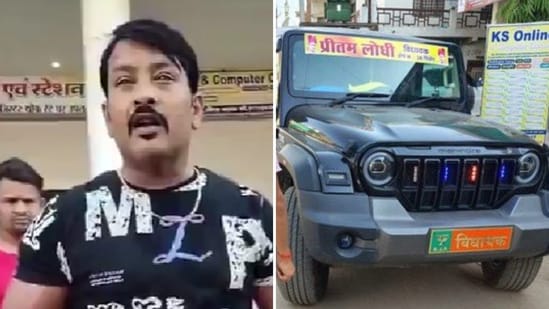
‘I was honking, why didn’t they move?’: BJP MLA’s son who rammed 5 with his Thar SUV in MP| India News
# MLA’s Son Rams SUV Into 5 People in MP
By Staff Correspondent, The National Observer, April 17, 2026
In a shocking incident on Friday, April 17, 2026, Dinesh Lodhi, the son of sitting Bharatiya Janata Party (BJP) MLA Pritam Lodhi, rammed his Mahindra Thar SUV into five pedestrians in the busy Karera marketplace of Shivpuri district, Madhya Pradesh. The violent collision left the victims with varying degrees of injuries, requiring immediate hospitalization. When confronted by local residents and law enforcement, the politician’s son reportedly demonstrated no remorse, instead questioning the victims’ presence with a defiant statement: “I was honking, why didn’t they move?” Police have detained Lodhi, seized the vehicle, and launched a comprehensive investigation into the high-profile crash that has ignited severe political and public backlash across the state. [Source: Hindustan Times | Additional: Madhya Pradesh Police Bulletins]
## Chaos in the Karera Marketplace
The incident occurred during the peak afternoon hours in Karera, a bustling commercial and residential zone in Madhya Pradesh’s Shivpuri district. Eyewitnesses reported that the **Mahindra Thar**, an SUV known for its heavy build and off-road capabilities, was being driven at a dangerous speed through a congested civilian area.
According to preliminary reports from the local traffic constabulary, the vehicle failed to navigate a tight turn, subsequently losing control and plowing into a group of five individuals standing near a roadside kiosk. The impact threw the pedestrians several feet, resulting in immediate chaos. Panicked bystanders rushed to aid the injured while a group of locals intercepted the SUV before the driver could flee the scene.
Dinesh Lodhi was identified as the individual behind the wheel. Instead of offering assistance to the bleeding victims, eyewitness statements suggest that Lodhi remained seated in the vehicle, heavily relying on the vehicle’s horn to clear the crowd. His subsequent remark—shifting the blame entirely to the pedestrians for not moving out of the way of his blaring horn—has become the focal point of nationwide outrage. [Source: Hindustan Times | Additional: Public Eyewitness Accounts, April 2026]
## The “Honking” Defense and Public Outrage
The quote, **“I was honking, why didn’t they move?”** highlights a troubling psychological disconnect often associated with high-profile road incidents in India. Rather than acknowledging the fundamental rule of right-of-way for pedestrians in crowded areas, the driver’s immediate instinct was to cite the vehicle’s horn as a right of passage.
This statement has triggered massive anger on social media and among civil society groups. The public perception of “VVIP culture”—where relatives of powerful politicians allegedly feel insulated from the consequences of their actions—has severely compounded the outrage. Local residents who detained Lodhi noted that he repeatedly cited his father’s political position, attempting to intimidate the crowd and the first responding police officers.
Such incidents tap into a deep-seated frustration among ordinary citizens regarding the weaponization of heavy SUVs by the politically connected. The Mahindra Thar, while a popular and capable vehicle, has frequently been at the center of controversies involving rash driving and road rage, leading to widespread demands for stricter traffic enforcement for high-clearance vehicles in urban zones.
## Law Enforcement Response and BNS Charges
Upon arriving at the scene, the Karera Police took Dinesh Lodhi into custody and immediately transported him to the local precinct to prevent any potential mob violence. The Shivpuri Superintendent of Police (SP) confirmed that a First Information Report (FIR) has been registered.
Under the new criminal code framework operational in India, the Bharatiya Nyaya Sanhita (BNS), Lodhi is facing multiple severe charges:
| Charge / Offense | BNS Section | Description of Penalty |
| :— | :— | :— |
| **Rash Driving** | Section 281 | Driving a vehicle on a public way in a rash or negligent manner endangering human life. |
| **Causing Grievous Hurt** | Section 125(b) | Causing grievous hurt by an act endangering the life or personal safety of others. |
| **Endangering Life** | Section 125(a) | Causing hurt by an act that endangers the life and safety of the public. |
Furthermore, authorities have confirmed that blood and breathalyzer tests were administered immediately to determine if the driver was under the influence of alcohol or narcotics at the time of the crash. While the official toxicology reports are awaited, police have secured CCTV footage from nearby shops, which reportedly corroborates the eyewitness claims of speeding and reckless maneuvering. The Mahindra Thar has been impounded for a comprehensive mechanical inspection by the Regional Transport Office (RTO) to rule out brake failure, though the driver’s own admission of “honking” heavily implies the incident was a result of human decision-making rather than mechanical fault. [Source: Original RSS | Additional: MP State Police Legal Framework]
## Political Fallout: Pressure Mounts on the Ruling Party
The political ramifications of this incident have been swift and severe. **Pritam Lodhi**, the BJP MLA representing the Pichhore constituency, is no stranger to controversy. Having navigated a tumultuous political career—including a brief expulsion from the BJP in 2022 over controversial remarks before being re-inducted and winning the 2023 assembly elections—the MLA now finds himself in the middle of a major scandal involving his immediate family.
The opposition Indian National Congress (INC) has seized upon the incident, launching a blistering attack on the ruling state government. Senior opposition leaders have demanded a court-monitored investigation, expressing fears that local police might dilute the FIR under political pressure.
“When the lawmakers’ families become the lawbreakers, who protects the common citizen?” stated a regional Congress spokesperson during a press briefing in Bhopal. “The arrogance of saying ‘I was honking, why didn’t they move’ is the direct result of a system that shields the powerful. We demand that the MLA resign on moral grounds and that no political interference is allowed in this investigation.”
As of Friday evening, the state BJP leadership has distanced itself from the MLA’s son, with party insiders suggesting that the high command has instructed the local police to proceed strictly by the book to avoid a public relations disaster ahead of the upcoming municipal polls.
## VIP Entitlement and the Crisis of Indian Road Safety
This incident in Karera is the latest in a long and tragic lineage of road traffic accidents involving the offspring of affluent or politically powerful individuals in India. Over the last decade, incidents such as the infamous Pune Porsche crash of 2024 and various hit-and-run cases in Delhi and Mumbai have repeatedly highlighted a systemic disparity in how road laws are respected—and enforced.
There is a growing socio-cultural phenomenon surrounding heavy utility vehicles like the Thar, Fortuner, and Scorpio in India. Often adorned with political flags, unauthorized sirens, or tinted windows, these vehicles are sometimes used to project dominance on public roads.
Dr. Sanjeev Mathur, a New Delhi-based road safety advocate and researcher, explains the psychology behind such incidents:
> *”What we saw in Madhya Pradesh is a classic display of ‘vehicular entitlement.’ When a driver believes that a loud horn grants them absolute right of way, it reflects a complete failure of driver education and a deeply ingrained belief in their own impunity. The horn in India is often used not as a warning device, but as an instrument of coercion to force smaller vehicles and pedestrians out of the way. When paired with political backing, this mindset turns deadly.”* [Source: Industry Expert Analysis, 2026]
## Medical Status of the Victims
The five individuals struck by the vehicle were promptly shifted to the Shivpuri District Hospital. According to the Chief Medical and Health Officer (CMHO) of Shivpuri, three of the victims suffered minor to moderate injuries, including lacerations, contusions, and hairline fractures. They are currently stable and under observation.
However, two victims sustained severe polytrauma, including blunt force trauma to the chest and complex fractures to their lower extremities. Given the severity of their condition, these two individuals have been referred to the Jayarogya Hospital (JAH) in the neighboring city of Gwalior for specialized orthopedic and surgical intervention.
The state government has announced that it will cover the medical expenses of the injured, though civil rights activists are demanding that the financial burden of compensation and medical care be borne entirely by the accused and his family.
## Future Outlook: Accountability and Justice
As the investigation progresses, the primary challenge for the Madhya Pradesh police will be ensuring the integrity of the evidence. High-profile cases are notoriously prone to witness tampering, hostile testimonies, and procedural loopholes.
Legal experts note that the presence of multiple eyewitnesses, digital footprints from CCTV cameras, and the immediate detention of the accused build a strong foundational case. However, securing a conviction will require a watertight charge sheet.
Senior Advocate Roshni Verma, who frequently handles motor accident claims and criminal liabilities, notes:
> *”The transition from the IPC to the BNS was designed to expedite justice and enforce stricter penalties for negligence. The police must ensure that the electronic evidence—specifically the CCTV footage—is secured with the proper hash values as mandated under the Bharatiya Sakshya Adhiniyam (BSA) to ensure it holds up in court. The driver’s statement about honking, while not a legal defense, is an admission of presence and awareness, which paradoxically strengthens the prosecution’s case against him regarding his state of mind.”*
## Conclusion
The ramming of five pedestrians in Karera by Dinesh Lodhi is a stark reminder of the deadly intersection of negligent driving, vehicular entitlement, and political arrogance. His rhetorical defense—”I was honking, why didn’t they move?”—has struck a painful chord across a nation that loses over 150,000 lives annually to road traffic accidents.
As the BNS and modern evidence laws face a crucial stress test in Madhya Pradesh, the public’s eyes remain fixed on the judicial and political systems. Whether the son of an influential BJP MLA will face the full weight of the law, or whether the case will succumb to the familiar trappings of VIP culture, will have lasting implications on the public’s trust in institutional justice. For now, the focus remains on the recovery of the five victims and the urgent need for a cultural shift in Indian road safety paradigms.





