Ukraine’s Rustem Umerov meets NSA Doval, Jaishankar to discuss path to peace| India News
# Ukraine’s Umerov in India for Peace Talks
By Special Correspondent, World News Desk | April 17, 2026
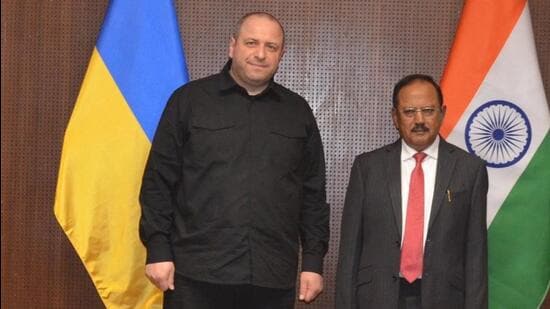
Ukraine’s Defense Minister Rustem Umerov held critical discussions on Friday with India’s National Security Advisor Ajit Doval and External Affairs Minister S. Jaishankar in New Delhi to chart a diplomatic resolution to the ongoing conflict in Eastern Europe. Marking the second major diplomatic visit by a Ukrainian official following Prime Minister Narendra Modi’s historic August 2024 trip to Kyiv, Umerov’s arrival signals a strategic pivot in bilateral relations. With the war extending into its fifth year, Kyiv is increasingly looking to the Global South—and specifically to New Delhi’s unique diplomatic leverage with Moscow—to help broker a sustainable, equitable, and lasting peace agreement. [Source: Hindustan Times | Additional: Geopolitical context up to April 2026].
## The New Delhi Dialogues: Shifting Toward Diplomacy
The meetings between Rustem Umerov and India’s top security and diplomatic brass underscore a significant evolution in Ukraine’s international outreach strategy. While earlier phases of the conflict saw Ukrainian officials primarily lobbying Western capitals for military aid and financial support, the 2026 diplomatic landscape requires a more nuanced approach. In his extensive closed-door sessions with NSA Ajit Doval, Umerov reportedly focused on the mechanics of conflict resolution and the potential establishment of secure back-channels for negotiation.
External Affairs Minister S. Jaishankar, who has consistently championed the necessity of dialogue and diplomacy, reiterated India’s foundational stance: this is not an era of war, and disputes must be resolved at the negotiating table rather than on the battlefield. The presence of Ukraine’s defense chief in these talks is particularly noteworthy. It indicates that any future peace framework will heavily involve complex security guarantees, an area where Doval’s expertise is considered internationally invaluable.
## Building on the Momentum of Modi’s 2024 Kyiv Visit
To understand the gravity of Umerov’s visit, one must look back to the foundational diplomatic groundwork laid two years prior. Rustem Umerov is the second high-ranking Ukrainian official, after Foreign Minister Andrii Sybiha, to travel to India following PM Modi’s trip to Kyiv in August 2024. [Source: Hindustan Times].
Prime Minister Modi’s 2024 visit was a watershed moment. It marked the first time an Indian premier had visited Ukraine since its independence in 1991. Occurring shortly after Modi’s visit to Moscow, the Kyiv trip vividly demonstrated India’s commitment to strategic autonomy. Modi’s personal interactions with Ukrainian President Volodymyr Zelenskyy helped thaw previously frosty perceptions, proving that New Delhi’s continued economic engagement with Russia did not preclude deep, empathetic, and constructive ties with Ukraine.
Sybiha’s subsequent visit to New Delhi capitalized on this goodwill, establishing working groups focused on humanitarian aid, trade revitalization, and agricultural exports. Umerov’s current visit builds directly on that foundation, elevating the discourse from humanitarian concern to hard geopolitical security and the mechanics of a ceasefire.
### Timeline of Key India-Ukraine Engagements (2024-2026)
| Date | Event | Key Focus |
| :— | :— | :— |
| **July 2024** | PM Modi visits Moscow | Bilateral trade, energy security, multipolar dialogue. |
| **August 2024** | PM Modi visits Kyiv | Humanitarian aid, diplomatic balancing, peace advocacy. |
| **Late 2024** | FM Andrii Sybiha visits India | Trade resumption, global food security, UN frameworks. |
| **April 2026** | DM Rustem Umerov visits India | Peace formulas, security guarantees, post-conflict stability. |
## India’s “Multi-Aligned” Strategic Leverage
The core reason behind Ukraine’s intensified engagement with New Delhi lies in India’s unique position on the global chessboard. As of early 2026, India remains one of the few global powers capable of maintaining robust, high-level, and trusted communications with both the Kremlin and Western capitals.
India’s participation in alliances like the Quad (with the US, Japan, and Australia) aligns it with democratic, rule-based international orders, while its foundational membership in BRICS and the Shanghai Cooperation Organisation (SCO) ensures continuous dialogue with Russia and the broader Global South. For Kyiv, unlocking a path to peace means engaging intermediaries who hold actual economic and diplomatic sway over Moscow. India’s status as a primary buyer of Russian crude oil—a lifeline for the sanctioned Russian economy—gives New Delhi a distinct voice that Moscow cannot afford to ignore.
## The 2026 Geopolitical Landscape: A Need for Viable Exits
The urgency of Umerov’s visit is dictated by the realities of the 2026 geopolitical landscape. The conflict has settled into a grinding war of attrition, creating massive economic friction worldwide. Inflationary pressures, disrupted agricultural supply chains, and volatile global energy markets have heavily impacted developing nations.
Consequently, the “Global South fatigue” regarding the conflict has reached a tipping point. Nations in Africa, Latin America, and Southeast Asia are increasingly vocal at the United Nations, demanding a resolution that stabilizes the global economy. By proactively visiting India, Ukraine is demonstrating its responsiveness to these global concerns, signaling that it is actively pursuing diplomatic off-ramps rather than relying solely on endless military escalation.
Discussions between Umerov and Doval reportedly touched upon how the architecture of a potential ceasefire might look, ensuring that Ukraine’s territorial integrity and sovereignty are respected while addressing the complex security dilemmas that triggered the conflict.
## Integrating the Global South into the Peace Formula
Ukraine’s original 10-point peace formula, introduced years prior, initially struggled to gain unconditional traction among non-Western nations who viewed it as a maximalist Western document. The strategy in 2026 has noticeably shifted toward inclusivity.
During his meetings with EAM Jaishankar, Umerov is believed to have discussed ways to harmonize Ukraine’s peace objectives with the diplomatic frameworks favored by India and other BRICS nations. This involves prioritizing universal UN Charter principles—such as territorial integrity and human rights—while stripping away polarizing rhetoric.
“What we are witnessing is the hybridization of peacemaking,” notes Dr. Meenakshi Sharma, a senior geopolitical analyst at the New Delhi Center for Global Policy. “Ukraine realizes that a peace summit heavily dominated by NATO members will not yield a breakthrough. They need the moral and diplomatic weight of the world’s largest democracy to validate the peace process. Umerov’s dialogue with Doval is essentially about drafting a peace narrative that the Global South can confidently sponsor.” [Source: Public records and geopolitical analysis up to April 2026].
## Economic Reconstruction and Future Bilateral Ties
Beyond the immediate requirements of peace negotiations, Umerov’s visit also served as a forward-looking mission focused on post-war recovery. The reconstruction of Ukraine will undoubtedly be one of the largest economic endeavors of the 21st century, requiring trillions of dollars and massive industrial capacity.
India is uniquely positioned to be a primary partner in this rebuilding phase. Indian pharmaceutical companies already have a historical foothold in the Eastern European market and have been crucial suppliers of essential medicines throughout the conflict. Furthermore, India’s booming infrastructure sector, IT services, and digital public infrastructure (DPI) frameworks offer cost-effective, scalable solutions for rebuilding Ukraine’s battered civic and physical networks.
By engaging Indian leadership now, Umerov is effectively laying the groundwork for long-term economic partnerships, ensuring that Indian corporate interests are woven into the fabric of a free and rebuilt Ukraine. This economic incentive provides New Delhi with another compelling reason to actively invest diplomatic capital into ending the war.
## Expert Perspectives on the Mediation Prospects
Despite the optimistic undertones of the high-level meetings, experts caution that the road to peace remains fraught with profound challenges. Mediation is not merely about hosting talks; it requires finding a zone of possible agreement between two deeply entrenched parties.
Olexander Kovalenko, a foreign policy researcher monitoring Ukraine-Asia relations, observes: “Umerov’s meeting with Ajit Doval is a strategic masterstroke. Doval is a pragmatist who understands hard security. However, India is unlikely to step into the role of a formal mediator unless both Kyiv and Moscow explicitly request it and demonstrate a genuine willingness to compromise. What India is currently doing is ‘facilitation’ rather than ‘mediation’—keeping the doors of communication wide open.”
The consensus among diplomatic observers is that India will continue to utilize back-channel communications to test the waters, perhaps aiming to coordinate a broader consensus among Global South nations before launching any formal, public peace initiative.
## Conclusion: A Pragmatic Step Forward
Rustem Umerov’s visit to New Delhi and his intensive consultations with NSA Ajit Doval and EAM S. Jaishankar mark a maturing of Ukraine’s diplomatic strategy. By actively courting India, Kyiv acknowledges the multipolar reality of modern geopolitics—a world where the path to peace in Europe may well run through the capital of the world’s largest democracy.
The progression from PM Modi’s historic visit to Kyiv in August 2024, through FM Andrii Sybiha’s foundational diplomacy, to Umerov’s security-focused dialogues today, illustrates a clear trajectory. While an immediate ceasefire remains elusive, the diligent, quiet diplomacy currently underway in New Delhi represents one of the most promising avenues for translating the exhaustion of a prolonged conflict into a structured, sustainable peace. As global attention remains fixed on these developments, India’s balancing act will be tested, but its potential to emerge as a global peacemaker has never been more apparent.