
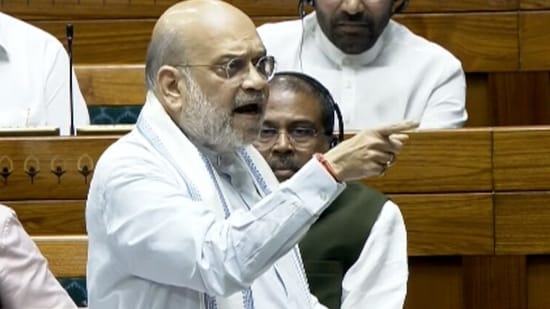
‘Insult to Nari Shakti’: Amit Shah fumes at opposition as women's reservation amendment fails in Lok Sabha| India News
# Shah Fumes as Women’s Quota Bill Fails
**By Special Correspondent, National News Desk** | **April 18, 2026**
On Friday evening in New Delhi, the Lok Sabha witnessed high-stakes political drama as a crucial constitutional amendment aimed at expediting the 33% reservation for women in legislative bodies failed to secure the necessary two-thirds majority. Union Home Minister Amit Shah launched a blistering attack on the Congress party and its allies, accusing the opposition of deliberately sabotaging the landmark legislation. Characterizing the defeat as a profound “insult to Nari Shakti” (women’s power), Shah argued that the opposition prioritizes political posturing over gender parity. The failure of this amendment stalls a vital mechanism meant to reshape the demographic makeup of Indian politics, raising urgent questions about when true legislative equality will be realized. [Source: Hindustan Times | Additional: Parliamentary Public Records].
## The Floor Defeat and Shah’s Fierce Rebuttal
The proceedings in the Lower House on April 17, 2026, were marked by raucous debate and parliamentary maneuvering. Because the proposed legislation involved altering constitutional mechanisms regarding electoral delimitation and seat allocation, it required a special majority—specifically, the support of two-thirds of the members present and voting, in addition to a simple majority of the total membership of the House.
When the electronic voting concluded, the ruling National Democratic Alliance (NDA) fell short of the requisite numbers, primarily due to a coordinated abstention and opposing votes from the INDIA bloc.
Addressing the media immediately after the session, an irate Amit Shah did not mince words. “Today is a dark day for the democratic empowerment of women in our country,” Shah stated. “The Congress and its alliance partners have unmasked their true, anti-women faces. By blocking the passage of this essential constitutional amendment, they have committed a grave insult to Nari Shakti. They have proven that their commitment to women’s empowerment is confined to empty slogans, not legislative action.” [Source: Hindustan Times].
Shah further emphasized that the government had brought forward the amendment in good faith to remove bureaucratic and logistical hurdles that have long delayed the implementation of the quota. He accused the opposition of moving the goalposts and holding the political futures of millions of Indian women hostage for narrow electoral gains.
## The Long Road of the Nari Shakti Vandan Adhiniyam
To understand the gravity of Friday’s legislative impasse, one must look at the protracted history of the Women’s Reservation Bill. The concept of reserving one-third of seats for women in the Lok Sabha and state legislative assemblies has been a contentious issue in Indian politics for nearly three decades.
**Key Milestones in the Women’s Quota Journey:**
* **1996:** The bill was first introduced by the HD Deve Gowda-led United Front government but lapsed due to a lack of consensus.
* **2010:** The Manmohan Singh-led UPA government successfully passed the bill in the Rajya Sabha, but it never saw the light of day in the Lok Sabha due to fierce opposition from coalition partners demanding sub-quotas.
* **2023:** In a historic special session, the Modi government passed the *Nari Shakti Vandan Adhiniyam* (106th Constitutional Amendment Act), securing near-unanimous support.
* **The Catch:** The 2023 Act stipulated that the 33% reservation would only come into effect *after* the next census was published and a subsequent delimitation (redrawing of constituency boundaries) exercise was completed.
The amendment introduced in April 2026 was widely seen as an attempt by the NDA government to decouple the immediate implementation of the quota from the highly complex and politically sensitive delimitation exercise. With the constitutional freeze on delimitation set to lift post-2026, the government sought a transitional mechanism to fast-track women’s reservations for the upcoming electoral cycles.
## The Opposition’s Stance: The Demand for Sub-Quotas
Despite the optical risk of voting against a women’s empowerment bill, the opposition INDIA bloc stood firm, arguing that their objection was not against women’s reservation, but against the structural inequities within the government’s proposed framework.
The primary point of contention remains the demand for a “quota within a quota.” Opposition leaders have vehemently argued that a blanket 33% reservation for women will disproportionately benefit women from privileged, upper-caste, and urban backgrounds, further marginalizing women from Other Backward Classes (OBCs) and minority communities.
“The Home Minister’s accusations are nothing but political grandstanding,” a senior Congress spokesperson stated following Shah’s remarks. “We have consistently demanded that the Women’s Reservation Bill must include a sub-quota for OBC women. Implementing this sweeping demographic change without a caste census and without protecting the representation of marginalized women is fundamentally flawed. The government refused to incorporate these amendments, making this bill a half-measure designed for headlines rather than real social justice.” [Source: Public Statements/Parliamentary Debates].
Furthermore, regional parties from southern India have expressed profound anxiety over the delimitation process itself. Because population control measures have been more successful in the South, leaders fear that a delimitation exercise based on fresh census data will drastically reduce their political representation in the Lok Sabha, shifting power heavily to the more populous northern states. The entanglement of women’s reservation with the delimitation debate has thus created a multi-layered constitutional deadlock.
## Expert Perspectives on the Legislative Impasse
Political analysts suggest that Friday’s events highlight the deep fault lines in India’s ongoing quest for social engineering and equitable representation. The failure of the amendment is expected to have significant ripple effects on the national political discourse.
Dr. Arundhati Menon, a constitutional law expert and senior fellow at the Institute for Democratic Studies in New Delhi, noted the tactical nature of the vote. “What we witnessed in the Lok Sabha is a classic example of complex intersectionality paralyzing legislative progress,” Dr. Menon explained. “The NDA wanted a major victory to showcase their commitment to gender parity ahead of upcoming state elections. The opposition, conversely, could not afford to alienate their core OBC voter base by endorsing a bill that ignores the sub-quota demand. Both sides are now going to fiercely contest the narrative of who exactly betrayed Indian women.”
Dr. Vikram Desai, a political sociologist, emphasized the demographic reality of the Indian electorate. “Women are no longer a passive demographic; they are an independent, highly mobilized voting bloc. In several recent state elections, female voter turnout has surpassed male turnout. The government will leverage Amit Shah’s ‘Insult to Nari Shakti’ narrative to paint the opposition as regressive. However, if the opposition successfully communicates that they were protecting the rights of marginalized OBC women, it could neutralize the government’s attack.” [Source: Independent Expert Analysis].
## Impact on State Elections and Female Voters
The immediate fallout of this legislative failure will be felt in the upcoming slate of state assembly elections scheduled for late 2026 and early 2027. Political parties across the spectrum have increasingly relied on women-centric welfare schemes—from direct cash transfers to subsidized cooking gas and free public transit—to court female voters.
The promise of 33% legislative reservation was meant to be the crown jewel of the NDA’s outreach to women. With the amendment stalled, the ruling party is pivoting to a strategy of assigning blame. Amit Shah’s swift and severe condemnation indicates that the Bharatiya Janata Party (BJP) intends to make the opposition’s blockage a central campaign issue.
Conversely, the opposition strategy will heavily rely on rural outreach, explaining the nuances of the OBC sub-quota demand. They aim to convince voters that true Nari Shakti encompasses all strata of society, particularly the most vulnerable, and cannot be achieved through homogenized legislation that favors the elite.
Currently, women make up only about 14% to 15% of the Lok Sabha—a figure that, while an improvement from past decades, places India behind several developing nations in terms of gender parity in national legislatures. The failure to pass Friday’s amendment means that a significant leap forward in closing this gap remains indefinitely paused.
## What Lies Ahead for Women in Indian Politics?
The defeat of the fast-track amendment leaves the original *Nari Shakti Vandan Adhiniyam* intact, but inextricably chained to the slow-moving wheels of the decadal census and the politically volatile delimitation process. Without a constitutional bypass, the actual seating of a Lok Sabha where one in three members is a woman may not materialize until the general elections of 2029, or potentially even 2034, depending on administrative delays.
In the short term, both political factions will embark on intense public relations campaigns. The government will likely continue to amplify Home Minister Amit Shah’s narrative, framing the opposition as anti-women obstructionists. Meanwhile, the INDIA bloc will double down on its demand for a comprehensive caste census, portraying itself as the true champion of marginalized communities.
Ultimately, the events of April 17, 2026, serve as a stark reminder that while the idea of women’s empowerment enjoys broad rhetorical consensus in India, the practical mechanics of sharing political power remain fiercely contested. Until a consensus is forged that addresses both gender parity and caste-based intersectionality, the promise of true Nari Shakti in India’s highest legislative halls will remain a delayed dream.