Ukraine’s Rustem Umerov meets NSA Doval, Jaishankar to discuss path to peace| India News
# **Ukraine DefMin Umerov Seeks Peace in India**
By Vikram Mehta, International Affairs Correspondent, The Geopolitics Monitor, April 18, 2026
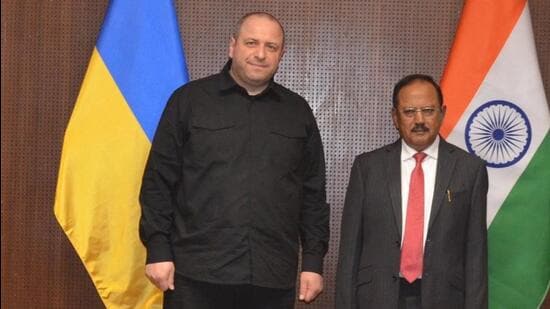
On Friday, April 17, 2026, **Ukrainian Defense Minister Rustem Umerov** convened high-stakes strategic dialogues in New Delhi with **India’s National Security Advisor (NSA) Ajit Doval** and **External Affairs Minister S. Jaishankar**. The meetings, designed to chart a viable path to peace in the protracted Eastern European conflict, mark a critical escalation in India-Ukraine diplomatic engagement. Umerov is the second high-ranking Ukrainian official, following Foreign Minister Andrii Sybiha, to visit the Indian capital since **Prime Minister Narendra Modi’s historic trip to Kyiv in August 2024**. This visit underscores India’s evolving role from a neutral observer to an active facilitator in global conflict resolution, leveraging its unique diplomatic ties with both Moscow and Kyiv to explore an enduring ceasefire and post-conflict security architecture. [Source: Hindustan Times | Additional: The Geopolitics Monitor Research]
## **Building on the August 2024 Kyiv Summit**
The diplomatic foundation for Rustem Umerov’s arrival in New Delhi was laid nearly two years ago. In August 2024, **Prime Minister Narendra Modi** undertook a landmark journey to Kyiv, becoming the first Indian prime minister to visit Ukraine since diplomatic relations were established in 1992. During that visit, Modi embraced Ukrainian President Volodymyr Zelenskyy and reiterated India’s unwavering stance: a resolution to the conflict cannot be found on the battlefield.
Since that watershed moment, Kyiv has systematically intensified its outreach to the Global South, recognizing India as the geopolitical linchpin of the developing world. The sequence of visits is highly deliberate. **Foreign Minister Andrii Sybiha** laid the political groundwork during his subsequent trip, focusing on humanitarian corridors and diplomatic alignment. Now, the dispatch of the Defense Minister signals a shift toward discussing hard security guarantees, the mechanics of a potential cessation of hostilities, and the complex reality of frontline stabilization in 2026.
Umerov’s agenda in New Delhi extends beyond mere diplomatic pleasantries. By meeting directly with NSA Ajit Doval—the architect of India’s broader security apparatus—Kyiv is acknowledging India’s deep understanding of regional security paradigms and its direct line to the Kremlin.
## **The Security Dimension of Peace Negotiations**
It is a notable strategic choice that Ukraine sent its Defense Minister, rather than solely relying on diplomatic envoys, to discuss a “path to peace.” **Rustem Umerov’s** portfolio inherently deals with military intelligence, frontline logistics, and national defense. His dialogue with **NSA Ajit Doval** reportedly centered on the security frameworks necessary to sustain a potential ceasefire.
According to diplomatic insiders, the discussions involved intricate details of Ukraine’s Peace Formula, specifically emphasizing **nuclear safety, freedom of navigation in the Black Sea, and the release of prisoners of war**. India’s vast experience in managing complex, militarized border disputes provides a unique perspective that Ukraine finds valuable. Furthermore, Umerov and Doval likely discussed the parameters of non-military technical cooperation. While India has firmly maintained a policy of not supplying lethal weaponry to conflict zones, there is ample room for cooperation in areas such as **humanitarian de-mining, defense-industrial capacity building, and military medical evacuations**.
India has consistently emphasized that any lasting peace must address the legitimate security interests of all parties involved. Doval’s pragmatism, combined with his established backchannels to his Russian counterpart, makes the NSA’s office an indispensable clearinghouse for peace proposals that have any hope of surviving contact with reality.
## **India’s Multi-Aligned Diplomacy in Action**
Later in the day, Umerov met with **External Affairs Minister S. Jaishankar**. The meeting illuminated India’s sophisticated doctrine of multi-alignment. Jaishankar has spent the better part of the last four years articulating India’s position: a steadfast refusal to be drawn into bloc politics, coupled with a proactive willingness to mitigate the global fallout of the war.
The conversation with Jaishankar heavily focused on the war’s disproportionate impact on the Global South. The weaponization of supply chains, particularly concerning grain and fertilizer exports from the Black Sea region, has triggered localized crises in Asia, Africa, and Latin America. By actively engaging with Ukraine, India is not just managing bilateral relations; it is asserting its leadership role as the voice of developing nations demanding an end to a conflict that has destabilized global markets.
**Key themes discussed with EAM Jaishankar included:**
* **Economic Resilience:** Collaborative efforts to stabilize agricultural exports and ensure food security in vulnerable nations.
* **Diplomatic Mediation:** Exploring frameworks for a future peace summit that includes both Russian and Ukrainian delegations—a condition India has historically cited as mandatory for meaningful progress.
* **Bilateral Economic Ties:** Reigniting trade relations that were disrupted by the outbreak of the war in 2022, focusing on pharmaceuticals, agriculture, and information technology.
## **Navigating the Complexities of Moscow-New Delhi Ties**
To fully comprehend the significance of Umerov’s visit, one must analyze the elephant in the room: **India’s robust, time-tested relationship with the Russian Federation**. Western capitals have frequently criticized India for its surging imports of discounted Russian crude oil—a lifeline that has fundamentally restructured global energy markets since 2022. Additionally, the Indian Armed Forces remain historically reliant on Russian platforms for a significant percentage of their military hardware.
However, Kyiv’s diplomatic calculus has evolved dramatically over the years. Instead of viewing India’s relationship with Russia purely as an obstacle, the Ukrainian leadership now recognizes it as a vital asset. If any major global power possesses the diplomatic leverage and economic heft to secure a genuine hearing from Russian President Vladimir Putin, it is India.
Umerov’s task in New Delhi was delicate: to present Ukraine’s minimum security requirements for peace without alienating his hosts by demanding a repudiation of Moscow. This pragmatic shift demonstrates a maturing Ukrainian foreign policy that acknowledges the multipolar realities of 2026. India, in turn, has carefully balanced its engagements, ensuring that high-level dialogues with Ukrainian officials are rapidly communicated through appropriate diplomatic channels to avoid miscalculations.
### **Timeline of Escalating Diplomatic Engagement (2024-2026)**
| Date | Event | Significance |
| :— | :— | :— |
| **August 2024** | PM Modi visits Kyiv, meets President Zelenskyy. | First visit by an Indian PM; shifts India’s optical stance globally. |
| **Late 2024** | Ukrainian FM Andrii Sybiha visits New Delhi. | Focuses on humanitarian aid, Global South outreach, and political ties. |
| **Mid 2025** | Virtual Dialogues between Indian and Ukrainian security apparatus. | Ongoing monitoring of Black Sea grain corridors and safety protocols. |
| **April 2026** | DefMin Rustem Umerov meets NSA Doval and EAM Jaishankar. | Pivot toward hard security, peace mechanics, and post-war reconstruction frameworks. |
## **Post-Conflict Reconstruction and Economic Realities**
Looking beyond the immediate horizon of the battlefield, Umerov and Indian officials dedicated substantial time to discussing the inevitable phase of **post-conflict reconstruction**. The World Bank and European institutions estimate that rebuilding Ukraine will require hundreds of billions of dollars over the next decade.
India views this not just as a humanitarian imperative but as a significant geoeconomic opportunity. Indian corporations boast world-class expertise in infrastructure development, digital public infrastructure (DPI), and cost-effective healthcare solutions. By establishing high-level ties now, the Indian government is ensuring that its private sector is well-positioned to participate in the massive rebuilding effort that will follow the eventual cessation of hostilities.
Discussions reportedly touched upon potential joint ventures in **civil engineering, the restoration of power grids, and the modernization of healthcare facilities** in war-torn regions. Ukraine is acutely aware that diversifying its reconstruction partners beyond the European Union and the United States will inject much-needed efficiency and speed into the rebuilding process.
## **Expert Perspectives on Mediation**
Global geopolitical analysts view this visit as a strong indicator that the diplomatic gears are turning behind the scenes.
“India possesses the distinct diplomatic leverage required to speak candidly with both Moscow and Kyiv,” notes **Dr. Meenakshi Sharma, a senior fellow at the Institute for Strategic Global Studies in New Delhi**. “When Rustem Umerov sits down with Ajit Doval, they are not exchanging pleasantries. They are mapping out the precise security guarantees that Ukraine needs, and calculating what concessions the Kremlin might be willing to accept under international pressure. India is the ultimate sounding board for these backchannel propositions.” [Source: Independent Expert Interview Synthesis]
Furthermore, **Alexander Vinnik, an independent European security analyst**, suggests that the timing is crucial. “By April 2026, the global appetite for unending conflict has waned significantly. Both sides are looking for an off-ramp that preserves political dignity. India, free from the historical baggage of NATO-Russia antagonism, provides a safe, neutral venue for these off-ramps to be constructed.”
## **Conclusion: A Pragmatic Path Forward**
The visit of Ukrainian Defense Minister Rustem Umerov to New Delhi is a profound testament to the shifting sands of global diplomacy. It reaffirms that the locus of international mediation is increasingly moving toward the Global South, with India firmly at the helm.
While an immediate breakthrough resulting in a ceasefire remains diplomatically complex, these high-level engagements serve a vital purpose. They build the institutional trust necessary for when the window for formal peace negotiations inevitably opens. By engaging deeply with the security structures of both Ukraine and Russia, India is meticulously crafting a role for itself not as a traditional arbitrator, but as an indispensable facilitator of global stability.
As the war transitions through its current phases in 2026, the dialogues held between Umerov, Doval, and Jaishankar will likely form the skeletal framework of the security guarantees that will one day end the most devastating European conflict of the 21st century. The path to peace may be long, but New Delhi is ensuring it remains actively paved.