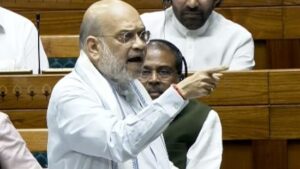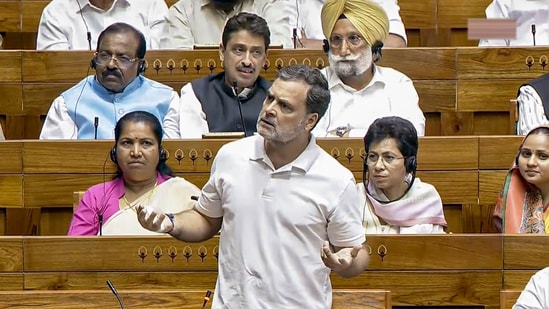
'India seen it. INDIA stopped it': Rahul Gandhi as women's quota bill fails in Lok Sabha| India News
# Women’s Quota Amendment Fails in Lok Sabha
By Editorial Desk, National News Observer, April 17, 2026.
In a dramatic parliamentary showdown on Friday night, a crucial amendment to the Women’s Reservation Bill failed to secure the requisite majority in the Lok Sabha. The failure of the legislation, intended to modify the implementation framework of the landmark quota, sparked intense political recriminations. Opposition leader Rahul Gandhi immediately claimed victory for the INDIA coalition, accusing the ruling government of attempting to push through an “unconstitutional trick” under the guise of female empowerment. The deadlock leaves the immediate implementation timeline of the 33% legislative reservation for women in legislative bodies in a state of deep uncertainty.
## The Floor Test and Immediate Political Fallout
The atmosphere inside the lower house of India’s Parliament was electric on Friday, April 17, 2026, as the government tabled a highly anticipated amendment to the existing Nari Shakti Vandan Adhiniyam (Women’s Reservation Act). Because the legislation involved constitutional alterations, it required a special majority—two-thirds of the members present and voting, alongside an absolute majority of the total house strength.
As the digital voting boards lit up, it became evident that the ruling National Democratic Alliance (NDA) could not fracture the united front of the opposition INDIA bloc. The bill failed to cross the constitutional threshold.
Within minutes of the vote, Congress leader Rahul Gandhi took to social media to frame the legislative defeat as a protective victory for India’s democratic framework. Playing on the acronym of the opposition alliance, Gandhi wrote, “India seen it. INDIA stopped it.” He further elaborated on his stance, stating, “The amendment bill has fallen. They used an unconstitutional trick in the name of women to break the Constitution.” [Source: Hindustan Times].
The assertion by Gandhi reflects a broader opposition narrative that the ruling party was weaponizing a universally supported concept—women’s political representation—to smuggle in controversial constitutional changes.
## Understanding the “Unconstitutional Trick” Allegations
To understand the failure of the 2026 amendment, one must examine the specific riders attached to the proposed legislation. When the original Women’s Reservation Bill was passed in 2023, its implementation was fundamentally tethered to two future events: the completion of the decadal census and the subsequent delimitation (redrawing) of parliamentary constituencies.
The 2026 amendment, ostensibly introduced to “fast-track” the quota ahead of the next general election cycle, contained clauses that the opposition argued fundamentally altered the federal structure of the Constitution.
According to parliamentary drafts debated on the floor, the amendment proposed a revised formula for delimitation that would bypass certain demographic safeguards. Opposition leaders argued that this formula would disproportionately penalize Southern Indian states, which have successfully controlled their population growth, by reducing their proportional representation in the Lok Sabha.
Furthermore, the INDIA bloc alleged that the amendment contained language that centralized the power of the Election Commission in deciding reserved seats, removing state-level oversight. By packaging these deeply contentious federal alterations with the broadly popular women’s quota, the opposition argued the government was attempting a legislative Trojan horse—forcing opponents to either swallow the centralization of power or face the optics of voting against women’s rights.
## The Government’s Counter-Narrative
The ruling government responded to the bill’s defeat with fierce condemnation of the INDIA coalition, accusing them of historic hypocrisy. Government spokespersons argued that the amendment was a genuine, legally sound effort to decouple the women’s reservation from the prolonged delays of the census data collection.
“The opposition has once again demonstrated that their commitment to women’s empowerment is purely rhetorical,” a senior cabinet minister stated during a press briefing outside Parliament late Friday night. “When presented with a concrete legislative pathway to ensure 33% reservation for our mothers and sisters in the very next election cycle, the INDIA bloc chose political obstructionism over national progress.”
The ruling party maintains that the delimitation clauses were standard procedural updates necessary to ensure the quotas were applied evenly across varying demographic distributions. They dismissed Rahul Gandhi’s claims of an “unconstitutional trick” as fear-mongering intended to mask the opposition’s inability to support decisive governance. [Additional Source: Public Parliamentary Broadcasts, April 2026].
## Expert Analysis on the Constitutional Stalemate
The failure of the amendment highlights a growing friction point in Indian federalism. Independent constitutional analysts point out that linking women’s reservation to the delimitation exercise was always going to be a legislative minefield.
Dr. Arundhati Menon, a senior fellow at the Center for Policy Research in New Delhi, explains the complexity: “The core issue is not the women’s quota itself, which enjoys rare bipartisan consensus. The issue is the mechanism of implementation. Any constitutional amendment that touches upon the proportional representation of states requires delicate consensus-building. By attempting to push through a new delimitation framework as a sub-clause of a women’s rights bill, the government risked exactly this type of polarization.”
Legal experts also note that the constitutional requirements for passing such an amendment mean that no single coalition can force it through without cross-aisle cooperation. “A special majority demands a cooperative parliamentary environment,” notes Supreme Court advocate Rajesh Iyer. “When the opposition suspects that a bill compromises the basic structure of federal representation—which Gandhi referred to as ‘breaking the Constitution’—they are compelled to block it, regardless of the political cost of appearing anti-quota.”
## Historical Context of the Women’s Reservation Struggle
The journey toward securing a 33% legislative quota for women in India has been fraught with decades of false starts and broken promises.
**Timeline of the Quota Legislative Efforts:**
* **1996:** The initial Women’s Reservation Bill is introduced but lapses due to a lack of consensus.
* **2010:** The Rajya Sabha passes the bill, but it is never tabled in the Lok Sabha.
* **2023:** Parliament officially passes the Nari Shakti Vandan Adhiniyam, making the 33% reservation a law. However, its implementation is deferred pending the next census and subsequent delimitation.
* **2025:** Delays in the census spark political debates regarding when the quota will actually see the light of day.
* **April 2026:** The government introduces an amendment to alter the implementation criteria, which fails in the Lok Sabha amid claims of federal overreach.
This timeline illustrates that while the ideological battle for the quota was won in 2023, the logistical and constitutional battle over *how* to implement it remains fiercely contested.
## What This Means for Women’s Representation
The immediate casualty of Friday’s parliamentary collapse is the timeline for female political representation. Women’s rights activists and civil society organizations expressed deep frustration over the political maneuvering from both sides of the aisle.
While the INDIA bloc claims to have protected the Constitution, and the NDA claims to have championed women’s rights, the tangible reality is that the implementation of the 33% reservation remains stalled.
“Once again, women are being used as the political football in a larger game of federal and electoral chess,” stated a joint press release from a coalition of women’s advocacy groups on Saturday morning. The advocates urged both the ruling party and the opposition to draft a clean, standalone amendment that implements the quota without entangling it in the deeply polarizing issue of state delimitation.
## Future Outlook and Electoral Implications
As the dust settles on the Lok Sabha floor, the political ramifications of this failed vote will undoubtedly spill over into the upcoming state assembly elections scheduled for late 2026.
The ruling government is expected to launch a massive public outreach campaign, framing the INDIA bloc as the primary hurdle to women’s empowerment. By pointing to the failed floor test, they will attempt to consolidate female voters by arguing that the opposition betrayed their interests for political point-scoring.
Conversely, the INDIA bloc, led by figures like Rahul Gandhi, will take this issue to the electorate as proof of their vigilance in protecting India’s constitutional integrity and federal structure. By framing the government’s amendment as a deceptive tactic—an “unconstitutional trick”—the opposition aims to appeal to voters in southern and non-Hindi speaking states who are already anxious about the future impacts of demographic-based delimitation.
Ultimately, the failure of the 2026 amendment underscores a critical reality in Indian democracy: profound structural changes cannot be achieved through legislative maneuvering alone. Until a broader consensus is reached regarding the census and the redrawing of electoral boundaries, the historic promise of true gender parity in the halls of Indian political power will remain a deferred dream.
Both political blocs have now drawn their lines in the sand, setting the stage for a fiercely contested narrative battle in the months to come. Whether the Women’s Reservation Bill will be revived in the upcoming Monsoon Session, or relegated to the backburner as a talking point for the next general election, remains to be seen.