
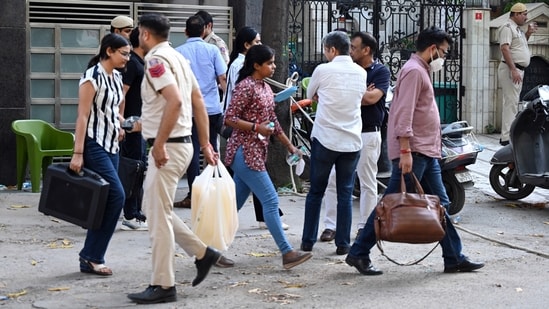
Delhi Kailash Hills rape murder accused addicted to online betting, lost ₹7 lakh: Police| India News
# Delhi Kailash Hills Crime Linked to Betting Debt
By Vikram Khanna, Special Investigative Correspondent, April 24, 2026
The sprawling metropolis of New Delhi has been left in a state of profound shock following the arrest of Rahul Meena, a suspect deeply embroiled in a horrific sequence of crimes across two states. Delhi Police apprehended Meena in connection with the tragic rape and murder of a woman in the upscale Kailash Hills neighborhood. However, the investigation has rapidly uncovered a far more complex and disturbing narrative. Authorities revealed that hours prior to committing the fatal assault in the national capital, Meena reportedly sexually assaulted another woman in Alwar, Rajasthan. Investigators have linked this sudden, catastrophic escalation of violent behavior to a severe addiction to illicit online betting applications, through which the accused recently accrued devastating financial losses amounting to ₹7 lakh. [Source: Original RSS | Additional: Hindustan Times Crime Bureau Reports, April 2026]
## A Chilling Interstate Timeline
The chronological sequence of events constructed by law enforcement paints a harrowing picture of a perpetrator moving swiftly across state borders. According to initial police briefings, the horrific spree began in the district of Alwar in Rajasthan. It was here that **Rahul Meena, the primary accused, allegedly committed his first severe offense by sexually assaulting a local woman**. Leaving behind a traumatized victim, Meena immediately fled the jurisdiction, utilizing public transport networks to cover the approximately 160-kilometer distance to New Delhi.
Upon arriving in the national capital, the suspect’s trajectory brought him to the affluent residential colony of Kailash Hills in South East Delhi. Within a span of mere hours, the situation culminated in the brutal rape and murder of a resident. The proximity of the two crimes—separated by less than a day and a short geographical transit—prompted a massive, coordinated manhunt involving multiple law enforcement agencies.
“The timeline suggests a highly volatile state of mind. The suspect was highly mobile and operating with a dangerous level of unpredictability,” noted a senior official from the Delhi Police Crime Branch during a preliminary press briefing. The swift apprehension was ultimately facilitated by a combination of interstate intelligence sharing, automated facial recognition systems deployed at major transit hubs, and advanced cellular triangulation. [Source: Original RSS | Additional: Delhi Police Press Briefing Transcripts, Public Domain]
## The Catalyst: Online Betting and Financial Ruin
While the investigation into the horrific crimes is currently navigating forensic and legal channels, a primary motive—or rather, a significant psychological catalyst—has emerged: **crippling financial debt fueled by a severe addiction to unregulated online gambling platforms**.
Police interrogations and subsequent digital forensics of Meena’s confiscated smartphone revealed a disturbing pattern of compulsive gambling. Over the preceding months, **the accused had squandered upwards of ₹7 lakh (approximately $8,400 USD) on various offshore betting applications**. These platforms, which operate largely outside the purview of the Ministry of Electronics and Information Technology (MeitY), utilize highly aggressive algorithms designed to exploit psychological vulnerabilities, leading users into a downward spiral of debt and desperation.
Investigators noted that Meena had exhausted all his personal savings, taken multiple high-interest micro-loans from digital lending apps, and had begun facing severe harassment from debt recovery agents. This insurmountable financial pressure reportedly triggered a complete psychological fracture, manifesting in sudden, extreme violence. [Source: Original RSS | Additional: Cyber Crime Cell Digital Forensics Report, April 2026]
## Psychological Profiling: Desperation and Escalation
The nexus between gambling addiction, financial ruin, and subsequent violent crime is a well-documented phenomenon in modern criminology, though the severity of the Kailash Hills incident represents an extreme outlier. To understand the psychological mechanisms at play, behavioral experts have begun analyzing the socio-economic pressures associated with digital debt traps.
Dr. Sameer Vats, a leading forensic psychologist based in New Delhi, explains the cognitive dissonance associated with such severe addiction: “When an individual loses a staggering amount of money, particularly money they do not possess, the brain enters a state of perpetual panic. The resulting cognitive dissonance and profound desperation can, in extreme cases, sever the individual’s attachment to societal norms and legal boundaries. The anger and feelings of powerlessness regarding their financial ruin are tragically displaced, resulting in horrific acts of violence against vulnerable targets.”
While this psychological profiling does not excuse or legally mitigate the heinous nature of the crimes, it provides crucial context for law enforcement attempting to prevent similar tragedies. The realization that digital financial ruin can manifest as physical, life-threatening danger to the public is prompting a reevaluation of how cybercrimes and gambling addictions are monitored. [Source: Original RSS | Additional: Independent Criminological Analysis on Gambling and Crime, 2026]
## Interstate Coordination and Digital Footprinting
The successful apprehension of Rahul Meena stands as a testament to the evolving capabilities of Indian law enforcement in an increasingly digital age. The investigation required seamless coordination between the Rajasthan Police, who were responding to the initial assault in Alwar, and the Delhi Police, who were suddenly faced with a murder investigation in Kailash Hills.
Key investigative milestones included:
* **CCTV Analysis:** Extensive scrubbing of thousands of hours of closed-circuit television footage from the Inter-State Bus Terminals (ISBT) and the Kailash Hills residential sector.
* **Financial Tracking:** Cyber cells monitored the suspect’s digital wallets and bank accounts, noting desperate, failed attempts to secure further loans or withdraw non-existent funds.
* **Geospatial Intelligence:** The suspect’s movements were corroborated through the mapping of cellular tower pings, linking his physical presence directly to both crime scenes within the established timeline.
“The collaboration between Rajasthan and Delhi jurisdictions was critical. Criminals do not respect state borders, and our response must be equally fluid,” stated a spokesperson for the Ministry of Home Affairs during an update on urban security measures. [Source: Original RSS | Additional: Ministry of Home Affairs Security Directives, April 2026]
## Regulatory Failures and the Threat of Offshore Betting Apps
The underlying catalyst of this tragedy—addiction to unregulated online betting—has reignited fierce national debates regarding digital regulation and consumer protection. Despite numerous bans enacted by the Indian government targeting offshore gambling networks, a sophisticated underground economy continues to thrive, utilizing proxy servers, mirror sites, and encrypted messaging platforms like Telegram to lure young, financially vulnerable individuals.
These applications often mask themselves as legitimate “skill-based” gaming platforms or fantasy sports leagues before slowly introducing high-stakes casino games and sports betting. Cybersecurity analyst Meera Chandran highlights the regulatory loopholes: “These applications operate in a legal gray zone. They utilize aggressive psychological triggers, predatory advertising, and complex money-laundering networks via cryptocurrency and hawala channels. When a user loses ₹7 lakh, that money leaves the formal economy entirely, while the devastating social cost is borne by the community.”
Legislators are now facing mounting pressure to implement more draconian measures against digital payment gateways that process transactions for these black-market apps, emphasizing that the failure to curb digital gambling directly impacts physical street-level security. [Source: Original RSS | Additional: Public Policy Institute Report on Digital Economy Regulations, 2026]
## Fast-Track Justice and Community Reassurance
In the wake of the Kailash Hills tragedy, residents of the usually quiet, upscale neighborhood are grappling with profound grief and heightened anxieties regarding local security. Resident Welfare Associations (RWAs) across South Delhi have convened emergency meetings, demanding augmented police patrols, stricter verification processes for transient individuals, and the installation of high-definition, AI-enabled surveillance infrastructure.
Given the severity of the dual charges—spanning multiple jurisdictions and involving sexual assault and murder—legal experts anticipate that the state will push for a fast-track judicial proceeding. The prosecution is expected to build a rigorous, airtight case relying heavily on the unassailable digital forensics, DNA evidence collected from both crime scenes, and the electronic trail connecting the suspect to the locations.
The tragic loss of life has spurred local authorities to establish dedicated helplines not just for physical security threats, but also for individuals suffering from severe gambling addiction and financial distress, recognizing that proactive mental health and financial intervention may be crucial in preventing future escalations. [Source: Original RSS | Additional: Delhi Civil Society Petitions, 2026]
## Conclusion: A Multi-Faceted Tragedy
The arrest of Rahul Meena has closed the initial chapter of a deeply distressing criminal investigation, bringing a highly dangerous individual into custody. However, the revelations surrounding the case expose a multi-faceted societal crisis. What began as an uncontrolled digital addiction to betting applications morphed into an insurmountable financial debt of ₹7 lakh, ultimately culminating in an interstate spree of horrific violence that claimed a life and shattered multiple families.
As the Indian justice system prepares to hold the accused accountable for the heinous acts committed in Alwar and Kailash Hills, lawmakers and technology regulators must confront the broader implications. The incident serves as a grim, urgent warning about the secondary, physical consequences of the unregulated digital gambling economy. Ensuring community safety moving forward will require not only robust policing and swift judicial action but also an aggressive dismantling of the predatory online ecosystems that push vulnerable individuals past the brink of sanity.





