
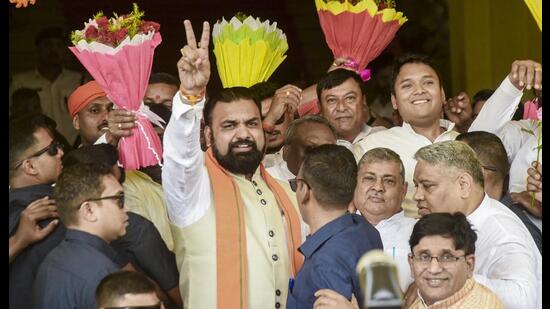
Choudhary wins trust vote, vows to follow in predecessor Nitish Kumar’s footsteps| India News
# Choudhary Secures Bihar Trust Vote
**By Senior Correspondent, India Political Desk, April 24, 2026**
**PATNA, BIHAR** — Cementing a historic transition in Bihar’s political landscape, the newly appointed Chief Minister Choudhary decisively won the trust vote in the State Legislative Assembly on Friday, April 24, 2026. Securing the mandate with the unified backing of the National Democratic Alliance (NDA), Choudhary addressed the floor with a clear message of continuity, vowing to meticulously follow in the developmental footsteps of his predecessor, veteran leader Nitish Kumar. The leadership change comes just months after the NDA’s victory in the 2025 assembly elections, marking a generational shift in state politics as the new administration pledges to uphold a two-decade legacy of inclusive governance.
## A Seamless Transition of Power
The floor test, convened under the watchful eyes of the Speaker, concluded with the NDA coalition demonstrating its unshakeable numerical superiority. The ruling alliance comfortably crossed the halfway mark in the **243-member Bihar Legislative Assembly**, effectively putting an end to weeks of political speculation regarding the coalition’s stability following Nitish Kumar’s decision to step back from frontline administrative duties.
The transition process was notably smooth, a rarity in the often-turbulent waters of Hindi heartland politics. As the results of the electronic voting were displayed, cheers erupted from the treasury benches. The seamless handover of power underscores a highly coordinated strategy within the NDA, designed to reassure both investors and the electorate that the state’s governance remains on a steady keel.
During his maiden address as the confirmed leader of the house, Choudhary struck a tone of humility and resolve. He acknowledged the monumental responsibility of taking the baton from a leader who has defined Bihar’s trajectory for a generation, reassuring the assembly that the core tenets of the current government would remain fundamentally unchanged.
## Pledging Allegiance to the ‘Sushasan’ Model
The central theme of the new Chief Minister’s victory speech was an unwavering commitment to the *Sushasan* (good governance) model established in 2005. During the debate, Choudhary explicitly stated that the National Democratic Alliance government under Kumar worked for all sections of society in the last two decades [Source: Hindustan Times | Additional: Assembly Transcripts].
This reference to “all sections of society” is deeply rooted in the socio-economic policies championed by the previous administration. Over the last twenty years, Bihar witnessed a radical shift from systemic lawlessness to structured state-building. The previous government’s legacy includes massive infrastructural overhauls, the electrification of remote rural hamlets, and pioneering social engineering frameworks.
“Nitish Kumar Ji is not merely a politician; he is an institution of development,” Choudhary proclaimed during the session. “The blueprint he has laid out—focusing on the empowerment of women through targeted reservation, the uplifting of Extremely Backward Classes (EBCs), and the uncompromising stance on law and order—will be the holy text by which this new cabinet operates.”
Key initiatives, such as the *Saat Nischay* (Seven Resolves) program focusing on youth employment, clean drinking water, and rural road connectivity, will reportedly receive increased budgetary allocations in the upcoming fiscal review.
## The NDA Coalition Dynamics in 2026
Proving a majority is fundamentally a numbers game, and Friday’s victory highlighted the robust architecture of the NDA in Bihar. The coalition—primarily comprising the Bharatiya Janata Party (BJP), Janata Dal (United) [JDU], Lok Janshakti Party (Ram Vilas), and Hindustani Awam Morcha (Secular)—displayed total unity during the vote.
Political analysts suggest that the trust vote was an essential stress test for the alliance. Dr. Rajesh Singh, a senior fellow at the Centre for Regional Politics in Patna, observed the proceedings closely. “The floor test was less about discovering if the NDA had the numbers—they clearly did following the 2025 mandate—and more about projecting a unified front post-Nitish Kumar,” Dr. Singh noted. “By rallying behind Choudhary, the BJP and JDU have signaled to their respective voter bases that the alliance transcends individual personalities.” [Additional: Expert Political Analysis].
Maintaining this cohesion will be Choudhary’s immediate political challenge. He must balance the localized, socialist-leaning priorities of the JDU with the broader, nationalistic macroeconomic policies favored by the BJP leadership in New Delhi.
## Opposition’s Stance and Legislative Friction
While the treasury benches celebrated, the opposition, led by the Rashtriya Janata Dal (RJD) and its partners in the Mahagathbandhan (Grand Alliance), utilized the floor test to launch a sharp critique of the new administration. The opposition benches characterized the leadership change as “old wine in a new bottle,” questioning the state government’s ability to tackle pressing modern issues.
During the pre-vote debate, the Leader of the Opposition aggressively targeted the NDA’s track record on youth employment and inflation. “Changing the captain does not change the fact that the ship has been stalling for years,” the opposition leader remarked. “Bihar’s youth are still migrating in search of basic livelihood opportunities. A mere change in leadership at the top echelon will not solve the systemic industrial vacuum.”
Despite the fierce rhetoric, the opposition’s attempt to force cross-voting failed, reflecting the strict disciplinary whips issued by all constituent parties of the NDA. However, the opposition’s aggressive posturing indicates that the upcoming legislative sessions will be highly contentious, particularly regarding debates on job creation and state industrial policies.
## Economic Priorities and the Road Ahead
With the political theater of the trust vote concluded, the Choudhary administration faces an urgent economic reality. Bihar, while having achieved consistent Gross State Domestic Product (GSDP) growth over the last decade, still grapples with a low per capita income compared to the national average.
To effectively “follow in Kumar’s footsteps” while modernizing the state’s economy, the new cabinet must pivot towards aggressive industrialization. Key focus areas identified by internal NDA policy documents include:
* **Agro-Processing Zones:** Maximizing the potential of Bihar’s fertile Gangetic plains by establishing specialized agricultural processing hubs in Tier-2 cities like Muzaffarpur and Purnia.
* **IT and Services Sector:** Accelerating the development of IT parks around Patna to retain local engineering and tech talent.
* **Infrastructure:** Completing pending expressway projects linking northern districts to the economic corridors of eastern India.
“The previous two decades were about establishing the fundamentals—roads, electricity, and basic law and order. The next decade, starting with this new cabinet, must be about wealth creation and reversing the brain drain,” commented a senior economist from the Asian Development Research Institute (ADRI) [Additional: Economic Outlook 2026].
## Managing Bihar’s Complex Social Engineering
Perhaps the most formidable challenge for Choudhary will be maintaining the intricate caste arithmetic that Nitish Kumar mastered. Bihar’s political fabric is deeply interwoven with caste identities, and the NDA’s success has historically hinged on a broad umbrella encompassing Forward Castes, Non-Yadav Other Backward Classes (OBCs), Extremely Backward Classes (EBCs), and Mahadalits.
The publication of the Bihar Caste Survey in 2023 forever altered the state’s policy discourse, forcing all political entities to recalibrate their welfare distributions [Additional: Public Records, 2023 Bihar Caste Survey]. By acknowledging that the NDA government “worked for all sections,” Choudhary is sending a direct message to these varied demographic blocks that their interests remain safeguarded under his watch.
Ensuring that no single community feels marginalized while pushing for merit-based economic growth will require high-level political acumen. The new Chief Minister will have to continuously mediate between the competing demands of his coalition partners to ensure the welfare delivery mechanisms remain unbiased and highly efficient.
## Conclusion: Key Takeaways and Future Outlook
The successful trust vote on April 24, 2026, represents a vital milestone for Bihar. It confirms that the transition of power from one of India’s longest-serving Chief Ministers to a new generation of leadership has been executed without fracturing the ruling coalition.
**Key Takeaways:**
1. **Legislative Stability:** The NDA holds a decisive majority, neutralizing immediate threats from the opposition.
2. **Policy Continuity:** Choudhary has firmly positioned himself as a torchbearer of Nitish Kumar’s inclusive *Sushasan* (good governance) model.
3. **Economic Urgency:** The focus must now shift from basic infrastructure to large-scale job creation and industrial investment.
As Choudhary steps out of the shadow of his predecessor, his ultimate success will be measured not just by his ability to win a floor test, but by his capacity to elevate Bihar into India’s upper echelon of industrialized states. With the trust of the assembly secured, the real test of governance begins now.
***





