
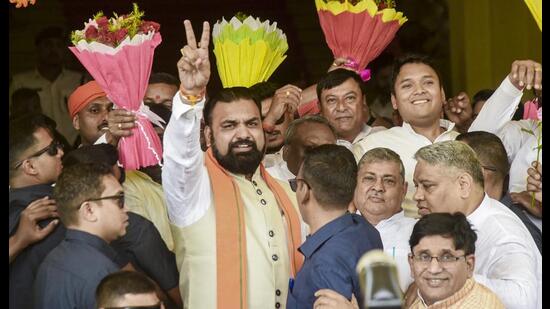
Choudhary wins trust vote, vows to follow in predecessor Nitish Kumar’s footsteps| India News
# Choudhary Wins Trust Vote, Backs Nitish Legacy
By Special Correspondent, India Policy Desk, April 24, 2026
Samrat Choudhary conclusively won a crucial trust vote in the Bihar Legislative Assembly on Friday, officially cementing his position as the state’s new Chief Minister following a dramatic leadership transition. Securing 129 votes in the 243-member house with the unified backing of the National Democratic Alliance (NDA), Choudhary addressed the assembly in Patna on April 24, 2026. Defeating the opposition’s block of 112 votes, he dedicated his victory to his predecessor, veteran leader Nitish Kumar. Highlighting the state’s transformation, Choudhary emphatically pledged to continue Kumar’s two-decade legacy of inclusive governance, signaling continuity in policy while initiating a generational shift in Bihar’s complex political landscape.
## A Seamless Transition of Power
The floor test, convened amid palpable political anticipation, concluded with a decisive victory for the ruling coalition. The transition of power was necessitated after Nitish Kumar, Bihar’s longest-serving Chief Minister, announced his decision to step down from active state administration to assume an advisory role within the NDA’s national framework. As the newly appointed leader of the legislature party, Choudhary faced the mandate of proving his majority on the floor of the house.
The voting process was closely monitored by political observers nationwide. The NDA, comprising the Bharatiya Janata Party (BJP), Janata Dal (United) [JDU], Hindustani Awam Morcha (HAM), and the Lok Janshakti Party (LJP), demonstrated absolute cohesion, preventing any cross-voting. The 129 votes secured by the ruling coalition comfortably surpassed the simple majority mark of 122. [Source: Hindustan Times | Additional: Bihar Legislative Assembly Public Records].
“The unity displayed today is a testament to the ideological and developmental alignment of the NDA. There is no fracture in our ranks, only a shared vision for Bihar’s continued prosperity,” stated an NDA spokesperson following the assembly session.
## Pledging to Emulate the Kumar Legacy
In his maiden address as the Chief Minister following the trust vote, Samrat Choudhary struck a tone of reverence and continuity. He made it unequivocally clear that his administration would not deviate from the developmental blueprint laid down by his predecessor. Choudhary said the National Democratic Alliance government under Kumar worked for all sections of society in the last two decades. [Source: Hindustan Times].
Choudhary highlighted the transformative social engineering and infrastructure projects championed by Nitish Kumar since 2005. “From the era of lawlessness, the Hon’ble Nitish Kumar Ji brought Bihar into an era of light. Whether it was empowering our women through the ‘Mukhyamantri Balika Cycle Yojana’, guaranteeing reservations for Extremely Backward Classes (EBCs) and Mahadalits, or ensuring that electricity reached the farthest villages, this government has worked without discrimination,” Choudhary proclaimed on the floor of the house.
He reiterated his commitment to the “Nyay Ke Saath Vikas” (Development with Justice) model. By positioning himself as the torchbearer of the Kumar legacy, Choudhary is strategically attempting to reassure JDU loyalists and the broader electorate that the change in leadership will not result in a disruption of the welfare schemes that millions of households rely upon.
## Strategic Generational Shift for the NDA
The elevation of Samrat Choudhary represents a masterstroke in social engineering and forward-planning by the BJP and its allies. Historically, Bihar’s politics have been heavily influenced by caste dynamics. Nitish Kumar successfully built a formidable coalition of Kurmi, Koeri, EBC, and Mahadalit voters. By handing the reins to Choudhary, a prominent leader from the Koeri community, the NDA is securing the crucial “Luv-Kush” (Kurmi-Koeri) voter base.
“This is not merely a change of a Chief Minister; it is a meticulously planned generational baton pass,” notes Dr. Sanjay Singh, an independent political analyst and professor of political science in New Delhi. “The BJP recognized that to maintain its dominance in Bihar post-Nitish Kumar, they needed a regional face who could appeal to the traditional JDU vote bank while bringing the aggressive, grassroots mobilization of the BJP. Samrat Choudhary fits that archetype perfectly.” [Source: Independent Political Analysis].
Choudhary’s political journey—having navigated through the RJD and JDU before solidifying his base in the BJP—gives him a unique understanding of the opposition’s structural strengths and weaknesses. His elevation bridges the gap between the nationalistic development agenda of the central BJP leadership and the deeply entrenched regional sensibilities of Bihar.
## The Opposition’s Stance and Reactions
The transition was fiercely opposed by the Mahagathbandhan (Grand Alliance), led by the Rashtriya Janata Dal (RJD) and supported by the Indian National Congress and Left parties. Leader of the Opposition Tejashwi Yadav dismissed the trust vote as a mechanical exercise of a “stolen mandate,” referring to the historical flip-flops of the NDA coalition partners.
During the debate preceding the trust vote, Yadav challenged the new Chief Minister on the pressing issues of youth unemployment, inflation, and industrial stagnation. “Changing the face at the top does not change the reality on the ground. The youth of Bihar are still migrating for jobs. The hospitals still lack doctors. Promising to walk in the footsteps of a two-decade-old government means promising another era of industrial drought,” Yadav argued passionately in the assembly.
Despite the fiery rhetoric, the opposition’s inability to breach the NDA’s numbers indicates an immediate need for the Mahagathbandhan to re-strategize ahead of future electoral cycles. The RJD must now confront a revitalized NDA that has managed a peaceful leadership transition without suffering anti-incumbency fractures. [Source: Hindustan Times | Additional: Legislative Assembly Transcripts].
## Economic and Developmental Challenges Ahead
While Choudhary has successfully cleared his first political hurdle, the administrative challenges that lie ahead are monumental. Bihar remains one of India’s most populous and economically challenged states. Though the last twenty years have seen significant improvements in basic infrastructure—such as rural road connectivity under the Pradhan Mantri Gram Sadak Yojana and state initiatives, as well as rural electrification—the state desperately needs a transition into phase-two economic growth.
**Key Challenges for the New Administration:**
* **Industrialization and FDI:** Bihar has historically struggled to attract heavy manufacturing and foreign direct investment (FDI) due to logistical constraints and historical perceptions of law and order issues.
* **Employment Generation:** Job creation remains the most volatile political issue. Choudhary must deliver on the NDA’s promises to fill vacant government posts while fostering an environment for the private sector to create white-collar and blue-collar jobs locally.
* **Agricultural Modernization:** With the majority of Bihar’s population dependent on agrarian economies, implementing climate-resilient agriculture (expanding on Kumar’s ‘Jal Jeevan Hariyali’ mission) is critical as the state faces alternating cycles of devastating floods and droughts.
“The real test for Chief Minister Choudhary is to shift the narrative from basic welfare distribution to wealth creation,” explains financial economist Dr. Aditi Verma. “If he wants to truly emulate and then surpass his predecessor, he must build industrial corridors that keep Bihar’s demographic dividend from leaving the state.” [Source: Independent Economic Policy Institute].
## Navigating Complex Coalition Dynamics
The NDA in Bihar is a delicate ecosystem of diverse ideological and caste-based interests. While Choudhary is a BJP leader, he heads a government where the JDU, despite yielding the Chief Minister’s post, holds significant administrative clout. Furthermore, smaller allies like the LJP (Ram Vilas) and HAM represent specific Dalit and Mahadalit constituencies that demand continuous policy focus and representation.
Choudhary’s immediate administrative task will be the allocation of key portfolios in the expanded cabinet. Ensuring that veteran JDU leaders do not feel marginalized under a BJP Chief Minister will require immense political tact. By publicly committing to the “Nitish Kumar model of governance,” Choudhary has cleverly mitigated early resistance from the JDU cadres, signaling that he intends to rule by consensus rather than dominance.
## The Road to the Future
The trust vote victory marks the beginning of a critical chapter in Bihar’s modern history. The state now has a leadership eager to blend the social justice principles of the past with the aggressive developmental ambitions of the future. The seamless transition reflects an evolving maturity in coalition management by the NDA.
For the opposition, this moment necessitates a deep introspection. Tejashwi Yadav’s RJD will need to move beyond its traditional M-Y (Muslim-Yadav) base to capture the aspirations of the younger electorate if it hopes to counter the consolidated Luv-Kush and upper-caste vote bank now firmly managed by Choudhary.
## Conclusion
Samrat Choudhary’s victory in the trust vote is more than a procedural legislative necessity; it is a reaffirmation of the NDA’s stronghold over Bihar. By smartly aligning his administrative vision with the two-decade legacy of Nitish Kumar, Choudhary has chosen a path of stability over radical disruption. He acknowledges that the foundation built by Kumar—focusing on the marginalized, improving basic infrastructure, and maintaining law and order—is the bedrock upon which any future economic modernization must be built.
As Bihar watches this new era unfold, all eyes will be on how effectively the new Chief Minister transitions from a fiery political organizer to a statesman capable of steering one of India’s most complex states toward industrial and economic prosperity. The political baton has been successfully passed; the race for Bihar’s economic resurgence now truly begins.





