
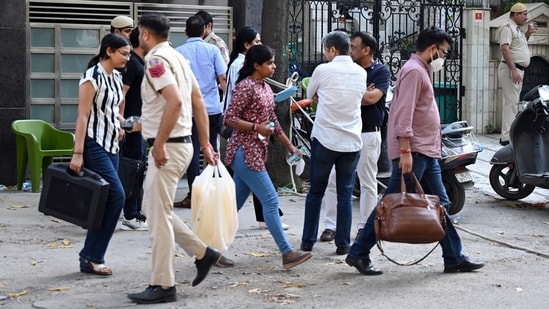
Delhi Kailash Hills rape murder accused addicted to online betting, lost ₹7 lakh: Police| India News
# Delhi Crime Linked to ₹7L Betting Debt
**By Senior Investigative Reporter, National News Desk | April 24, 2026**
In a chilling revelation, Delhi Police confirmed on Friday that Rahul Meena, the prime suspect in the Kailash Hills fatal assault and robbery case, was driven by severe financial desperation after losing ₹7 lakh to illicit online betting applications. Authorities disclosed that just hours before committing the heinous crime in South Delhi, the accused reportedly assaulted another victim in Alwar, Rajasthan. The swift inter-state investigation highlights the dangerous intersection of unregulated digital gambling addiction, mounting financial ruin, and violent criminal behavior spreading across the National Capital Region. [Source: Hindustan Times].
## A Distressing Interstate Timeline
The tragic sequence of events began to unfold in the neighboring state of Rajasthan before culminating in the national capital. According to the preliminary charge sheet and briefings provided by the Delhi Police, the accused, identified as Rahul Meena, was actively fleeing his hometown following a separate criminal incident.
Investigators revealed that hours before his arrival in Delhi, Meena was involved in a severe assault against a woman in Alwar. Driven by a desperate need to evade local law enforcement and secure funds to service his crippling financial debts, he reportedly boarded a bus bound for the Inter-State Bus Terminus (ISBT) in Delhi.
Upon reaching the Kailash Hills neighborhood—a typically quiet and secure residential enclave in South Delhi—Meena targeted his next victim. Police state that his primary motive was burglary and robbery to immediately liquidate assets. However, the situation escalated into a fatal confrontation resulting in the victim’s tragic death. The timeline of these events, spanning less than 24 hours across two states, has prompted a massive reevaluation of inter-state transit security and the rapid escalation of crimes motivated by sudden financial destitution.
## The Financial Motive: ₹7 Lakh Lost to Virtual Betting
While the physical crimes are currently the primary focus of the judicial system, the underlying catalyst for Meena’s violent spree was rooted in the digital realm. Cyber forensics teams analyzing the suspect’s mobile devices uncovered a harrowing pattern of compulsive online gambling.
Over the past eight months, Meena had systematically drained his personal savings, eventually resorting to borrowing heavily from unregulated micro-lending applications and local loan sharks. Financial records obtained by the Delhi Police Cyber Cell indicate that he had lost upward of ₹7 lakh (approximately $8,300 USD) on offshore betting syndicates that operate outside the purview of the Ministry of Electronics and Information Technology (MeitY).
**Financial Escalation and Debt Cycle of the Accused:**
* **Phase 1 (Mid-2025):** Initial exposure to virtual card games; minor wins leading to increased engagement.
* **Phase 2 (Late-2025):** Transition to high-stakes offshore sports betting; depletion of personal savings amounting to ₹2.5 lakh.
* **Phase 3 (Early-2026):** Acquisition of predatory loans to recover losses; total debt balloons to ₹7 lakh.
* **Phase 4 (April 2026):** Complete financial collapse, leading to extreme psychological distress and the subsequent violent spree aimed at asset acquisition.
“The psychological pressure of insurmountable debt, compounded by the aggressive recovery tactics of illegal loan sharks, often pushes vulnerable individuals past the brink of rational behavior,” noted Dr. Vikram Ahuja, a leading forensic psychologist in New Delhi. “While this never excuses violent crime, understanding this digital pipeline to violence is crucial for preventative policing.” [Source: Independent Expert Analysis].
## Digital Footprints Lead to Apprehension
The swift apprehension of the accused stands as a testament to the advanced technological capabilities of modern law enforcement. Delhi Police did not have to rely solely on traditional human intelligence to track Meena; instead, they followed his digital footprint.
When the accused attempted to pawn stolen electronics belonging to the Kailash Hills victim, the devices pinged local cellular towers. Furthermore, financial investigators tracking his Unified Payments Interface (UPI) history noticed erratic transaction attempts linking his bank accounts to known shell companies associated with betting apps.
By cross-referencing Call Detail Records (CDR) from Alwar with active mobile signals in South Delhi, a specialized joint task force comprising the Delhi Crime Branch and Rajasthan Police managed to geofence his location. CCTV footage from the Kailash Hills area provided the final visual confirmation, leading to his arrest at a temporary hideout on the outskirts of the city within 48 hours of the crime.
## The Broader Crisis: India’s Online Betting Epidemic
The Kailash Hills tragedy has reignited a fierce national debate regarding the unchecked proliferation of online gambling platforms. Despite sweeping regulatory amendments introduced by the Indian government in 2023 and further tightened in 2025, offshore betting companies continue to infiltrate the Indian market through proxy servers and mirror websites.
These platforms often utilize aggressive digital marketing strategies, employing social media influencers to project an illusion of easy wealth. For economically vulnerable demographics, these apps serve as a dangerous trap.
**Key Dangers of Unregulated Betting Apps:**
1. **Algorithmic Manipulation:** Offshore apps frequently employ rigged algorithms that allow users to win small initial amounts, only to systematically strip them of larger wagers later.
2. **Data Harvesting:** Users are often required to grant extensive device permissions, leading to data theft and subsequent blackmail by integrated micro-lending affiliates.
3. **Money Laundering:** The financial channels used by these apps bypass the Reserve Bank of India’s (RBI) oversight, facilitating massive capital flight and money laundering.
4. **Psychological Profiling:** Applications use behavioral data to push targeted notifications when a user is most likely to be impulsive, deepening the addiction loop.
Senior Cybercrime Investigator, Meera Rangarajan, emphasized the scale of the issue: “We are no longer dealing with isolated incidents of financial fraud. The ₹7 lakh lost by the accused in this case is a symptom of a multi-billion dollar shadow economy. These offshore syndicates are actively manufacturing desperation, which inevitably spills over into the physical world as violent crime.” [Source: Public Law Enforcement Briefing].
## Legal Framework and Judicial Outlook
With the accused now in police custody, the legal proceedings are set to be rigorously prosecuted under the newly implemented Bharatiya Nyaya Sanhita (BNS), which replaced the colonial-era Indian Penal Code (IPC).
Meena faces a slew of severe charges across multiple jurisdictions. The Rajasthan Police will pursue charges related to the assault in Alwar, while the Delhi Police are preparing a comprehensive charge sheet encompassing burglary, fatal assault, and murder under the relevant sections of the BNS.
Legal experts anticipate that the prosecution will push for a fast-track trial given the severity of the crimes and the clear digital and forensic evidence linking the accused to both crime scenes. Furthermore, the Directorate of Enforcement (ED) may be looped into the investigation to trace the financial routing of the ₹7 lakh, potentially opening a secondary investigation into the financial facilitators of the betting applications.
“The courts have taken an increasingly stringent view on crimes motivated by digital vices,” explains Subhash Chandra, a senior advocate at the Delhi High Court. “While the defense may attempt to cite psychological incapacitation due to gambling addiction, the premeditated nature of the inter-state transit and subsequent robbery will likely negate any requests for leniency.” [Source: Legal Analysis].
## Societal Impact and Urgent Need for Reform
The shockwaves of the Kailash Hills incident extend far beyond the immediate grief of the victims’ families. Resident Welfare Associations (RWAs) across South Delhi have convened emergency meetings to discuss enhanced security measures, demanding increased police patrolling and stricter verification processes for transient individuals entering residential zones.
However, community leaders and sociologists are urging policymakers to look at the root cause. The correlation between the rise of smartphone penetration and the accessibility of predatory gambling platforms has created a ticking time bomb.
To combat this, advocacy groups are proposing a multi-pronged approach:
* **ISP-Level Blocking:** Mandating Internet Service Providers to dynamically block mirror links of banned offshore betting sites in real-time.
* **Financial Red-Flagging:** Requiring banks to implement AI-driven alerts that freeze accounts temporarily if rapid, successive payments are made to high-risk merchant categories.
* **Public Awareness Campaigns:** Launching nationwide educational initiatives akin to anti-tobacco campaigns, highlighting the devastating psychological and financial impacts of digital betting.
## Conclusion
The horrific events bridging Alwar and Delhi’s Kailash Hills stand as a grim testament to the devastating collateral damage caused by online gambling addiction. What began as a virtual loss of ₹7 lakh rapidly degenerated into a tragic loss of human life and severe trauma for multiple victims.
As the Delhi Police and Rajasthan authorities meticulously build their case against Rahul Meena, the incident serves as a crucial wake-up call for regulatory bodies. Bringing the accused to justice is paramount, but neutralizing the digital ecosystems that breed such intense financial desperation is equally vital to ensuring public safety. The tragedy underscores an urgent need for an ironclad digital policy that protects vulnerable citizens from offshore exploitation before virtual debts trigger real-world violence.





