
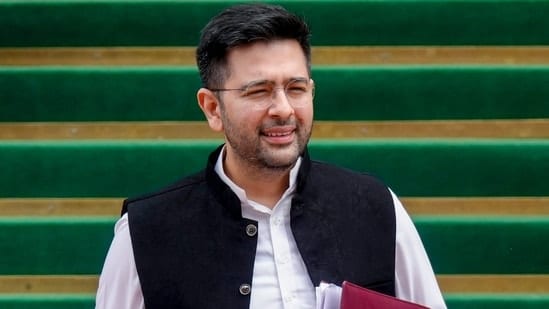
Raghav Chadha on why he left AAP along with 6 other MPs: ‘Mai unke gunaah me…’| India News
# Raghav Chadha Quits AAP: The 7-MP Mass Exodus
By Special Correspondent, National Policy Desk, April 24, 2026
In a seismic development that has sent shockwaves through the Indian political landscape, senior leader **Raghav Chadha** officially resigned from the Aam Aadmi Party (AAP) on Friday, April 24, 2026, leading a mass exodus alongside six other Members of Parliament. Speaking at a heavily attended press conference in New Delhi, Chadha cited an irreparable ideological rift and a departure from the party’s anti-corruption origins as the primary catalysts for the rebellion. Declaring, “Mai unke gunaah me shamil nahi ho sakta” (I cannot be a partner in their sins), Chadha emphasized that their collective departure is rooted in a commitment to national integrity over partisan survival.
## The Breaking Point: “Mai Unke Gunaah Me…”
For years, Raghav Chadha has been the urbane, articulate face of the Aam Aadmi Party. From his early days as a young chartered accountant drafting the party’s foundational anti-corruption manifestos to becoming one of the youngest members of the Rajya Sabha representing Punjab, his political trajectory was intrinsically tied to AAP’s rise. However, the press conference on Friday marked a stark, bitter conclusion to that decade-long association.
Addressing the media with a somber demeanor, Chadha did not mince words regarding the internal decay he perceives within the party’s high command. “We didn’t enter politics to make our career, but we left our career to enter politics for the nation,” Chadha stated, reiterating the idealistic fervor that initially birthed the AAP from the 2011 India Against Corruption movement [Source: Hindustan Times].
His use of the word *gunaah* (sin or crime) is particularly damning. While he refrained from detailing specific legal infractions during his opening statement, political analysts view this phrasing as a direct indictment of the ongoing controversies and governance compromises that have plagued the party’s leadership over the past three years. By framing his departure as an act of moral preservation, Chadha has effectively challenged the very ethical foundation upon which AAP currently stands.
## Profiles of the Rebellion: The Loss of Key Strategists
The departure is not limited to Chadha; the inclusion of six other MPs transforms this resignation from a solitary act of dissent into a full-blown party crisis. While the exact strategic configurations are still emerging, the departing bloc reportedly consists of a mix of Lok Sabha and Rajya Sabha members, primarily drawing from the party’s strongholds in Punjab and Delhi.
This faction represents a significant brain trust within the AAP. These are lawmakers who have spearheaded legislative debates, managed crucial state election campaigns, and represented the party’s defense on national television. Their exit signals a profound disenchantment not just at the grassroots level, but at the highest echelons of party strategy.
**Key Impacts of the Exodus:**
* **Loss of Articulate Defenders:** AAP loses its most prominent English and Hindi-speaking national spokespersons.
* **Punjab Dynamics:** With several rebelling MPs hailing from Punjab, the party faces a potential crisis of faith in a state where it holds a dominant legislative majority.
* **Parliamentary Leverage:** The sudden reduction in parliamentary numbers severely curtails AAP’s ability to negotiate within opposition alliances.
## The Genesis of the Rift: Idealism vs. Realpolitik
To understand the magnitude of Friday’s announcement, one must trace the trajectory of AAP’s internal struggles. Over the last few years, the party has transitioned from an insurgent, activist-led organization into a conventional political machine. This transition necessitated realpolitik compromises that alienated its founding idealists.
The continuous barrage of probes by central agencies—ranging from the infamous Delhi excise policy case to allegations of financial mismanagement in state-run boards—created a siege mentality within the party. While AAP leadership has consistently dismissed these probes as political vendettas orchestrated by the ruling dispensation, a faction within the party began to express discomfort with the sheer volume of allegations and the lack of internal transparency.
According to party insiders, Chadha and his cohort had repeatedly demanded structural reforms and greater financial accountability within the party’s decision-making bodies. When these demands were allegedly met with silence or marginalization, the seeds of the April 2026 exodus were sown [Additional: Independent Political Analysis].
## Expert Analysis: A Tectonic Shift in Opposition Politics
The ramifications of this split extend far beyond the immediate embarrassment for the Aam Aadmi Party. Political scientists argue that this could alter the opposition’s architecture heading into future electoral cycles.
Dr. Sameer Mahajan, Senior Fellow at the New Delhi Institute of Policy Studies, notes the strategic severity of this development. *”Raghav Chadha was the bridge between AAP’s populist welfarism and the urban middle-class intelligentsia,”* Dr. Mahajan explains. *”His assertion that the party has committed ‘gunaah’ shatters the moral high ground AAP has clung to since its inception. When your core architect of anti-corruption messaging implies that the party is now part of the very swamp it promised to drain, the electoral damage is incalculable.”*
Furthermore, the timing is critical. As regional parties attempt to consolidate power to challenge national heavyweights, AAP’s internal fragmentation weakens its bargaining power in national coalitions.
## The Anti-Defection Conundrum: What Happens to the MPs?
A crucial legal and constitutional question now hangs over Chadha and the six other MPs: their status as parliamentarians. Under the Tenth Schedule of the Indian Constitution (commonly known as the Anti-Defection Law), elected members can be disqualified if they voluntarily give up the membership of their political party.
However, the law provides an exception if a split involves at least two-thirds of the legislative party’s members. Given AAP’s current strength in both houses of Parliament, the faction of seven MPs must carefully navigate this mathematical threshold.
* **Scenario A:** If the seven MPs do not constitute the required two-thirds majority of AAP’s parliamentary party, they face immediate disqualification upon their formal resignation from the party, necessitating by-elections.
* **Scenario B:** They may attempt to claim they are the “real” AAP, a tactic previously utilized by splinter factions in Maharashtra (such as the Shiv Sena and NCP splits), though this requires a prolonged legal battle before the Election Commission of India.
* **Scenario C:** Chadha and his peers may choose the ethical high route—resigning from their parliamentary seats entirely to seek a fresh mandate from the public, which aligns perfectly with their stated claim of entering politics “for the nation” rather than for career advancement.
## AAP’s Response: Damage Control and Accusations
Unsurprisingly, the official response from the Aam Aadmi Party headquarters has been swift and combative. In a counter-press briefing held late Friday evening, party spokespersons sought to minimize the ideological weight of the exodus, framing it instead as a capitulation to pressure from central investigative agencies.
“It is deeply unfortunate that those who were given everything by the party and the public have chosen to abandon the ship during its most challenging hour,” an AAP senior leader stated. “The rhetoric of ‘gunaah’ is nothing but a smokescreen to hide their inability to withstand the political intimidation orchestrated by our rivals.”
Despite the brave face, sources within the Delhi Secretariat indicate a state of high alarm. Emergency meetings have been convened by the party high command to prevent any further defections, particularly among Members of the Legislative Assembly (MLAs) in Punjab and Delhi who might be sympathetic to Chadha’s faction.
## Where Do They Go From Here?
The million-dollar question in New Delhi’s political corridors is the future destination of this formidable bloc of lawmakers. Chadha remained tight-lipped about his immediate political steps, focusing entirely on the reasons for leaving rather than his next destination.
Speculation is rife across three primary possibilities:
1. **Integration into a National Party:** Both the Bharatiya Janata Party (BJP) and the Indian National Congress would eagerly welcome a leader of Chadha’s demographic appeal and organizational capability. Joining a national party would offer the rebel MPs immediate institutional backing.
2. **Forming a Splinter Faction:** They could establish a new regional outfit, perhaps styling it as the “authentic” inheritor of the India Against Corruption movement’s ideals. This would resonate in urban constituencies but requires massive logistical effort.
3. **A Strategic Pause:** Chadha, leveraging his professional background as a chartered accountant and policy expert, might retreat into a civil society role temporarily, using his clean image to build a non-partisan policy platform before returning to active electoral politics.
## Conclusion: The End of an Era for India’s Alternative Politics
The resignation of Raghav Chadha and six MPs on April 24, 2026, will likely be recorded as an inflection point in contemporary Indian politics. The Aam Aadmi Party, which captured the global imagination by promising a radically transparent, citizen-led governance model, now finds itself battling the very accusations of hubris and moral compromise it once hurled at established political dynasties.
Chadha’s parting words, “Mai unke gunaah me shamil nahi ho sakta,” will echo through the upcoming electoral campaigns, serving as powerful ammunition for AAP’s detractors and a source of profound soul-searching for its remaining loyalists. As India looks ahead to a reshaped political battlefield, the departure of these seven lawmakers serves as a stark reminder: in politics, the transition from revolutionary idealism to pragmatic governance is fraught with casualties, and the moral high ground is the hardest territory to hold.





