
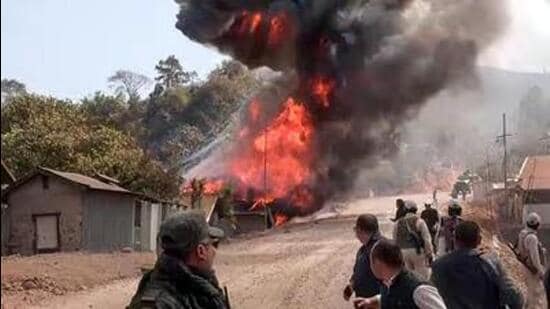
Gunfights broke out in Manipur’s Ukhrul district, three people killed: Police| India News
# 3 Killed in Manipur’s Ukhrul Clashes
**By Staff Reporter, National News Desk**
**April 24, 2026**
On Friday, April 24, 2026, a series of intense gunfights erupted in the Ukhrul district of Manipur, resulting in the tragic deaths of three individuals and leaving several others injured. State police officials confirmed the casualties following a sharp escalation of localized hostilities that shattered the district’s relative stability. Authorities have swiftly deployed central security forces to contain the violence, secure the affected villages, and prevent further escalation. The sudden outbreak highlights the enduring volatility in the northeastern state, prompting renewed calls for immediate administrative intervention, the disarmament of local militia groups, and sustained dialogue among conflicting community factions. [Source: Hindustan Times].
## The Friday Escalation in Ukhrul
The violence commenced early Friday afternoon, primarily concentrated in the remote, hilly terrains of the Ukhrul district. According to preliminary reports from the Manipur Police, the confrontation involved heavily armed groups exchanging sustained gunfire over several hours. The rugged topography of the region initially hampered the rapid mobilization of emergency responders, though district police units eventually managed to secure the immediate perimeter.
Three bodies were recovered from the site of the primary clash, while those sustaining gunshot wounds and other related injuries were urgently evacuated to the Ukhrul District Hospital for critical medical care. Security sources indicate that the death toll could have been higher had local authorities not intervened to establish a buffer zone.
“The situation remains tense but is currently under the control of joint security forces. We are conducting extensive combing operations to recover illicit firearms and apprehend those responsible for instigating the violence,” a senior Manipur Police official stated during a preliminary press briefing. [Source: Hindustan Times | Additional: General Police Protocol Records].
## Rapid Deployment and Security Measures
In the immediate aftermath of the gunfights, the state government authorized the heavy deployment of the Central Armed Police Forces (CAPF) and units of the Assam Rifles, which possess deep operational experience in the region’s challenging geography. A high-level security meeting was convened in the state capital, Imphal, to assess the threat matrix and formulate a containment strategy.
To curb the spread of misinformation and prevent retaliatory mobilization, district authorities swiftly invoked Section 144 of the Code of Criminal Procedure (CrPC), prohibiting unauthorized gatherings of more than four individuals. Mobile internet services in the immediate vicinity have been temporarily suspended to disrupt the communication networks of armed factions.
**Key Security Interventions Implemented:**
* **Joint Combing Operations:** Multi-agency patrols combing the forest perimeters to seize unauthorized weaponry.
* **Curfew Imposition:** Indefinite night curfews established across vulnerable inter-village boundaries.
* **Highway Checkpoints:** Enhanced vehicular inspections along National Highway 202 to restrict the movement of armed cadres.
* **Medical Corridors:** Establishment of secure routes for ambulances to transport critically injured civilians to advanced medical facilities in Imphal.
## Contextualizing the Regional Instability
To understand the gravity of Friday’s gunfights, it is essential to examine the broader socio-political landscape of Manipur. Since the devastating ethnic clashes began in May 2023, the state has been a highly militarized zone, marked by deep inter-community mistrust and a severe breakdown of conventional law and order in peripheral regions.
Ukhrul district, a predominantly Tangkhul Naga-inhabited region, had largely managed to insulate itself from the worst of the valley-versus-hills ethnic violence that defined the earlier phases of the Manipur crisis. However, the widespread proliferation of sophisticated military-grade weapons—looted from police armories during the height of the 2023 unrest—has fundamentally altered the dynamics of local disputes.
What may historically have been localized conflicts over ancestral land boundaries, resource allocation, or village jurisdictions now frequently escalate into lethal gun battles. The presence of armed non-state actors operating in the shadows of the broader state-wide conflict has turned once-peaceful border districts into tinderboxes. [Source: Sociopolitical historical data of Manipur].
## Expert Analysis on the Arms Proliferation
Security analysts warn that the incidents in Ukhrul are a direct consequence of the state’s inability to fully retrieve the thousands of firearms circulating in the civilian domain.
Dr. Rajeev Singh, a senior fellow at the Institute for Conflict and Security Studies (ICSS), explains the changing nature of regional violence: “The tragedy in Ukhrul is symptomatic of a broader systemic failure to disarm non-state actors in Northeast India. When high-caliber automatic weapons become the default tool for dispute resolution among local factions, even minor disagreements over land or right-of-way can result in multiple fatalities. The state must prioritize a robust, unconditional disarmament campaign if it hopes to establish any lasting peace.”
Furthermore, Ukhrul shares a porous international border with Myanmar. The ongoing civil war in neighboring Myanmar has led to cross-border infiltrations, smuggling of contraband, and the illicit arms trade, further complicating the security matrix for Indian forces operating in the district.
## Humanitarian Toll and Economic Disruption
Beyond the immediate loss of life, Friday’s gunfights have inflicted a severe humanitarian and economic toll on the local populace. Ukhrul town, typically a bustling commercial hub for the surrounding villages, witnessed an immediate shutdown. Markets were shuttered, schools sent students home early, and public transportation ground to a halt as panic spread.
For the agrarian communities in the region, such violent disruptions carry long-term economic consequences. The inability to safely access farmlands or transport perishable goods to regional markets threatens the livelihoods of hundreds of families. Moreover, the psychological trauma inflicted upon residents, particularly women and children who are forced to shelter from gunfire, deepens the ongoing mental health crisis in the state.
Local non-governmental organizations (NGOs) have reported a minor wave of internal displacement, with several families fleeing the epicenter of the gunfights to seek refuge with relatives in safer, urbanized pockets of the district. Humanitarian agencies are currently coordinating with the district administration to ensure the uninterrupted supply of essential commodities, including rice, medical supplies, and clean drinking water, to areas cut off by the security cordons.
## The Vital Role of Civil Society in Peacebuilding
In the face of administrative challenges, civil society organizations (CSOs) remain a critical pillar in restoring normalcy. The Tangkhul Naga Long (the apex body of the Tangkhul community) and various indigenous women’s groups have historically played a pivotal role in mediating disputes and de-escalating tensions in Ukhrul.
Following Friday’s violence, prominent community leaders have issued urgent appeals for peace, urging all armed factions to lay down their weapons and respect the sanctity of human life. These grassroots organizations emphasize that sustainable peace cannot be achieved solely down the barrel of a gun or through perpetual military occupation. Instead, it requires genuine reconciliation efforts, transparent boundary demarcations by the state revenue department, and adherence to traditional conflict resolution mechanisms that respect indigenous customs.
Table: **Key Factors Exacerbating Regional Tensions in Manipur**
| Factor | Description |
| :— | :— |
| **Illicit Arms** | Circulation of military-grade weapons looted during previous unrests. |
| **Land Disputes** | Unresolved historical conflicts over inter-village boundaries and resources. |
| **Porous Borders** | Proximity to Myanmar facilitates smuggling and movement of armed cadres. |
| **Militarization** | Heavy presence of conflicting militias creating an atmosphere of perpetual fear. |
| **Economic Strain** | Blockades and curfews disrupting traditional livelihoods and trade. |
## Conclusion and Future Outlook
The fatal gunfights in Manipur’s Ukhrul district serve as a grim reminder of the fragile security environment in the region. While the immediate law and order situation is being managed through the heavy deployment of police and central security forces, the underlying issues of arms proliferation, territorial disputes, and inter-factional rivalry remain unresolved.
The deaths of three individuals on Friday are a tragic loss that underscores the urgent need for a multi-pronged approach to peacebuilding. Moving forward, the state and central governments must prioritize not only kinetic security operations to disarm rogue elements but also initiate inclusive political dialogues. Empowering local civil society organizations and addressing the economic anxieties of the populace will be paramount in ensuring that districts like Ukhrul do not slide further into a cycle of retributive violence. Until comprehensive disarmament and sociopolitical reconciliation are achieved, the specter of sudden, deadly flare-ups will continue to loom over Manipur.





