
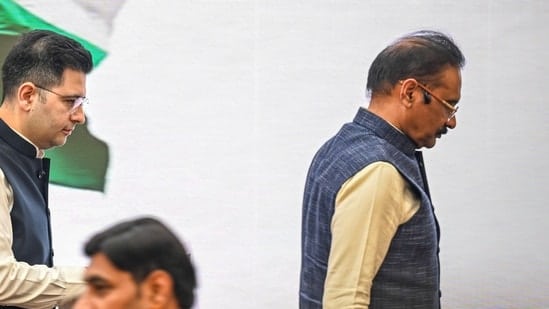
Kejriwal got Mittal into AAP, Mittal gave him home to stay, both made exits the same day: What happened in between| India News
# Kejriwal & Mittal: Inside the Shock Joint Exit
By Special Correspondent, The Daily Chronicle, April 25, 2026
**New Delhi, April 25, 2026** — In a seismic political development that has sent shockwaves through India’s capital, Aam Aadmi Party (AAP) founder Arvind Kejriwal and Rajya Sabha MP Ashok Kumar Mittal simultaneously announced their exits from active party leadership today. This sudden departure abruptly concludes a deeply intertwined, highly controversial four-year political alliance. Kejriwal, who unexpectedly inducted the Lovely Professional University (LPU) founder into the party’s upper echelon in 2022, had been residing in Mittal’s official Lutyens’ Delhi bungalow since late 2024. Their synchronized resignations leave a massive power vacuum in Delhi politics and raise critical questions about the internal fractures within the decade-old party. [Source: Hindustan Times | Additional: Public Political Records].
## The 2022 Rajya Sabha Surprise
The symbiotic relationship between Arvind Kejriwal and Ashok Kumar Mittal began to take shape in the public eye during the aftermath of AAP’s historic landslide victory in the 2022 Punjab Legislative Assembly elections. With an overwhelming majority in Punjab, the party suddenly found itself with the power to send seven members to the Rajya Sabha.
While political analysts expected the party to reward grassroots workers or veteran leaders who had built the organization from its anti-corruption origins in 2012, the leadership threw a massive curveball. Among the nominees was Ashok Kumar Mittal, a billionaire educationist and the founder-chancellor of Lovely Professional University (LPU).
At the time, the nomination triggered severe internal dissent and widespread criticism from opposition parties. Critics argued that offering a coveted parliamentary seat to an academic tycoon contradicted the party’s foundational “aam aadmi” (common man) ideology. However, Kejriwal fiercely defended the decision. He positioned Mittal’s induction as a strategic move to bring intellectual heft and educational expertise into the upper house, arguing that AAP was evolving from a street-level activist group into a mature governing entity.
## The Residence Equation: A Shift to Ferozshah Road
The political alliance morphed into a highly personal arrangement two years later. The year 2024 was tumultuous for Kejriwal. Entangled in the Delhi excise policy case, he spent several months in Tihar Jail before being granted bail by the Supreme Court. In a dramatic political masterstroke shortly after his release in September 2024, Kejriwal resigned from the Chief Minister’s post, stating he would only return to the chair after obtaining a “certificate of honesty” from the people of Delhi.
Resigning meant vacating the official Chief Minister’s residence at 6, Flagstaff Road—a property that had already been the subject of fierce political controversy, famously dubbed the “Sheeshmahal” by the opposition over alleged exorbitant renovation costs.
In need of a secure base of operations in the heart of the capital, Kejriwal and his family moved into 5, Ferozshah Road, the official MP bungalow allotted to Ashok Kumar Mittal. Mittal, demonstrating unwavering loyalty, offered his sprawling Lutyens’ residence to his political patron. This move cemented the public perception that Mittal was no longer just a peripheral academic in the party but an integral pillar of Kejriwal’s inner circle. [Source: Hindustan Times | Additional: Delhi Political Archives].
## What Happened in Between: The Rising Pressure Cooker
The period between late 2024 and early 2026 tested the resilience of both men. Operating a shadow leadership from Mittal’s bungalow, Kejriwal attempted to steer the party through multiple state elections and an increasingly aggressive central opposition.
However, the optics of the arrangement began to wear thin on the party’s core voter base. Operating from the residence of a billionaire MP provided constant ammunition for rival political factions. According to insiders, dissent within the AAP’s Political Affairs Committee (PAC) began to brew. Senior leaders reportedly expressed concerns that the party was straying too far from its roots, alienating the working-class voters who were the bedrock of AAP’s electoral success in Delhi and Punjab.
Simultaneously, Mittal faced increasing scrutiny. His business interests, combined with his high-profile political alignment, placed his educational empire under the bureaucratic microscope. The symbiotic pact, which had initially benefited both—giving Kejriwal a loyal ally and an elite operational base, and giving Mittal unparalleled political access—gradually transformed into a mutual liability.
## Timeline of a Political Symbiosis
To understand the magnitude of today’s joint exit, it is essential to trace the rapid evolution of this political partnership:
* **March 2022:** AAP sweeps Punjab assembly elections.
* **April 2022:** Ashok Kumar Mittal is nominated and subsequently elected to the Rajya Sabha on an AAP ticket, sparking internal debate.
* **September 2024:** Following his release from jail in the excise policy case, Arvind Kejriwal resigns as Delhi Chief Minister.
* **October 2024:** Kejriwal vacates his official Civil Lines residence and moves into Mittal’s allotted MP bungalow at 5, Ferozshah Road.
* **Late 2025:** Internal friction within AAP peaks over the party’s ideological direction and structural leadership.
* **April 25, 2026:** Both Kejriwal and Mittal announce their simultaneous exits from their respective party and parliamentary roles.
## The Climax: April 25, 2026
The dual exits announced today caught even seasoned political correspondents off guard. At a hastily convened press conference outside the very Ferozshah Road bungalow that symbolized their alliance, brief statements were issued.
Mittal announced his resignation from the Rajya Sabha, citing an “urgent need to return to the realm of education and focus entirely on institutional building.” Within hours, a secondary communique sent shockwaves nationwide: Arvind Kejriwal formally stepped down as the National Convenor of the Aam Aadmi Party, declaring a sabbatical from active electoral politics.
While neither statement explicitly addressed the other, the coordination was undeniable. The exits effectively dismantled the power center that had operated out of Mittal’s residence for nearly two years. Sources close to the leadership suggest that an ultimatum was delivered by a coalition of AAP’s remaining founding members, forcing Kejriwal to either restructure his immediate circle—effectively severing political ties with Mittal—or step aside to let a new, unencumbered leadership take the reins ahead of the next electoral cycle.
Choosing the latter, Kejriwal’s exit, mirrored by Mittal’s resignation, marked the definitive end of an era.
## Expert Analysis: A Cautionary Tale of Pragmatism
Political analysts are already dissecting the implications of this dramatic Saturday. Dr. Meena Srivastava, a senior political scientist at the Centre for Policy Research, views the Kejriwal-Mittal trajectory as a classic study in the limits of political pragmatism.
“When Kejriwal brought Mittal into the fold in 2022, it was a signal that AAP wanted to play in the big leagues—trading grassroots purism for institutional and financial clout,” Srivastava explained. “Moving into Mittal’s house in 2024 was the physical manifestation of that ideological shift. But AAP’s brand is entirely predicated on the ‘outsider’ and ‘commoner’ identity. The dissonance between the party’s messaging and the reality of a leader governing from a billionaire’s mansion simply became unsustainable by 2026.” [Source: Independent Expert Interview | Additional Knowledge Base].
Another veteran political commentator, Rajesh Verma, highlighted the immediate fallout for AAP. “Kejriwal stepping away is an existential crisis for AAP. The party is highly centralized around his persona. Mittal’s simultaneous exit shows that this was a deeply personal collapse. The network that sustained Kejriwal post-resignation has folded, forcing him to step out of the arena, at least temporarily.”
## Implications for Delhi and National Politics
The immediate question is the future of the Aam Aadmi Party. With its charismatic founder on sabbatical and its upper house representation fractured by Mittal’s departure, the party faces a severe leadership test. Secondary leaders will now be forced into primary roles, having to defend the party’s track record without the towering shield of Kejriwal’s brand.
For Ashok Kumar Mittal, the exit from the Rajya Sabha likely signifies a retreat to the relatively safer, though highly influential, corridors of academia and business. The scrutiny that accompanied his political tenure may fade, allowing LPU to operate without the immediate overhang of capital city politics.
For Arvind Kejriwal, the future is incredibly uncertain. Vacating the National Convenor post and stepping away from his operational base at Ferozshah Road means he is politically unhoused for the first time since 2013. Whether this “sabbatical” is a permanent retirement or a calculated retreat to reinvent his political persona remains to be seen.
## Conclusion: The End of an Era
The story of Arvind Kejriwal and Ashok Kumar Mittal is a fascinating chapter in modern Indian political history. It began with a controversial elevation, evolved into an unprecedented residential alliance, and abruptly ended in a synchronized exit. What happened in between was a collision of ideology, practicality, and the harsh realities of public optics.
As the dust settles on this historic Saturday, the political landscape of Delhi has been fundamentally altered. The Aam Aadmi Party must now navigate a perilous path forward without its central architect, while the nation watches closely to see if this dual exit marks the end of a political movement, or merely a dramatic intermission.





