
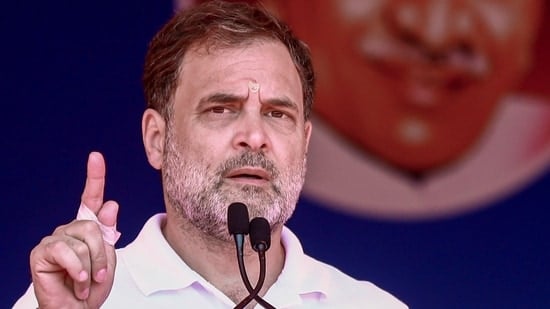
'Every time...victim is Dalit, poor': Rahul seeks high-level probe into Ghazipur rape-murder, demands swift justice| India News
# Ghazipur Dalit Case: Rahul Demands Swift Probe
**By Special Correspondent, National Affairs Desk**
**April 25, 2026**
On Saturday, April 25, 2026, senior Congress leader Rahul Gandhi demanded a high-level, independent investigation into the tragic rape and murder of a Dalit woman in Ghazipur, Uttar Pradesh. Reacting to distressing reports that local police delayed registering the case, Gandhi fiercely criticized the administration, stating that a government which forces grieving parents to beg for a basic First Information Report (FIR) has fundamentally lost its moral right to govern. This incident has sparked massive political uproar in New Delhi and Lucknow, highlighting ongoing systemic failures in India’s criminal justice system, exposing the deep vulnerabilities of marginalized communities, and triggering urgent nationwide demands for immediate legal accountability. [Source: Hindustan Times].
## The Ghazipur Tragedy and Political Outcry
The horrific incident in Ghazipur has once again brought the intersection of caste, class, and gender-based violence to the forefront of Indian political discourse. Taking to social media and addressing the press, Rahul Gandhi emphasized a deeply unsettling pattern, noting, “Every time… the victim is Dalit, poor.” His remarks underscore a recurring grievance among opposition parties and human rights activists: that the state apparatus frequently fails the most vulnerable citizens during their most desperate hours of need.
Gandhi’s demand for a high-level probe is rooted in allegations of severe local police apathy. According to initial reports, the victim’s parents faced immense bureaucratic hurdles and outright resistance when attempting to file a complaint regarding their missing and ultimately deceased daughter. The Congress leader used this administrative failure to question the state government’s widely publicized claims of a “zero-tolerance” policy toward crime, suggesting that such policies are selectively applied and often bypass those residing at the lower ends of the socio-economic spectrum.
The political opposition has rapidly rallied behind Gandhi’s statements. Various regional and national leaders have echoed his sentiments, demanding not just justice for the Ghazipur victim, but a complete overhaul of how rural police stations handle complaints from marginalized groups. The narrative being built is one of a systemic democratic failure, where the fundamental right to access justice is treated not as a constitutional guarantee, but as a privilege reserved for the socially and politically dominant. [Source: Hindustan Times | Additional: Public discourse on UP Law and Order].
## The Struggle for an FIR and Administrative Apathy
At the heart of the Ghazipur controversy is the alleged refusal of local law enforcement to promptly register an FIR. In Indian jurisprudence, the registration of an FIR is the mandatory first step that sets the criminal justice machinery into motion. The Supreme Court of India, through its landmark *Lalita Kumari* judgment, has explicitly ruled that the police must register an FIR immediately if the complaint discloses a cognizable offense. Yet, ground realities frequently contradict these judicial mandates.
“The phenomenon of ‘burking’—where police officials suppress crime statistics by refusing to register FIRs—remains a persistent disease in rural policing,” explains Meera Sahay, a senior advocate specializing in criminal justice reform in New Delhi. “When a marginalized family, particularly from a Dalit background, approaches a rural police station, they are often met with suspicion, hostility, or blatant dismissal. The fact that a grieving family must ‘beg’ for an FIR in 2026 shows a complete breakdown of administrative empathy and legal compliance.”
Experts note that local police often succumb to pressure from dominant caste groups or local politicians, leading to deliberate delays. This crucial lost time often results in the destruction of vital forensic evidence, the intimidation of witnesses, and the eventual weakening of the prosecution’s case. Gandhi’s assertion that a government overseeing such an apathetic administration has lost its “moral right” taps into the deep frustration felt by civic rights organizations fighting against this institutional inertia. [Source: Original RSS | Additional: Supreme Court Guidelines on FIR Registration].
## The Intersecting Vulnerabilities of Dalit Women
The tragedy in Ghazipur cannot be viewed as an isolated incident; it is symptomatic of the intersecting vulnerabilities faced by Dalit women in India. Being marginalized on three distinct fronts—caste, class, and gender—Dalit women frequently find themselves at the absolute bottom of the socio-economic hierarchy, making them disproportionately targeted for violence.
Sociologists and human rights groups have long pointed out that sexual violence in rural India is rarely just about gender; it is frequently utilized as a tool of caste assertion and subjugation. When marginalized communities attempt to assert their rights, claim land, or simply demand equal treatment, violence against the women of that community is often used by dominant groups to instill fear and re-establish social hierarchies.
“Violence against Dalit women is a structural issue, inextricably linked to the socio-economic power dynamics of the region,” states Dr. Anil Kumar, a professor of sociology who researches caste dynamics in North India. “The perpetrators often operate with an implicit assumption of impunity. They believe, often correctly, that the local authorities will not aggressively pursue a case against them if the victim is poor and Dalit. Gandhi’s statement accurately identifies this grim reality—poverty and caste dictate the quality of justice one receives.”
Historical data from the National Crime Records Bureau (NCRB) has consistently shown concerning trends regarding crimes against Scheduled Castes (SCs). While legislative frameworks exist to protect these groups, the translation of these laws into actual grassroots protection remains severely hindered by deep-seated societal prejudices that permeate the lower ranks of law enforcement. [Source: Hindustan Times | Additional: General NCRB Trends and Sociological Studies].
## Political Ramifications in Uttar Pradesh
The Ghazipur incident has arrived at a highly sensitive time for Uttar Pradesh’s political landscape. The state administration has aggressively marketed its governance model as one based on strict law enforcement, often citing rapid police action and stringent measures against organized syndicates. However, the opposition argues that this iron-fisted approach completely ignores the micro-level atrocities committed against vulnerable citizens.
Rahul Gandhi’s forceful intervention is part of a broader strategy by the Congress party and its allies to hold the ruling dispensation accountable on issues of social justice. By explicitly linking the failure to file an FIR with the government’s moral legitimacy, the opposition is attempting to puncture the administration’s primary narrative of improved law and order.
Local political dynamics are also rapidly shifting. Regional parties that rely heavily on Dalit and marginalized vote banks are mobilizing protests in Ghazipur and surrounding districts. The demand for a high-level probe is not merely a call for a specialized police team, but a demand to bypass the local administrative machinery entirely, which is perceived as compromised. Political analysts suggest that how the state government handles the fallout of this case—whether it opts for immediate disciplinary action against the erring police officials or assumes a defensive posture—will significantly impact its standing among marginalized electorates. [Source: Hindustan Times | Additional: UP Political Context 2026].
## The Legal Landscape: New Criminal Laws and Old Prejudices
The administrative failure in Ghazipur brings to light the stark contrast between India’s modern legal ambitions and archaic local realities. With the recent nationwide transition to the Bharatiya Nagarik Suraksha Sanhita (BNSS), which replaced the colonial-era Code of Criminal Procedure (CrPC), the legal mandates for prompt FIR registration, electronic complaints (e-FIRs), and immediate medical examination of victims have been theoretically strengthened.
Furthermore, the Scheduled Castes and the Scheduled Tribes (Prevention of Atrocities) Act remains one of the most stringent pieces of legislation designed specifically to protect marginalized communities. The Act explicitly penalizes public servants who neglect their duties, including the refusal to register complaints.
However, legal experts argue that no amount of legislative modernization can substitute for ground-level sensitization. “We have upgraded our criminal codes, but we have not upgraded the mindset of the local constabulary,” notes advocate Sahay. “The BNSS mandates strict timelines and allows for Zero FIRs to be filed anywhere regardless of jurisdiction. Yet, in Ghazipur, parents had to beg. This demonstrates that the bottleneck is not the law, but the caste-bias and class-bias inherent in the personnel enforcing the law.”
The failure to invoke the SC/ST Act immediately, alongside relevant sections for murder and sexual assault, highlights a deliberate attempt to dilute the severity of the crime—a tactic frequently employed to protect influential perpetrators. Gandhi’s call for swift justice implicitly demands that the full weight of these modern statutory provisions be applied without prejudice. [Source: Original RSS | Additional: Legal Framework of BNSS and SC/ST Act].
## Calls for Systemic Reform and Accountability
The demands stemming from the Ghazipur case extend beyond the immediate arrest of the perpetrators. Activists and political figures alike are calling for strict, punitive action against the police officials who delayed the FIR. Establishing a precedent of holding law enforcement accountable is viewed as the only viable deterrent against future negligence.
**Key demands emerging from civic rights groups include:**
* **Immediate Suspension:** Disciplinary action and suspension of the station house officer (SHO) and related personnel who refused to register the initial complaint.
* **Judicial Oversight:** A court-monitored investigation or the transfer of the case to an independent agency to ensure local political dynamics do not influence the probe.
* **Implementation of Statutory Compensation:** Immediate financial and legal assistance to the victim’s family as mandated by the SC/ST (Prevention of Atrocities) Rules.
* **Police Sensitization Drives:** Mandatory, rigorous training programs for rural law enforcement focused on caste sensitivity and gender-based violence.
If the government wishes to retain its moral authority, as questioned by Rahul Gandhi, it must demonstrate an unwavering commitment to these reforms. The public patience for commissions and inquiries that yield no structural changes is wearing thin, making swift, transparent action a political and moral imperative. [Source: Hindustan Times | Additional: Human Rights Commission Guidelines].
## Conclusion: Key Takeaways and Future Outlook
The tragic rape and murder of a Dalit woman in Ghazipur, coupled with the shameful administrative apathy her family endured, stands as a dark reminder of the enduring inequalities within India’s criminal justice system. Rahul Gandhi’s intervention has rightfully amplified a localized tragedy into a matter of national conscience, posing uncomfortable questions about who the state apparatus truly serves.
**Key Takeaways:**
1. **Systemic Bias:** The necessity for marginalized parents to “beg” for an FIR indicates a severe, deep-rooted bias within rural policing structures.
2. **Political Accountability:** The opposition is drawing a direct line between administrative failures and the ruling government’s moral right to govern, challenging the overarching narrative of superior law and order.
3. **Legislative Gap:** Despite modern legal frameworks like the BNSS and the SC/ST Act, grassroots implementation remains hobbled by socio-economic prejudices.
Looking ahead, the trajectory of the Ghazipur case will serve as a crucial litmus test for the state’s administration. Will it result in a genuinely independent, high-level probe that not only punishes the perpetrators but also the complicit officials? Or will it fade into the tragic statistics of marginalized suffering? True “swift justice” will require moving beyond political rhetoric to ensure that the doors of police stations are equally open to all citizens, regardless of their caste, class, or economic standing.





