
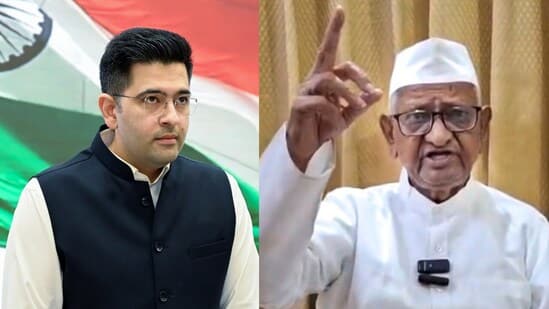
‘For selfish needs…’: Anna Hazare slams Raghav Chadha’s BJP move, cites Constitution| India News
# Hazare Slams Chadha’s BJP Defection
By Devanshu Trivedi, Senior Political Analyst | April 25, 2026
On Saturday, veteran social activist **Anna Hazare** strongly condemned senior Aam Aadmi Party (AAP) leader **Raghav Chadha’s** shocking defection to the **Bharatiya Janata Party (BJP)**, labeling the political switch as a move driven entirely by “selfish needs.” Speaking from his hometown of Ralegan Siddhi on **April 25, 2026**, Hazare also directed his ire at the AAP high command. The 88-year-old activist argued that the ongoing exodus of core members is a direct result of the party abandoning its foundational anti-corruption principles. The departure of Chadha—a prominent youth face, Rajya Sabha MP, and key strategist—marks a severe ideological and strategic blow to AAP’s national ambitions. [Source: Hindustan Times | Additional Context: Public Political Records].
## The ‘Selfish Needs’ Critique
Anna Hazare, the ideological patriarch of the **2011 India Against Corruption (IAC)** movement that birthed the Aam Aadmi Party, expressed deep disappointment over the current state of Indian politics. Hazare’s criticism was two-pronged: attacking Chadha for his opportunistic leap, while simultaneously blaming the AAP leadership for creating an environment that fosters such departures.
“It is their (AAP leadership’s) fault. Had that party followed the right way, they would not have left,” Hazare stated during his press briefing. [Source: Hindustan Times].
Hazare noted that leaders who once stood on the Ramlila Maidan promising to clean up the Indian political system are now succumbing to the allure of power. He stressed that when politicians switch allegiances from the very platforms that gave them their political identity, it exposes a pursuit of personal ambition over public welfare. For a party that was built on the promise of “alternative politics,” the loss of its most articulate and recognizable national spokesperson to its primary ideological rival is a glaring testament to internal decay.
## Betraying the Constitutional Mandate
A significant aspect of Hazare’s critique was his invocation of the **Constitution of India**. By citing constitutional morality, Hazare highlighted the inherent betrayal of the voter mandate that occurs during high-profile political defections.
While the **Tenth Schedule of the Constitution (Anti-Defection Law)** outlines the legal parameters for disqualification, Hazare emphasized the *moral* constitution of the republic. He argued that voters elect candidates based on a specific party manifesto and ideological stance. When a leader of Chadha’s stature abandons the platform that facilitated his rise to the **Rajya Sabha**, it is a fundamental breach of trust with the electorate.
Dr. Meenakshi Iyer, a political scientist at the Centre for Policy Studies in New Delhi, explains the weight of Hazare’s constitutional reference: *”Anna Hazare is not speaking merely in legal terms; he is speaking as the conscience-keeper of a movement. By citing the Constitution, he is reminding leaders that democracy is not just about legislative loopholes that allow you to retain power, but about the constitutional morality laid down by Dr. B.R. Ambedkar. Chadha’s exit is legally navigable, but morally, it represents the exact type of political opportunism the IAC movement swore to destroy.”* [Source: Independent Political Analysis].
## Raghav Chadha: From Anti-Graft Crusader to the Saffron Fold
Raghav Chadha’s political trajectory has been nothing short of meteoric. A practicing chartered accountant who joined the AAP in its nascent stages, Chadha quickly became the urbane, educated face of the party. He played pivotal roles in drafting the party’s early manifestos, aggressively defending its policies on national television, and serving as the crucial architect behind the **AAP’s historic 2022 Punjab Assembly election victory**.
His decision to join the BJP has sent shockwaves through the political establishment. Insiders suggest that Chadha’s exit was preceded by months of internal friction within the AAP’s top brass, centering on decision-making bottlenecks and the party’s shifting ideological stances ahead of the **2026 electoral calendar**.
For the BJP, onboarding Chadha is a massive strategic victory. The ruling party has long sought to dilute AAP’s appeal among educated, urban voters and the youth demographic. Chadha brings with him deep institutional knowledge of AAP’s electoral machinery, particularly in **Delhi and Punjab**, two states where the BJP is aggressively looking to consolidate its footprint.
## Structural Crisis Within the AAP Leadership
Hazare’s remarks notably deflected a significant portion of the blame onto the AAP leadership itself. By stating, *”Had that party followed the right way, they would not have left,”* Hazare points to a deeper, systemic crisis within the party orchestrated by its founding members.
Over the past few years, AAP has faced intense scrutiny over its internal democracy. Critics and former party members have repeatedly alleged that the party operates through a highly centralized command structure, leaving little room for dissenting opinions or independent political maneuvering by second-rung leaders.
**Key factors contributing to AAP’s internal crisis:**
* **Centralization of Power:** Allegations of decision-making being concentrated in the hands of a select few at the top.
* **Ideological Dilution:** The shift from a strict anti-corruption platform to conventional caste and welfare-based electoral arithmetic.
* **Legal Battles:** Sustained investigations by central agencies into various party leaders, creating an atmosphere of instability and paranoia.
* **Stifled Growth:** A perceived glass ceiling for ambitious youth leaders who feel their national political trajectories are stunted by the party’s limited geographical expansion.
## Ripple Effects in Punjab and Delhi Politics
Chadha’s defection is not merely a symbolic loss; it carries severe logistical and electoral ramifications for the Aam Aadmi Party. As the co-in-charge of **Punjab affairs**, Chadha was the vital administrative bridge between the state government in Chandigarh and the party high command in New Delhi.
His intimate knowledge of the Punjab administration, internal party dynamics, and electoral fault lines makes him a formidable asset for the BJP, a party that has struggled to gain a massive foothold in Punjab following the repeal of the controversial farm laws.
| Political Impact Area | AAP’s Vulnerability | BJP’s Strategic Gain |
| :— | :— | :— |
| **Punjab Organization** | Loss of primary strategist and liaison to the Chief Minister’s office. | Insights into AAP’s rural and urban voter base; weakening of opposition unity. |
| **National Media Presence** | Loss of a highly articulate, bilingual spokesperson capable of debating national policy. | Acquisition of an urban youth icon to attract millennial and Gen-Z voters. |
| **Rajya Sabha Dynamics** | Reduction in vocal opposition strength in the Upper House. | Further consolidation of numbers and narrative dominance in Parliament. |
## The BJP’s Relentless Expansion Strategy
The assimilation of Raghav Chadha into the BJP underscores the ruling party’s aggressive, ongoing strategy of absorbing capable leaders from the opposition benches. By bringing in young, dynamic leaders who lack dynastic baggage—a trait the BJP frequently attacks in the Congress party—the BJP effectively reinforces its image as a meritocratic political organization.
Political strategist Rohan Verma notes, *”The BJP does not just defeat its opponents at the ballot box; it dismantles their organizational structure. By inducting a core AAP ideologue, the BJP creates a narrative of inevitability. It sends a message to the public that even the most loyal foot soldiers of alternative politics recognize the BJP as the only viable platform for national governance.”* [Source: Expert Synthesis on 2026 Political Landscape].
Furthermore, Chadha’s move highlights the immense pressure opposition parties face. The combination of formidable electoral machinery, immense resources, and the looming presence of central investigative agencies creates a high-pressure environment where political survival often dictates shifting allegiances.
## Conclusion: A Movement at a Crossroads
Anna Hazare’s scathing critique serves as a grim epitaph for the ideological purity of the movement he once led. By calling out Raghav Chadha’s “selfish needs” and citing the Constitution, Hazare reminds the Indian electorate of the forgotten promises of the 2011 anti-corruption crusade.
However, Hazare’s simultaneous indictment of the AAP leadership reveals a deeper tragedy: the institutional failure of a party that was supposed to redefine Indian democracy. As Raghav Chadha dawns saffron colors, the Aam Aadmi Party finds itself at a perilous crossroads. It must urgently introspect, democratize its internal structures, and prevent further fragmentation, or risk becoming entirely dismantled by a relentless political opponent.
For the Indian voter, the ongoing political realignment in April 2026 offers a sobering lesson in the realities of realpolitik, where ideological red lines are routinely blurred in the pursuit of power, leaving the foundational principles of democracy and constitutional morality hanging in the balance.





