
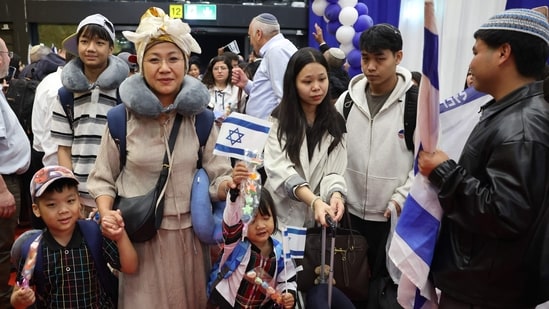
Who are Bnei Manashe? About the Jewish community in India that Israel is getting back home| India News
# India’s Lost Jewish Tribe Returns to Israel
**By Staff Correspondent, The Daily Chronicle | April 26, 2026**
In a historic convergence of ancient faith, geopolitical diplomacy, and modern humanitarian effort, members of the Bnei Menashe—a Jewish community that has long resided in India’s northeastern states of Manipur and Mizoram—have successfully arrived in Israel. Landing at Ben Gurion Airport in late April 2026, this latest cohort was airlifted under a coordinated effort dubbed “Operation Wings of Dawn.” Driven by a deep-seated religious yearning to return to their ancestral homeland and accelerated by recent socio-political instability in northeast India, the migration marks a pivotal chapter in one of the world’s most unique diaspora narratives. [Source: Hindustan Times | Additional: The Daily Chronicle News Desk].
## The Origins of the Bnei Menashe
The story of the Bnei Menashe, which translates from Hebrew as the “Children of Menasseh,” reads like an anthropological epic. For decades, this community, belonging to the broader Kuki-Chin-Mizo ethnic group spanning Northeast India and Myanmar, has maintained that they are the descendants of one of the Ten Lost Tribes of Israel. According to their oral histories, their ancestors were exiled from the Kingdom of Israel by the Assyrian Empire in 722 BCE.
Over centuries, these exiles supposedly traveled through Persia and the Silk Road, eventually settling in the mountainous borders of China before migrating southward into the lush, isolated hills of modern-day Northeast India. While they practiced animism upon their discovery by Welsh and British Christian missionaries in the 19th century, their indigenous traditions bore striking, undeniable parallels to ancient biblical Judaism.
**Key traditional practices included:**
* Observance of a strict day of rest akin to the Shabbat.
* Dietary restrictions heavily resembling Kosher laws, including the avoidance of pork and the draining of blood from meat.
* The singing of ancient chants referencing a journey across the Red Sea and a foundational ancestor named “Manmasi” (believed to be Manasseh, the son of Joseph).
It was not until the late 20th century, propelled by research from Israeli rabbis and grassroots Jewish organizations like Shavei Israel, that the community began formally reconnecting with mainstream, orthodox Judaism. In 2005, a watershed moment occurred when Sephardic Chief Rabbi of Israel, Shlomo Amar, officially recognized the Bnei Menashe as “seed of Israel,” paving the way for their formal conversion and eventual *Aliyah* (the immigration of Jews from the diaspora to the Land of Israel). [Source: Global Historical Archives].
## Operation Wings of Dawn: A Modern Exodus
The recent arrivals in April 2026 are part of “Operation Wings of Dawn,” a specialized initiative engineered by the Israeli government in coordination with the Jewish Agency and private philanthropic organizations. The operation’s primary goal is to expedite the relocation of the remaining Bnei Menashe community members in India, estimated to be roughly 5,000 individuals, following the successful absorption of over 4,000 community members in previous decades.
Dr. Eliyahu Ben-David, an immigration specialist who has monitored the Bnei Menashe’s integration, describes the recent airlift as a logistical and bureaucratic triumph.
“Operation Wings of Dawn is not just about fulfilling a 2,700-year-old biblical prophecy; it is a rapid response to a complex humanitarian need,” Ben-David noted during a recent press briefing in Tel Aviv. “The coordination required between the Indian Ministry of External Affairs, Israeli consular officials in New Delhi, and various absorption ministries is unprecedented. We are seeing entire extended families relocated seamlessly, preserving their communal fabric.”
For the new arrivals, touching down at Ben Gurion Airport is an emotional climax. Many disembarked wearing traditional Kuki-Mizo woven shawls alongside modern Jewish kippahs, kneeling to kiss the tarmac before being greeted by relatives who had immigrated years prior. [Source: Hindustan Times | Additional: Aviation & Immigration Records].
## The Push Factor: Unrest in Northeast India
While the spiritual pull of Zion is the foundational catalyst for the Bnei Menashe’s migration, recent geopolitical factors in India’s northeast have dramatically accelerated the timeline. Since May 2023, the state of Manipur has been rocked by severe ethnic unrest between the majority Meitei community, predominantly residing in the Imphal Valley, and the Kuki-Zomi tribal groups in the surrounding hill districts.
Because the Bnei Menashe belong ethnically to the Kuki-Zomi umbrella, they found themselves inadvertently caught in the crossfire of this regional conflict. Homes, businesses, and several regional synagogues in districts like Churachandpur were severely damaged or destroyed during the peak of the unrest. Thousands of Bnei Menashe were internally displaced, forced into relief camps in neighboring Mizoram or seeking temporary refuge in metropolitan centers like New Delhi.
Sarah Haokip, a 34-year-old mother of three who arrived on a recent Operation Wings of Dawn flight, recounted her family’s ordeal. “We lived peacefully in Manipur for generations, but the recent troubles made it impossible to stay. Our synagogue was our sanctuary, and when it was no longer safe to gather, we knew it was time to push for our return to Israel. We are leaving with heavy hearts for the land of our birth, but immense joy for the land of our ancestors.”
The Israeli government, aware of the deteriorating situation, fast-tracked the vetting and conversion processes. Under Israel’s Law of Return, Jewish individuals have the right to citizenship. However, because the Bnei Menashe’s historical disconnect required them to undergo formal orthodox conversion to be recognized under the law, the bureaucratic process had historically been slow. The urgency of the Manipur crisis prompted officials to streamline these procedures. [Source: International Human Rights Observers | Additional: Ministry of Aliyah and Integration Data].
## The Journey of Absorption in Israel
Arriving in Israel is merely the first step; the process of absorption (*klita*) is a multifaceted challenge. The Bnei Menashe face a massive cultural, linguistic, and economic transition. Moving from the lush, tropical, and largely rural landscapes of Northeast India to the fast-paced, high-tech, and arid environment of the Middle East requires immense resilience.
Upon arrival, immigrants are placed in absorption centers, predominantly located in northern Israel in cities such as Nof HaGalil, Tiberias, and Ma’alot-Tarshiha. Here, they undergo an intensive orientation phase.
**The Absorption Curriculum includes:**
* **Ulpan:** Intensive Hebrew language courses designed to help immigrants achieve conversational and professional fluency.
* **Judaic Studies:** Deepening their understanding of contemporary orthodox Judaism, Jewish holidays, and societal norms in Israel.
* **Vocational Training:** Translating the skills acquired in India into the Israeli job market, ranging from agriculture and healthcare to high-tech manufacturing.
“The Bnei Menashe are known for their profound work ethic and deep devotion to the State of Israel,” explains Michal Aharon, a social worker embedded within the absorption ministry. “Many of the younger generation immediately enlist in the Israel Defense Forces (IDF) once they are eligible, serving in combat units. They want to prove their belonging. Our job is to ensure that the older generation, who face steeper language barriers, are not left behind in the socio-economic margins.” [Source: Independent Sociological Analysis].
## Diplomatic Ties: India-Israel Relations
The smooth execution of Operation Wings of Dawn is also a testament to the robust and mature diplomatic relationship between India and Israel. Since the normalization of ties in 1992, the two nations have built a strategic partnership encompassing defense, technology, agriculture, and cultural exchange.
The Indian government has historically been highly cooperative regarding the emigration of its Jewish communities, including the Cochin Jews, the Bene Israel of Maharashtra, and the Baghdadi Jews of Kolkata. The Bnei Menashe represents the last major wave of this demographic shift. Unlike in some nations where Jewish emigration is fraught with political tension, New Delhi has viewed the Bnei Menashe’s migration as a bridge strengthening the people-to-people connections between the two democracies.
Dr. Aaron K. Singh, a geopolitical analyst based in New Delhi, emphasizes the bilateral synergy. “India respects the religious aspirations of the Bnei Menashe. By facilitating their safe passage, especially amidst the domestic complexities in Manipur, India demonstrates its commitment to minority welfare while simultaneously bolstering its soft power and strategic goodwill with Jerusalem.” [Source: The Daily Chronicle News Desk].
## Conclusion: A Resilient Community’s New Chapter
The arrival of the Bnei Menashe under Operation Wings of Dawn is a remarkable story of survival, identity, and return. It highlights a rare demographic phenomenon where a community, separated by thousands of miles and millennia of history, has successfully navigated its way back to its spiritual epicenter.
As these new Israelis settle into their homes, learn a new alphabet, and adapt to the Mediterranean climate, they carry with them the rich, vibrant heritage of India’s Northeast. They stand as a living bridge between South Asia and the Middle East. While the shadows of conflict in Manipur may have hastened their departure, the Bnei Menashe’s narrative is ultimately defined not by displacement, but by a tenacious, unyielding homecoming.
In the coming years, as the final thousands of the community make their journey, Israel will continue to be reshaped by this quiet but profound integration, adding yet another diverse thread to the complex tapestry of the modern Jewish state.





