
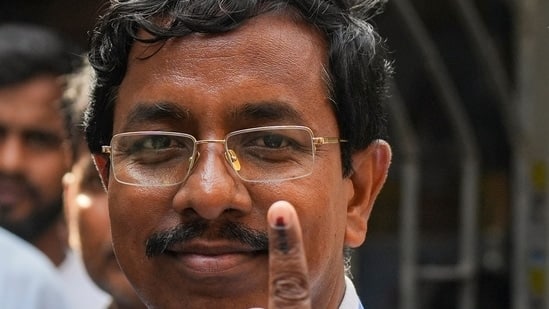
Pabitra Kar: TMC’s grassroots challenger in the high-stakes Nandigram battle| India News
# Nandigram 2026: TMC’s Kar vs BJP’s Adhikari
**By Vikram Chatterjee, Political Editor, India Electoral Desk | April 25, 2026**
In the high-stakes battleground of Nandigram, the Trinamool Congress (TMC) has officially fielded grassroots leader Pabitra Kar to challenge Bharatiya Janata Party (BJP) heavyweight and incumbent Member of the Legislative Assembly, Suvendu Adhikari, in the 2026 West Bengal elections. As the state gears up for an intensely polarized polling phase this May, all eyes have once again converged on Purba Medinipur district. Five years after TMC supremo Mamata Banerjee’s narrow defeat in this very constituency, the ruling party has dramatically shifted its strategy. Instead of a top-tier celebrity or state-level minister, TMC is banking on Kar’s deep local networks to counter Adhikari’s formidable regional dominance and national backing. [Source: Hindustan Times | Additional: West Bengal Election Commission Briefing, April 2026].
## The Grassroots Challenger: Who is Pabitra Kar?
To understand the TMC’s strategy in 2026, one must look at the profile of their chosen candidate. Unlike the parachuted politicians or cinematic figures often deployed in high-profile constituencies, Pabitra Kar is a quintessential organizational man. For decades, Kar has operated beneath the media radar, focusing primarily on the agrarian and cooperative networks that form the economic backbone of Purba Medinipur.
Kar’s selection is a calculated maneuver by the Trinamool Congress high command. Following the defection of the Adhikari family to the BJP prior to the 2021 elections, the TMC struggled with a severe leadership vacuum in the district. Kar, who stayed loyal to the party during its most turbulent periods in the region, was tasked with quietly rebuilding the fractured booth-level committees.
His daily routine involves interacting with betel leaf farmers, paddy cultivators, and local fishermen—demographics that have felt the sting of inflation and erratic weather patterns over the past few years. By nominating Kar, the TMC is attempting to change the narrative from a clash of titans to a battle between a humble local worker and a powerful political dynast. [Source: Hindustan Times | Additional: Regional Socio-Political Archives].
## The Ghost of 2021 and Nandigram’s Historical Weight
It is impossible to analyze the current political climate of Nandigram without traversing its blood-stained and revolutionary history. In 2007, the region became international news when a violent anti-land acquisition movement against a proposed Special Economic Zone (SEZ) left 14 villagers dead. That movement, spearheaded under the banner of the Bhumi Uchched Pratirodh Committee (BUPC), catapulted Mamata Banerjee to power, ending 34 years of Left Front rule in 2011.
Ironically, Suvendu Adhikari was Banerjee’s primary ground commander during that agitation. Fast forward to 2021, the mentor and the protégé clashed in a historic electoral duel. Adhikari, running on a BJP ticket, defeated Chief Minister Banerjee by a razor-thin margin of 1,956 votes in an election marred by controversy, recounts, and ongoing legal petitions.
This historical context makes the 2026 contest more than just an election; it is a battle for the legacy of the 2007 agrarian revolt. Adhikari claims the legacy as the “son of the soil” who stood by the martyrs, while the TMC asserts that the true spirit of the Nandigram movement resides with the party symbol and the chief minister who led from the front.
## BJP’s Fortress: Suvendu Adhikari’s Incumbency Advantage
As the Leader of the Opposition (LoP) in the West Bengal Legislative Assembly, Suvendu Adhikari has spent the last five years consolidating his grip over the Medinipur belt. His political machinery is arguably the most organized faction within the Bengal BJP, operating semi-autonomously through a vast network of loyalists, cooperative society heads, and local influencers.
Adhikari’s 2026 campaign is heavily anchored in anti-incumbency sentiments against the state government. He has rigorously amplified allegations of corruption within the TMC, specifically focusing on the recent school job scams, ration distribution irregularities, and local syndicates.
Furthermore, Adhikari benefits from the immense infrastructural push by the Central Government. By consistently contrasting the Modi administration’s central schemes (like PM Kisan Samman Nidhi) with the state government’s delivery mechanisms, Adhikari has managed to maintain a strong developmental narrative alongside his aggressive Hindutva pitch, which resonates strongly with the majority demographic in the region.
## Demographic Arithmetic and Voting Blocs
Elections in Nandigram are ultimately decided by complex demographic arithmetic, heavily polarized along community and caste lines. The constituency comprises distinct voting blocs that both parties are desperately trying to court.
**Key Demographic Breakdowns:**
* **The Mahishya Community:** Forming nearly 50% of the electorate, this agrarian Hindu caste is the traditional stronghold of the Adhikari family. Their consolidation behind the BJP in 2021 was the primary reason for Suvendu’s victory.
* **Minority Voters:** Muslims constitute roughly 25-27% of Nandigram’s population. They have remained steadfastly loyal to the TMC. Consolidating this vote without fragmentation is crucial for Pabitra Kar’s mathematical chances.
* **Scheduled Castes (SC) and Swing Voters:** Making up the remaining segment, these voters often swing based on the efficacy of state welfare delivery versus central interventions.
Pabitra Kar belongs to the local community, and TMC strategists hope his caste identity and localized appeal will chip away at Adhikari’s Mahishya vote bank. Even a 5-7% swing in the dominant Hindu caste demographic, combined with solid minority backing, could theoretically tip the scales in TMC’s favor.
## TMC’s Strategic Pivot: Localizing the Narrative
By deciding not to contest from Nandigram herself in 2026, Mamata Banerjee has executed a calculated political pivot. In 2021, Adhikari successfully framed the contest as an “insider versus outsider” battle, branding the Chief Minister as an outsider to Medinipur.
With Pabitra Kar as the face of the TMC campaign, that narrative is entirely neutralized.
“The Trinamool Congress has learned from the optical errors of 2021,” notes Dr. Ayanabho Sengupta, a Kolkata-based political analyst and author of several texts on Bengal’s electoral history. “By pitting a quiet, organizational man against the Leader of the Opposition, TMC is forcing Adhikari to fight a distinctly local election. If Adhikari attacks Kar too aggressively, he risks coming across as bullying a grassroots worker. It turns a David versus Goliath battle on its head.” [Source: Independent Political Analysis, April 2026].
Furthermore, Kar’s campaign heavily emphasizes the Mamata Banerjee government’s flagship welfare schemes. The *Lakshmir Bhandar* scheme (monthly financial assistance for women) and *Swasthya Sathi* (health insurance) are the mainstays of his door-to-door outreach, attempting to bypass political polarization through direct economic benefits.
## On-the-Ground Campaign Realities in 2026
As of late April 2026, the atmosphere in Nandigram is electric and highly militarized. The Election Commission of India has already deployed several companies of Central Armed Police Forces (CAPF) to prevent a repeat of the post-poll violence that scarred the region in previous cycles.
The visual contrast between the two campaigns is stark. Adhikari’s rallies are massive, highly produced affairs, featuring prominent national BJP leaders flying in via helicopters, massive saffron stage setups, and booming rhetoric promising an end to TMC’s “syndicate raj.”
In contrast, Pabitra Kar’s campaign is deliberately micro-managed. He travels in small convoys, frequently walking through the narrow alleys of Reyapara and Bhekutia. His speeches focus strictly on local grievances: the repair of embankments damaged by recent cyclones, the pricing of agricultural produce, and ensuring the seamless delivery of state funds to women’s bank accounts.
“We do not need helicopters to reach our people; we live among them,” Kar was recently quoted saying during a panchayat-level meeting in Nandigram Block 1. “The people here know who stood with them during the floods and who was busy in Delhi.” [Source: Hindustan Times].
## Conclusion: Implications for West Bengal’s Future
The electoral verdict of Nandigram in 2026 will reverberate far beyond the borders of Purba Medinipur.
If Suvendu Adhikari secures a convincing victory, it will cement his position not just as the undisputed leader of the BJP in West Bengal, but as the primary architect of the anti-TMC resistance. It would validate the BJP’s strategy of aggressive polarization coupled with anti-corruption campaigning.
Conversely, if Pabitra Kar manages to pull off an upset, it will be hailed as a masterstroke by Mamata Banerjee. Defeating the Leader of the Opposition with a grassroots cadre would severely cripple the BJP’s morale and reaffirm the TMC’s absolute dominance over rural Bengal’s political landscape.
Ultimately, the high-stakes battle of Nandigram serves as the perfect microcosm for the 2026 West Bengal elections—a fierce contest between towering political ambition, the enduring legacy of agrarian revolution, and the quiet, persistent hum of grassroots mobilization. As voters prepare to press the electronic voting machine buttons, they carry the weight of Bengal’s volatile history on their shoulders.





