
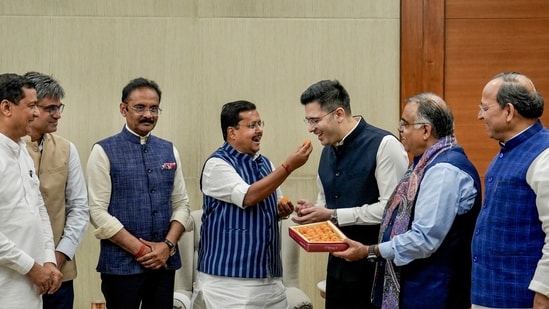
Rajya Sabha chair accepts Raghav Chadha, other AAP rebels' BJP merger: ‘Welcome to nation-building NDA’| India News
# AAP Rebels Merge With BJP in Rajya Sabha
By Political Desk, National News Chronicle | April 27, 2026
On April 27, 2026, the Indian political landscape experienced a seismic shift as the Rajya Sabha Chair officially accepted the merger of seven rebel Aam Aadmi Party (AAP) Members of Parliament into the ruling Bharatiya Janata Party (BJP). Heavyweights including Raghav Chadha, Sandeep Pathak, and Swati Maliwal officially severed ties with the AAP, delivering a crippling blow to the opposition’s upper house strength. The Chair welcomed the lawmakers to the “nation-building NDA,” legally recognizing the transition under the Tenth Schedule, as the defectors comfortably crossed the two-thirds majority required to bypass India’s stringent anti-defection laws. [Source: Hindustan Times].
## The Anatomy of a Historic Political Exodus
The mass exodus from the Aam Aadmi Party is unprecedented in the party’s turbulent but relatively short history. The official parliamentary bulletin confirmed that seven sitting Rajya Sabha MPs—**Raghav Chadha, Ashok Mittal, Sandeep Pathak, Vikramjit Singh Sahney, Harbhajan Singh, Swati Maliwal, and Rajinder Gupta**—have formally been inducted into the BJP.
This transition was not a sudden overnight defection but the culmination of months of brewing internal discontent. According to the parliamentary proceedings published early Monday morning, the Rajya Sabha Chair reviewed the petition submitted by the rebel faction. Finding that the move met all constitutional prerequisites, the Chair ratified the merger, stating, “Welcome to the nation-building NDA.” [Source: Hindustan Times].
The integration of these seven leaders into the National Democratic Alliance (NDA) fundamentally alters the arithmetic of the Rajya Sabha, stripping the AAP of its most vocal and strategically important representatives in New Delhi.
## The Mathematics of the Tenth Schedule
The legal mechanics of this defection rest heavily on the **Tenth Schedule of the Indian Constitution**, commonly known as the Anti-Defection Law. Originally designed to prevent opportunistic party-hopping, the law mandates that MPs who voluntarily give up their party membership face immediate disqualification. However, there is a critical exemption: if at least two-thirds of a legislative party’s members agree to merge with another political party, they are shielded from disqualification.
Prior to this event, the Aam Aadmi Party held 10 seats in the Rajya Sabha. The departure of exactly seven MPs equates to 70% of the party’s legislative strength in the Upper House, safely clearing the 66.6% threshold required by the Constitution.
“Because the rebel faction constitutes more than two-thirds of the AAP’s total strength in the Rajya Sabha, the merger is completely insulated from the punitive measures of the Tenth Schedule,” explains Dr. Arindam Bose, a senior constitutional scholar based in New Delhi. “Legally, the Rajya Sabha Chair had no grounds to disqualify them, making this a masterclass in constitutional maneuvering by the BJP.” [Additional: Constitutional Law Analysis].
## Breaking Down the Rebel Faction: Who Left and Why?
The sheer profile of the departing MPs makes this merger devastating for the AAP. Each defector brings a unique set of political, strategic, or financial capital to the BJP:
* **Raghav Chadha:** Once considered the blue-eyed boy of the AAP and a trusted lieutenant of the party high command, Chadha’s departure is the most symbolically damaging. His articulate defenses of the party on national television were a staple of AAP’s media strategy. Sources suggest his prolonged absences during critical party crises in recent years created an irreparable rift with the leadership.
* **Sandeep Pathak:** The AAP’s organizational mastermind and National General Secretary (Organization). Pathak was credited with engineering the party’s historic landslide victory in Punjab. His exit severely handicaps the AAP’s grassroots electoral machinery ahead of future state elections.
* **Swati Maliwal:** The former Delhi Commission for Women (DCW) chief’s relationship with the AAP leadership fractured publicly in mid-2024 following allegations of an assault by a close aide to the Chief Minister. Her shift to the BJP has long been anticipated by political insiders, framing her exit as a quest for political vindication.
* **Harbhajan Singh:** The cricket legend turned politician has largely remained non-controversial but has increasingly aligned with nationalist narratives that fit seamlessly into the BJP’s ideological framework.
* **The Industrialists (Ashok Mittal, Vikramjit Singh Sahney, and Rajinder Gupta):** Mittal (Chancellor of Lovely Professional University), Sahney (Sun Group), and Gupta (Trident Group) represent the corporate and philanthropic backing from Punjab. Their defection is widely seen as an alignment with the central government’s pro-business and economic stability policies, ensuring uninterrupted regional development.
## A Crippling Blow to AAP’s National Ambitions
For the Aam Aadmi Party, losing 70% of its Rajya Sabha presence is more than a numerical setback; it is an existential crisis for its national ambitions. The party had spent a decade meticulously expanding its footprint beyond Delhi, using its Upper House MPs to project a formidable opposition voice against the BJP on the national stage.
“This is practically a surgical strike on the AAP’s intellectual and strategic core,” notes Meenakshi Rao, a senior political analyst. “Losing Pathak dismantles their electoral war room. Losing Chadha and Maliwal silences their most resonant and recognizable voices in Parliament. The party is now virtually muted in the Council of States.” [Additional: Political Impact Assessment].
Furthermore, the optics of anti-corruption crusaders and foundational party members joining the BJP dilutes the AAP’s long-standing moral high ground. It leaves the remaining leadership scrambling to manage the narrative of internal collapse while defending against relentless attacks from opposition parties.
## BJP’s Upper House Consolidation and Legislative Agenda
For the Bharatiya Janata Party, this merger is a calculated triumph of legislative engineering. Throughout its successive terms, the NDA has occasionally faced roadblocks in the Rajya Sabha, where it lacked the brute majority it enjoys in the Lok Sabha.
By absorbing seven new MPs, the BJP takes a massive leap toward an absolute majority in the Upper House. This mathematical advantage is crucial for the latter half of 2026, as the government seeks to push through highly contested and structural legislative reforms. Speculation is rife that the NDA is preparing the groundwork for ambitious constitutional amendments, potentially involving sweeping electoral reforms or delimitation exercises.
“The addition of these seven MPs provides the BJP with a vital legislative buffer. It guarantees smoother passage for contentious bills that the opposition INDIA bloc would have otherwise stalled,” states a recent editorial analysis from a leading policy think tank. [Additional: Parliamentary Data Analysis].
## The “Operation Lotus” Allegations and Opposition Backlash
The immediate aftermath of the Rajya Sabha Chair’s announcement sparked outrage across opposition benches. Remaining AAP loyalists and allied parties within the INDIA bloc were quick to label the merger as another chapter of **”Operation Lotus”**—a colloquial term used by the opposition to describe the BJP’s alleged strategy of toppling rival governments and poaching lawmakers through coercion or inducement.
Opposition leaders took to social media and public forums to condemn the move, accusing the ruling dispensation of utilizing federal investigative agencies to pressure the industrialists and politicians into switching allegiances. However, the rebel faction swiftly dismissed these allegations.
In a joint press statement following the official merger, the defected MPs cited “stifling internal dictatorship,” “loss of the party’s original anti-corruption vision,” and a “desire to contribute to the Prime Minister’s vision for a developed India” as their primary motivations for joining the NDA. [Source: Hindustan Times].
## Conclusion: The Reshaping of India’s Political Landscape
The April 2026 defection of Raghav Chadha, Swati Maliwal, Sandeep Pathak, and four other prominent AAP MPs to the BJP will likely be remembered as a watershed moment in contemporary Indian politics.
**Key Takeaways:**
* **Constitutional Validity:** By executing a defection of 7 out of 10 MPs, the rebels successfully bypassed the Tenth Schedule’s disqualification clauses, securing their Rajya Sabha tenures under the BJP banner.
* **Legislative Power Shift:** The NDA moves significantly closer to absolute dominance in the Rajya Sabha, removing legislative hurdles for major upcoming bills.
* **AAP’s Crisis:** The Aam Aadmi Party loses its core parliamentary voices, financial backers from Punjab, and its chief electoral strategist, demanding an immediate and massive organizational rebuild.
As the political dust settles, the focus will inevitably shift to how the Aam Aadmi Party attempts to recover from this institutional hemorrhage. Meanwhile, the BJP’s “nation-building NDA” continues to consolidate its pan-India hegemony, leaving a deeply fractured opposition struggling to mount a cohesive challenge in the halls of Parliament.





