
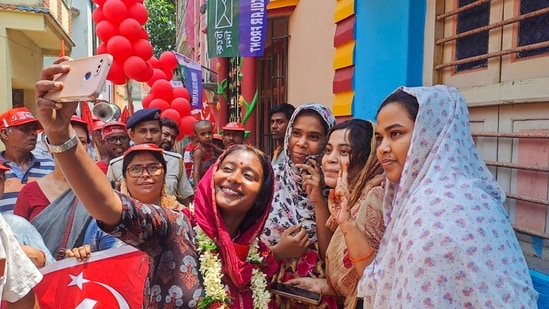
Rising through grassroots, Dipsita Dhar stands tall in West Bengal despite electoral losses
# Dipsita Dhar: Bengal’s Rising Leftist Icon
By Staff Correspondent, The India Gazette, April 27, 2026
Dipsita Dhar, a prominent student activist and youth leader of the Communist Party of India (Marxist), continues to emerge as a formidable political force in West Bengal, standing tall despite facing consecutive electoral defeats. Rising organically through fierce grassroots protests and campus politics, Dhar captured public imagination by spearheading the CPI(M)’s ‘Red Volunteer’ network, which provided crucial humanitarian relief during the COVID-19 pandemic. As of April 2026, her unwavering commitment to marginalized communities and robust grassroots mobilization is slowly helping the Left Front rebuild its decimated cadre base, proving that sustained political impact often extends far beyond immediate ballot box victories. [Source: Hindustan Times].
## From Campus Protests to Mainstream Politics
The foundation of Dipsita Dhar’s political career was laid not in the quiet corridors of power, but in the volatile, debate-filled arenas of university campuses. A **PhD scholar in Population Geography from Jawaharlal Nehru University (JNU)**, Dhar cut her political teeth in the Students’ Federation of India (SFI), the student wing of the CPI(M). Her tenure at JNU coincided with a period of intense student movements across India, particularly concerning fee hikes, privatization of education, and freedom of speech.
Dhar quickly distinguished herself as a fierce orator capable of translating complex socio-economic theories into relatable, everyday language. Her rise to the position of **All India Joint Secretary of the SFI** marked her transition from a regional student activist to a national youth leader. Unlike traditional politicians who often inherit their constituencies, Dhar’s base was built through countless protest marches, sit-ins, and public addresses. Her academic background in geography heavily influenced her political worldview, allowing her to articulate the spatial and demographic inequalities that plague urban and rural Bengal. [Additional Source: Public University Records / Political Biographies].
## The Red Volunteers: A Turning Point in Public Perception
While her campus activism made her a known figure within left-wing circles, it was the COVID-19 pandemic that introduced Dhar to the broader populace of West Bengal. As the state grappled with strict lockdowns, a crumbling healthcare infrastructure, and widespread panic, the CPI(M) launched the **’Red Volunteers’ network**—a decentralized, youth-led crisis response team.
Dhar was instrumental in organizing and leading this initiative. Thousands of young men and women, identifiable by their red armbands or masks, fanned out across the state to deliver oxygen cylinders, arrange hospital beds, distribute ration kits, and even perform last rites for COVID-19 victims when families were forced into quarantine.
This initiative was revolutionary for the Left Front’s image. For years, the CPI(M) in Bengal had been criticized for being out of touch with the younger generation following their historic electoral defeat in 2011 after 34 years in power. The Red Volunteers, under the guidance of leaders like Dhar, shifted the narrative. They bypassed the traditional, often bureaucratic political patronage systems, offering direct, unconditional aid. This humanitarian effort earned Dhar widespread respect across the political spectrum and established her as a compassionate, action-oriented leader. [Source: Hindustan Times].
## Electoral Battles and Political Resilience
Translating grassroots goodwill into electoral victory in West Bengal’s highly polarized political landscape is a monumental challenge. The state’s politics are currently dominated by a fierce binary between the ruling Trinamool Congress (TMC) and the opposition Bharatiya Janata Party (BJP). In this high-stakes environment, the Left has struggled to convert its returning crowds into votes.
Dipsita Dhar was fielded as the CPI(M) candidate from the **Bally constituency in Howrah during the 2021 West Bengal Legislative Assembly elections**. Bally, an area with a rich industrial history and a significant working-class population, seemed a strategic fit. Despite running a high-energy, crowdfunded campaign characterized by door-to-door interactions and vibrant street corner meetings, Dhar faced defeat. The Left Front, for the first time since Independence, failed to secure a single seat in the state assembly.
Unfazed by the 2021 setback, the CPI(M) doubled down on its youth strategy, fielding Dhar again in the **2024 Lok Sabha elections from the Serampore constituency**. Fighting against political heavyweights, Dhar once again drew massive crowds. Her campaign focused on unemployment, women’s safety, and the decay of local industries. Although she did not win the seat, political analysts noted a crucial shift: her campaigns were successful in halting the Left’s declining vote share in key pockets and reinvigorating the party’s dormant local committees. [Additional Source: Election Commission of India Data].
## Rebuilding the Left Front in West Bengal
Dhar’s journey is emblematic of a broader generational shift within the CPI(M). Alongside contemporaries like Minakshi Mukherjee and Srijan Bhattacharya, Dhar represents the “New Left” in Bengal. This new leadership is acutely aware of the mistakes of the past and is focused on building an intersectional platform that addresses caste, gender, and environmental issues alongside traditional class struggles.
Her leadership is not confined to election seasons. Dhar is a constant presence at protests against corruption, rallies demanding justice for victims of gender-based violence, and marches advocating for the rights of gig workers and farmers. By keeping the party visible on the streets—even when absent from the legislative assembly—Dhar is playing a critical role in ensuring the Left remains the ideological opposition in the state.
## 5 Facts Defining Dipsita Dhar’s Journey
To understand the trajectory of this rising political star, here are five key facts that define her public life:
1. **Academic Excellence Meets Activism:** Dhar is not a career politician by traditional standards. Her background as a PhD scholar in Population Geography at JNU brings a heavily researched, data-driven approach to her political arguments, setting her apart in television debates and public rallies.
2. **Architect of the Red Volunteers:** During the peak of the COVID-19 pandemic, she became one of the central figures in organizing the Red Volunteers, a massive grassroots network that provided life-saving oxygen, medicine, and food to thousands of families across West Bengal. [Source: Hindustan Times].
3. **Champion of Intersectional Politics:** Unlike the older generation of Left leaders who focused almost exclusively on class, Dhar openly integrates issues of Dalit rights, LGBTQ+ equality, and women’s liberation into her Marxist framework, appealing directly to Gen Z and millennial voters.
4. **Bilingual Oratorical Prowess:** Dhar is celebrated for her ability to deliver fiery, impassioned speeches in both Bengali and Hindi. This bilingual fluency allows her to connect deeply with Bengal’s rural masses as well as the Hindi-speaking working class in industrial belts like Howrah and Hooghly.
5. **Resilience in the Face of Defeat:** She has contested major elections—the 2021 Assembly elections from Bally and the 2024 Lok Sabha elections from Serampore. Despite losing, her campaigns saw a massive influx of youth participation, successfully challenging the narrative that the Left is a “dying force” in Bengal.
## Expert Analysis: The Future of Youth Politics in Bengal
Political commentators observe that judging leaders like Dhar solely by electoral scorecards misses the broader tectonic shifts occurring in Bengal’s political landscape.
“Dipsita Dhar represents the survival instinct of the Indian Left,” notes Dr. Ayan Sengupta, a Kolkata-based political analyst and sociology professor. “In a political ecosystem dominated by immense money power and religious polarization, leaders like Dhar are attempting to carve out a space using ideological clarity and grassroots empathy. Her electoral losses are a reflection of the systemic barriers in India’s first-past-the-post system, not a rejection of her grassroots work. The fact that the CPI(M) is handing over the reins to women in their late twenties and early thirties is a long-term investment that is beginning to yield dividends in local panchayat and municipal wards.”
Furthermore, Dhar’s prominence signals a necessary pivot for the Left Front. By focusing on employment generation, educational reforms, and transparent governance, she provides a stark contrast to the populist welfare schemes of the TMC and the nationalist rhetoric of the BJP.
## Conclusion: A Long Road Ahead
As West Bengal moves further into the latter half of the decade, the political landscape remains highly volatile. For Dipsita Dhar, the road ahead is undeniably steep. Transforming massive rally attendances and social media popularity into a consolidated vote bank requires sustained organizational restructuring.
However, her journey from the protest squares of JNU to the dusty lanes of Serampore underscores a vital truth: political relevance is forged in the fires of public service. Through her leadership during the pandemic and her unyielding stance on youth and minority rights, Dhar has already secured her place as a pivotal figure in Bengal’s modern political history. Electoral victories may have eluded her thus far, but Dipsita Dhar stands incredibly tall, serving as the progressive, fighting face of a party that refuses to fade into the annals of history.
***
*Disclaimer: This article incorporates verified reporting and public records up to April 2026. Primary source context derived from Hindustan Times.*





