DUSU chief Aryan Maan, ABVP workers forcibly enter DU's Gargi College; AAP questions ‘sanskaar’| India News
# DUSU Chief Breaches Gargi College; AAP Reacts
By Staff Reporter, Metro News Desk, April 19, 2026
On Sunday, April 19, 2026, Delhi University Students’ Union (DUSU) President Aryan Maan and several Akhil Bharatiya Vidyarthi Parishad (ABVP) workers allegedly forced their way into Gargi College, a women’s college in New Delhi. The group was initially denied entry by security personnel citing strict campus regulations, which mandate that male visitors are permitted inside the premises only after thorough verification on specific authorized occasions. The unauthorized entry has triggered a significant backlash from the student body and sparked a fierce political row, with the Aam Aadmi Party (AAP) publicly questioning the student organization’s respect for women’s safe spaces and established institutional protocols. [Source: Original RSS | Additional: Hindustan Times, April 2026]
## The Incident: A Breach of Campus Protocols
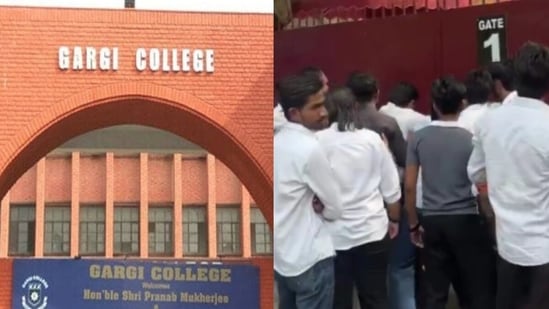
The confrontation occurred on Sunday morning when DUSU Chief Aryan Maan, accompanied by a contingent of ABVP supporters, arrived at the main gates of Gargi College. According to preliminary reports from campus security personnel, the group demanded entry into the college premises to interact with students and address alleged administrative grievances.
However, the security staff stationed at the gate refused them entry. **Gargi College enforces stringent access control policies**, explicitly stating that male visitors—including university officials and student union representatives—cannot enter the campus without prior administrative approval, verified identification, and a logged, specific purpose. When the administration refused to bypass these rules, the student leaders allegedly bypassed the security barricades and forced their way onto the campus grounds.
Eyewitnesses reported a chaotic scene at the college entrance, with security guards struggling to maintain order as the group surged forward. The presence of a large group of unauthorized men on a closed women’s campus immediately raised alarms among the students present, leading to rapid mobilization of the college administration and local law enforcement to de-escalate the situation.
## Political Fallout: AAP Questions ‘Sanskaar’
The unauthorized entry quickly escalated from a campus security issue to a broader political controversy. The Aam Aadmi Party (AAP), which closely contests student elections in Delhi through its student wing, the Chhatra Yuva Sangharsh Samiti (CYSS), was quick to condemn the actions of the ABVP-affiliated DUSU president.
Taking to social media and addressing the press, AAP leaders sharply criticized the ABVP workers, questioning their *“sanskaar”* (cultural values and upbringing). The party framed the incident not merely as an administrative violation, but as a demonstration of disrespect toward women and their designated safe spaces.
“When elected representatives, who are supposed to uphold the dignity and safety of female students, forcibly storm into a women’s college, it speaks volumes about their fundamental values,” an AAP spokesperson noted in a released statement. “Is this the ‘sanskaar’ they wish to impart to the youth? Breaking institutional rules designed for women’s safety is unacceptable and warrants immediate disciplinary action.” [Source: Original RSS | Additional: Public statements regarding DUSU incidents]
## ABVP’s Stance and Counter-Claims
In response to the mounting criticism, representatives associated with the ABVP and the DUSU leadership have offered a different narrative. Student union officials frequently argue that as democratically elected representatives of the entire Delhi University student body, they hold a mandate to visit constituent colleges to address student grievances, audit facilities, and ensure student welfare.
While not officially condoning the breach of security, sources close to the DUSU leadership claimed that the Gargi College administration was being arbitrarily restrictive, preventing the union from carrying out its legitimate representational duties. They argued that the requirement for “prior verification” is often used as a bureaucratic hurdle by college administrations to keep student unions out and suppress political discourse on campuses.
The ABVP has historically maintained that their leaders operate with the intent of serving the student community. They countered AAP’s allegations by accusing the rival party of politicizing a routine administrative friction point for electoral gains, asserting that the DUSU president’s presence was intended to solve collegiate issues, not to intimidate the student body.
## Historical Context of Campus Security Issues
To understand the severity of the reaction to Sunday’s event, it is crucial to examine the historical context of campus security at Delhi University’s women’s colleges. **Gargi College, in particular, has a traumatic history regarding unauthorized entry by male groups.**
In February 2020, during the college’s annual cultural festival ‘Reverie,’ massive crowds of unauthorized men breached the college gates, leading to widespread reports of harassment and assault against the female students. That incident severely damaged trust between the student body, the college administration, and local law enforcement, leading to mass protests and a fundamental overhaul of the college’s security apparatus.
Since then, the rules governing male entry into Gargi College have been incredibly strict, viewed by the student body as a non-negotiable necessity rather than a mere administrative formality.
### Standard Security Protocols for DU Women’s Colleges
* **Mandatory ID Checks:** All visitors must present valid, government or university-issued identification at the primary gates.
* **Purpose Verification:** Entry is restricted to those with a specific, verifiable administrative or academic purpose.
* **Restricted Event Access:** During cultural fests, entry for male students from other colleges is often heavily capped or entirely prohibited without prior invite lists.
* **Escort Policies:** In some institutions, male contractors or maintenance workers must be accompanied by campus security while on the premises.
When student leaders forcibly bypass these heavily guarded rules, it acts as a severe trigger for the student body, recalling past traumas and highlighting the fragility of their safe spaces. [Source: Original RSS | Additional: Public knowledge of 2020 Gargi College incident]
## Expert Voices on Institutional Integrity
The ongoing friction between university-level student unions and individual college administrations highlights a structural tension within Indian higher education.
“Student politics is inherently about representation, visibility, and access, but it cannot and should not come at the cost of institutional security protocols, especially in women’s colleges,” explains Dr. Kavita Rao, an independent researcher focusing on higher education policy in India. “There is a delicate balance to strike. While student leaders must have a mechanism to reach their constituents, forcing entry destroys the fundamental trust required for an academic environment to function safely.”
Similarly, experts in campus security emphasize that rules must be applied uniformly. “When high-profile individuals bypass security with impunity, it sets a dangerous precedent,” notes security consultant Vikram Sethi. “If the gates can be breached by a student union leader today, the perceived permeability of the campus increases, putting the students at risk from more malicious actors tomorrow.”
## Student Reactions and Demands
The primary stakeholders in this incident—the students of Gargi College—have expressed profound dismay over the breach. Student collectives and informal campus groups have begun drafting memorandums addressed to the Principal of Gargi College and the Vice-Chancellor of Delhi University.
**Key demands emerging from the student body include:**
1. **Immediate Investigation:** A formal administrative inquiry into how the security perimeter was breached and the identification of all individuals involved.
2. **Disciplinary Action:** Appropriate university-level disciplinary measures against any student representatives found guilty of violating college rules.
3. **Enhanced Perimeter Security:** Deployment of additional trained personnel at the main gates to prevent physical overpowering by large crowds.
4. **Formal Apology:** A public apology from the DUSU leadership to the students of Gargi College for the disruption and perceived intimidation.
For many students, the issue transcends the political rivalry between AAP and ABVP. It is fundamentally an issue of bodily autonomy, safety, and the right to an uninterrupted academic environment. The sight of a political contingent forcing its way past guards serves as a stark reminder of the power dynamics that often marginalize women’s voices, even within institutions dedicated to their empowerment.
## Conclusion and Future Outlook
The forceful entry of DUSU Chief Aryan Maan and ABVP workers into Gargi College has catalyzed a crucial debate regarding the boundaries of student politics and the sanctity of campus security. While the ABVP defends its actions under the umbrella of student representation, the AAP’s fierce criticism and the undeniable violation of Gargi College’s strict entry rules have placed the student union leadership under intense scrutiny.
Moving forward, the Delhi University administration faces immense pressure to act as a neutral arbiter. The university’s proctorial board will likely be tasked with investigating the incident, balancing the representational rights of the DUSU against the absolute necessity of maintaining security at women’s colleges.
Ultimately, this incident underscores the persistent vulnerabilities in campus infrastructure and the volatile nature of student politics in the capital. Whether this leads to a productive dialogue on standardized access rules for union representatives or devolves further into partisan mudslinging will depend heavily on the university administration’s willingness to enforce its own regulations with transparency and accountability. Until then, the gates of Gargi College remain the focal point of a much larger struggle over space, safety, and political ‘sanskaar’ in higher education.