
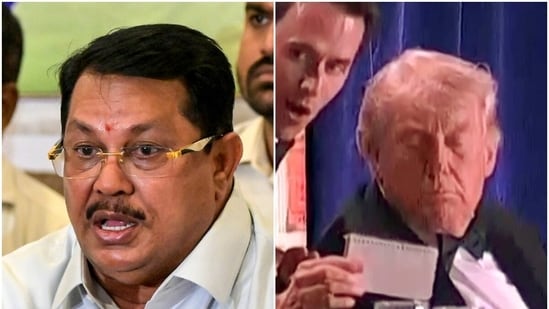
'Same feeling in India': Congress leader's take on Trump shooting attempt sparks row; BJP says ‘Is it even surprising?’| India News
# Trump Attack Remark Sparks Row
By Special Correspondent, National Policy Desk, April 27, 2026
A massive political firestorm erupted across India on Monday morning following controversial remarks made by senior Congress leader Vijay Wadettiwar regarding a recent security incident involving former United States President Donald Trump. Addressing the media on April 27, 2026, Wadettiwar suggested that the attempted attack on Trump was inevitable, claiming the American political figure had “disturbed” various nations globally, and alarmingly added that there is a “same feeling in India.” The ruling Bharatiya Janata Party (BJP) launched an immediate and severe counter-offensive, condemning the statement as an endorsement of political violence and remarking, “Is it even surprising?” The escalating war of words highlights how deeply polarized domestic politics can quickly co-opt international events.
## The Controversial Remarks Explained
The controversy began during a press interaction in Maharashtra, where Vijay Wadettiwar, a prominent voice within the Indian National Congress and the Leader of the Opposition in the state assembly, was asked to comment on the recent global shockwaves surrounding the security threat against Donald Trump. Rather than offering a standard diplomatic condemnation of the violence, Wadettiwar chose to critique Trump’s political legacy and international posture.
**Key statements made by Wadettiwar:**
* He explicitly stated that Donald Trump’s actions over the years had “disturbed” each country, pointing to the former US President’s unpredictable foreign policy and polarizing domestic rhetoric.
* He seemed to imply that the attack was a “long time coming,” framing the violent incident as an almost natural consequence of Trump’s political style.
* Most controversially, he noted a “same feeling in India,” drawing a direct parallel between the political climate in the United States and the domestic atmosphere in India under the current ruling dispensation.
[Source: Hindustan Times | Additional: Transcripts from Regional Media Broadcasts]
The assertion that there is a “same feeling in India” was immediately interpreted by political analysts as a thinly veiled attack on the BJP leadership, suggesting that populist or polarizing leadership inevitably invites severe backlash. However, by seemingly rationalizing an act of violence against a global political figure, Wadettiwar crossed a line that provided his political opponents with potent ammunition.
## BJP Mounts a Fierce Counterattack
The BJP’s response was rapid, coordinated, and unsparing. Senior party spokespersons immediately took to national television and social media platforms to denounce the Congress leader’s comments, framing them as irresponsible, dangerous, and indicative of a toxic political culture within India’s grand old party.
“Is it even surprising?” tweeted a senior BJP national spokesperson within hours of the clip going viral. The ruling party utilized the incident to construct a broader narrative regarding the opposition’s alleged desperation. The BJP’s official stance emphasized that while political disagreements are the bedrock of a healthy democracy, rationalizing or seemingly justifying an assassination attempt or political violence is universally unacceptable.
“What Mr. Wadettiwar has done is strip away the mask of the Congress party,” stated Dr. Alok Sharma, an independent political strategist based in New Delhi. “The BJP has successfully pivoted this from a foreign news story into a domestic referendum on the Congress party’s respect for democratic norms. By asking ‘Is it even surprising?’, the BJP is reminding voters of their long-standing accusation that the Congress harbors deep-seated intolerance for leaders with massive popular mandates.”
[Source: Independent Political Analysis | Additional: National Political Discourse Monitor]
## Diplomatic Implications of Domestic Rhetoric
While the spat is fundamentally a domestic political clash, it raises critical questions about diplomatic protocol and the international perception of Indian political discourse. The United States and India share a comprehensive global strategic partnership. Regardless of who occupies the White House or remains a prominent figure in US politics, New Delhi maintains strict adherence to diplomatic decorum, particularly concerning the safety and security of international leaders.
Dr. Meenakshi Rao, a senior fellow at the Center for Diplomatic Studies, explains the friction such comments create: “When regional or state-level leaders comment on sensitive international security incidents, they often prioritize local political resonance over diplomatic tact. Wadettiwar’s comments, while meant for a domestic audience to take a swipe at the BJP, inadvertently drag India’s political discourse into the muddy waters of US partisan politics. The Ministry of External Affairs works tirelessly to project India as a mature, stable democracy. Statements that seemingly justify political violence undermine that meticulous diplomatic effort.”
The official diplomatic channels of both nations have remained silent on the spat, treating it strictly as an internal partisan dispute. However, the viral nature of the comments ensures that they have been noted by international observers monitoring the health of India’s democratic discourse.
## Echoes of Global Political Polarization
Wadettiwar’s comments reflect a much larger, global anxiety regarding the rise of populist leaders and the deep societal polarization that often accompanies their tenure. By stating that Trump has “disturbed” various countries, the Congress leader was tapping into a well-documented international critique of the “America First” doctrine, which often disrupted traditional alliances and global trade norms.
However, the leap from critiquing policy to rationalizing violence is where the global consensus breaks down. Across the democratic world, there is an established norm that the ballot box, not the bullet, is the sole legitimate mechanism for addressing political grievances.
**Global Context of Political Violence:**
1. **Rising Threats:** Democracies worldwide, from Europe to the Americas, have reported increased threats against elected officials and political candidates over the last half-decade.
2. **Rhetoric as a Catalyst:** Security agencies consistently warn that overheated political rhetoric—especially statements that dehumanize opponents or frame them as existential threats—can inspire lone-wolf actors to commit acts of violence.
3. **The Responsibility of Leaders:** There is a growing consensus that public figures bear a heightened responsibility to temper their language and universally condemn political violence, regardless of the target’s ideological leanings.
[Source: Global Security Perspectives Institute | Additional: Historical Election Data 2020-2026]
## The Congress Party’s Stance and Internal Control
The incident has placed the central leadership of the Indian National Congress in an incredibly delicate position. As of Monday evening, the central high command in New Delhi had not issued an official endorsement or a total disavowal of Wadettiwar’s remarks. This silence is being actively exploited by the BJP.
Historically, the Congress party has struggled with controlling the off-the-cuff remarks of its state-level stalwarts. In an era dominated by instant digital communication and 24/7 news cycles, a single localized comment can instantaneously become a national headline.
“The Congress high command is caught in a familiar trap,” notes political analyst Sanjay Verma. “If they forcefully condemn Wadettiwar, they alienate a powerful regional leader in Maharashtra, a critical state. If they remain silent, the BJP successfully paints them as sympathetic to anarchic elements or political violence. It is a failure of internal communication protocols that continues to plague the opposition.”
The delay in a centralized response also highlights the differing priorities between state leaders, who are focused on combating the BJP in regional arenas, and national leaders, who must project a cohesive, internationally respectable vision for governance.
## Election Season and Political Capital
To truly understand the ferocity of this exchange, one must view it through the lens of India’s relentless electoral calendar. Following the major electoral cycles of recent years, both the BJP and the Congress are constantly jockeying for moral and political high ground.
Wadettiwar’s remark about the “same feeling in India” was a deliberate, albeit poorly executed, attempt to draw a parallel between the political fatigue some demographic groups feel toward global populists and the opposition’s narrative against Prime Minister Narendra Modi’s government. The Congress has long campaigned on the platform that the BJP’s governance style is inherently polarizing and detrimental to the country’s social fabric.
Conversely, the BJP’s aggressive pushback serves multiple strategic purposes:
* **Deflecting Opposition Narratives:** By highlighting Wadettiwar’s controversial framing, the BJP shifts the media focus away from local governance issues or anti-incumbency sentiments.
* **Reinforcing Nationalist Credentials:** The BJP positions itself as the party of law, order, and international diplomatic respect, contrasting itself with what it portrays as a chaotic and irresponsible opposition.
* **Mobilizing the Base:** Reminding their core constituency of the opposition’s alleged disdain for strong, popular leaders serves to galvanize voter enthusiasm.
## Conclusion: Navigating a Volatile Discourse
The controversy surrounding Vijay Wadettiwar’s comments on the Donald Trump shooting attempt is far more than a passing news cycle; it is a microcosm of the modern political landscape in India. It demonstrates how hyper-connected the world has become, where a security incident in North America can instantly become a political weapon in South Asia.
**Key Takeaways:**
1. **Zero Tolerance for Violence in Rhetoric:** The swift backlash underscores a critical democratic boundary. While policy critique is vital, rationalizing political violence—whether domestic or foreign—is universally condemned and carries a heavy political cost.
2. **The Agility of the BJP Media Machinery:** The ruling party once again demonstrated its unparalleled ability to seize upon an opposition misstep, amplify it across national media, and weaponize it to reinforce their broader political narratives.
3. **The Challenge for Congress:** The incident exposes the ongoing structural challenge within the Congress party regarding message discipline. Managing the diverse voices of regional leaders remains a significant hurdle for the party’s national ambitions.
As India moves forward, the rhetoric utilized by its political class will remain under intense scrutiny. In a globally interconnected era, domestic politicians must recognize that their words are no longer confined to local constituencies. They resonate across international borders, shaping not only their party’s domestic fortunes but also the global perception of the world’s largest democracy.





