
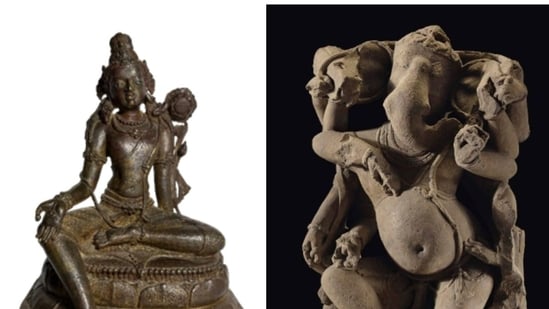
Buddha statue, dancing Ganesha: Inside the $14 million-worth 657 antiquities that the US returned to India
# US Returns $14M Stolen Antiquities to India
**By Special Correspondent, Heritage & Diplomatic Desk**
**April 30, 2026**
In a monumental victory for cultural preservation, the United States formally returned 657 stolen antiquities valued at approximately $14 million to India during a repatriation ceremony in New York on Thursday. Recovered through extensive international investigations into illicit art trafficking, the artifacts include culturally priceless pieces such as a historic Buddha statue and a rare dancing Ganesha. Rajlakshmi Kadam, representing the Consulate General of India in New York, officially received the collection. This historic handover highlights an intensifying global crackdown on smuggling networks and underscores the strengthening diplomatic and cultural ties between Washington and New Delhi. [Source: Hindustan Times].
## The Handover Ceremony: A Diplomatic Milestone
The official transfer of the 657 artifacts took place at a highly secure facility in New York City, marking one of the largest single repatriations of cultural property to India in recent history. The sheer volume and financial value of the collection—estimated at $14 million on the legitimate art market—represent decades of systematic looting from India’s ancient temples, archaeological sites, and rural communities.
Rajlakshmi Kadam, from the Consulate General of India in New York, presided over the formal signing of the transfer documents. The event was attended by high-ranking officials from U.S. Homeland Security Investigations (HSI) and the Manhattan District Attorney’s Office, both of which played pivotal roles in tracking, seizing, and authenticating the stolen artifacts.
“This repatriation is not merely a transfer of objects; it is the restoration of our history, our spirituality, and our cultural identity,” noted a statement released by the Indian Consulate following the event. The ceremony reflects a concerted shift in international law enforcement, moving beyond simply intercepting illicit goods to ensuring they are returned to their rightful sovereign owners. [Source: Hindustan Times | Additional: U.S. Customs and Border Protection Public Records].
## Spotlight on the Crown Jewels: Buddha and the Dancing Ganesha
While the 657 artifacts span various eras, regions, and mediums, a few standout pieces have captured the attention of art historians and cultural heritage experts worldwide. Prominent among them are an exquisitely carved stone Buddha statue and a dynamic bronze depiction of a dancing Ganesha.
**The Dancing Ganesha:**
Historians believe the bronze Ganesha dates back several centuries, likely originating from the Chola Dynasty in southern India—a period renowned for its exceptional metallurgical craftsmanship and lost-wax bronze casting. Depicting the elephant-headed deity in a joyous, rhythmic pose, the idol was originally intended for a temple sanctuary before it was violently extracted by idol thieves.
**The Buddha Statue:**
The recovered Buddha statue, carved from sandstone, represents the pinnacle of early Indian sculptural traditions. The serene facial features, traditional monastic robes, and intricate halo suggest origins in the eastern or central archaeological zones of India. Artifacts of this caliber are not merely decorative; they serve as primary historical texts that inform researchers about ancient trade routes, religious practices, and regional artistic evolution.
“Pieces like the dancing Ganesha and the stone Buddha are the beating heart of India’s living heritage,” says Dr. Arindam Sen, a leading scholar of South Asian antiquities based in London. “When these items are ripped from their original contexts and placed in foreign private collections, they lose their spiritual and historical resonance. Returning them restores their voice.” [Additional: Expert Analysis on South Asian Art History].
## Dismantling the Illicit Antiquities Trade
The return of these $14 million worth of artifacts is the culmination of years of rigorous investigative work. For decades, South Asia has been heavily targeted by sophisticated transnational smuggling syndicates. These networks employ local thieves to loot unguarded temples and archaeological sites. The stolen goods are then smuggled out of the country, funneled through transit hubs, and supplied with forged provenance documents—false histories designed to make the artifacts appear legally acquired.
Once “laundered,” these items are sold to high-net-worth collectors, elite auction houses, and prestigious museums in the West.
The Manhattan District Attorney’s Antiquities Trafficking Unit, working in tandem with HSI, has been at the forefront of dismantling these networks. While specific ongoing investigations tied to this latest cache remain classified, previous major busts—such as the operation against notorious art trafficker Subhash Kapoor—have established a robust legal blueprint for seizing stolen Indian artifacts.
“The art market is undergoing a painful but necessary reckoning,” explains Sarah Jenkins, an attorney specializing in international art law. “Law enforcement agencies are no longer accepting vague ownership histories. If an artifact from a source country like India lacks transparent, documented export papers predating the 1970 UNESCO Convention, authorities will increasingly treat it as stolen property.” [Additional: Interpol Art Theft Guidelines].
## Categorization of the Repatriated Antiquities
The 657 returned artifacts span a remarkable breadth of India’s cultural and historical timeline. While the complete inventory is currently under the custodianship of the Archaeological Survey of India (ASI), early reports indicate a diverse collection:
* **Bronze Sculptures:** Primarily from Southern India, including deities from the Hindu pantheon used in temple processions.
* **Terracotta Figurines:** Ancient artifacts from Eastern India, detailing the everyday life and early religious practices of the region.
* **Stone Architectural Fragments:** Carved pillars, temple friezes, and ceiling brackets that were chiseled away from structural monuments.
* **Numismatics:** Rare historical coins that provide insight into the economic and dynastic histories of the subcontinent.
* **Manuscripts and Paintings:** Fragile works on paper and cloth that were illegally exported to feed the global appetite for South Asian miniature paintings.
## Bilateral Ties and Cultural Diplomacy
The successful repatriation of 657 artifacts goes beyond law enforcement; it is a profound exercise in cultural diplomacy. In recent years, the United States and India have significantly deepened their strategic partnership. While defense, trade, and technology often dominate the headlines, cultural heritage has emerged as a vital pillar of mutual cooperation.
Since 2014, the repatriation of Indian antiquities from the U.S. has accelerated dramatically. Landmark handovers occurred during Prime Minister Narendra Modi’s visits to the United States in 2021 and 2023, setting a precedent for continuous bilateral cooperation. Thursday’s event, attended by Rajlakshmi Kadam, cements this momentum. [Source: Hindustan Times].
The U.S. and India recently signed a Cultural Property Agreement (CPA) designed to impose strict import restrictions on certain categories of archaeological and ethnological materials from India. This bilateral treaty empowers U.S. border agents to automatically seize undocumented Indian artifacts upon entry, cutting off the market at the source.
“Diplomacy is fundamentally about mutual respect,” notes a former U.S. State Department official. “When the United States expends resources to track down and return the cultural soul of another nation, it builds an immense reservoir of goodwill that transcends standard political discourse.”
## The Global Paradigm Shift in Restitution
The $14 million return to India is symptomatic of a broader, global paradigm shift regarding cultural property. For centuries, the dominant narrative within the international art community was that Western museums and private collections were the safest repositories for global heritage. Today, that colonial-era mindset has been thoroughly dismantled.
Source nations across Asia, Africa, and Latin America are aggressively pursuing the return of their looted heritage. Empowered by the 1970 UNESCO Convention on the Means of Prohibiting and Preventing the Illicit Import, Export and Transfer of Ownership of Cultural Property, nations like India are building specialized task forces to track their stolen history.
In India, organizations such as the India Pride Project—a global network of volunteers using social media and facial recognition technology to identify stolen idols in foreign museums—have democratized the hunt for looted artifacts. These grassroots efforts, combined with the diplomatic weight of the Indian government and the legal muscle of U.S. federal agencies, have created a hostile environment for art smugglers.
## Journey Home: What Happens Next?
Following the ceremonial handover in New York, the 657 artifacts will be carefully crated under the supervision of specialized art handlers. They will then be flown back to New Delhi, where they will be formally received by the Archaeological Survey of India (ASI) and the Ministry of Culture.
Upon arrival, the ASI will begin a meticulous process of conservation and cataloging. Each piece will be examined for damage sustained during its illegal extraction and transit. Researchers will then cross-reference the artifacts with police reports of temple thefts, aiming to identify the exact geographical origins of each piece.
In previous repatriations, the Indian government has successfully returned specific deities to the exact rural temples from which they were stolen decades ago—a deeply emotional and spiritual event for local communities. Artifacts whose precise origins cannot be determined will likely be housed in the National Museum in New Delhi or featured in specialized exhibitions highlighting the dark realities of the illicit antiquities trade.
## Conclusion: A Warning to the Art Market
The repatriation of 657 antiquities worth $14 million is a watershed moment for India’s cultural heritage. The presence of the iconic Buddha statue and the dancing Ganesha among the returned items highlights the priceless nature of what has been reclaimed.
This historic event in New York serves as a stern warning to the global art market: the era of turning a blind eye to the illicit origins of cultural property is over. As international law enforcement agencies refine their investigative techniques and source nations amplify their demands for restitution, collectors and institutions holding undocumented artifacts face unprecedented legal and reputational risks.
Ultimately, the successful return of these artifacts is a testament to what can be achieved when nations collaborate. As the Buddha and the dancing Ganesha make their long-awaited journey home, they carry with them not just the weight of history, but the promise of a more ethical future for global cultural heritage.





