
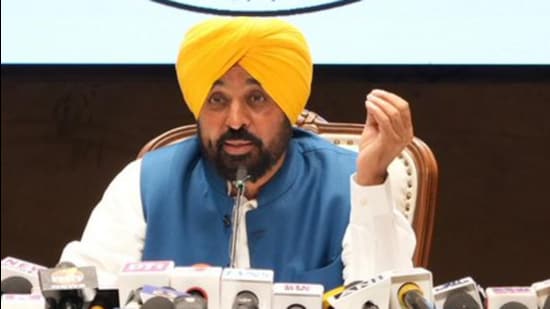
As Mann’s recall pitch heads to Prez house, why Constitution offers little room
# Why Mann’s MP Recall Pitch Faces Legal Wall
By Senior Political Correspondent, The National Policy Desk | April 30, 2026
On Thursday, April 30, 2026, a high-profile political delegation led by Punjab Chief Minister Bhagwant Mann marched to Rashtrapati Bhavan in New Delhi, submitting a formal memorandum to the President of India. The demand seeks the immediate implementation of a legal mechanism to recall an underperforming or controversial Member of Parliament (MP). While Mann’s aggressive push has ignited widespread public debate and resonated deeply with voters seeking greater accountability, the campaign faces an insurmountable hurdle: the Indian Constitution. Currently, India’s constitutional framework offers absolutely no provision for the mid-term recall of an elected parliamentarian, rendering the political pitch legally toothless. [Source: Hindustan Times | Additional: Constitutional Law Records].
## The Political Resonance vs. Constitutional Reality
The optics of Mann’s march to the President’s house are undeniably potent. In a rapidly evolving democratic landscape where voters are increasingly impatient with absentee lawmakers and unfulfilled electoral promises, the concept of a “Right to Recall” acts as a powerful populist rallying cry. The delegation argued that if the electorate possesses the democratic right to elect a representative, they must inherently possess the right to de-elect them before their five-year term expires if they fail to serve the public interest.
However, political resonance does not equate to legal viability. The Indian democratic system operates on a representative model rather than a direct democracy model. Once an MP is elected to the Lok Sabha, their tenure is protected under the Constitution for the full five-year term, subject only to specific disqualifications.
“The demand submitted to the Rashtrapati Bhavan is a brilliant piece of political theater, but it crashes head-first into the bedrock of Indian constitutional law,” explains Dr. Meenakshi Ramanathan, a senior professor of Constitutional Law at the National Law University, Delhi. “The President of India has no discretionary power to recall an MP. Any change of this magnitude would require a constitutional amendment, passing with a two-thirds majority in both houses of Parliament, and subsequent ratification by at least half of the state legislatures.” [Source: Independent Legal Analysis].
## What the Representation of the People Act Dictates
To understand the legal roadblock, one must look at the **Representation of the People Act, 1951 (RPA)**, and Articles 101 and 102 of the Indian Constitution. These texts govern the vacation of seats and disqualification of members, but they conspicuously omit any mention of voter-initiated recall.
Currently, an MP can only lose their seat under a strict set of circumstances:
* **Holding an Office of Profit:** Accepting a government position that yields financial gain.
* **Unsound Mind or Insolvency:** Being declared mentally unsound by a competent court or functioning as an undischarged insolvent.
* **Loss of Citizenship:** Voluntarily acquiring the citizenship of a foreign state.
* **Criminal Conviction:** Being convicted of a crime and sentenced to two or more years in prison, which results in immediate disqualification as per the landmark Lily Thomas vs. Union of India (2013) Supreme Court judgment.
* **Defection:** Violating the Tenth Schedule (Anti-Defection Law) by voluntarily giving up party membership or voting against the party whip.
Absent these specific legal and behavioral violations, “voter remorse” or “non-performance” are not legally actionable grounds to strip an MP of their parliamentary status. [Source: Representation of the People Act, 1951].
## A Historical Rejection: The Constituent Assembly Debates
The absence of a recall provision in the Indian Constitution is not an oversight; it was a deliberate choice. During the drafting of the Constitution in the late 1940s, the concept of recalling elected representatives was heavily debated.
Several members of the Constituent Assembly argued that a recall mechanism would keep lawmakers tethered to the genuine needs of their constituents. However, the architect of the Indian Constitution, Dr. B.R. Ambedkar, firmly opposed it. He argued that India’s nascent democracy, fraught with caste divisions, communal tensions, and massive illiteracy, was not ready for such a tool. Ambedkar and other framers feared that a right to recall would subject MPs to constant harassment by defeated political rivals, forcing them to engage in perpetual campaigning rather than making difficult, long-term legislative decisions.
In the decades since, the idea has resurfaced periodically. In 1974, socialist leader Jayaprakash Narayan made the “Right to Recall” a central pillar of his *Sampoorna Kranti* (Total Revolution) movement against the Indira Gandhi government. More recently, in 2016, BJP MP Varun Gandhi introduced a Private Member’s Bill—the Representation of the People (Amendment) Bill—seeking to introduce the recall of MPs and MLAs if 75% of voters petitioned for it. The bill failed to garner cross-party support and quietly lapsed. [Source: Parliamentary Archives | Additional: Historical Records].
## The Local Government Exception
Proponents of Mann’s pitch frequently point to India’s local governments as proof that a recall system can work. In several Indian states, including Madhya Pradesh, Bihar, Chhattisgarh, and Rajasthan, specific provisions allow for the recall of Panchayat leaders (Sarpanchs) and municipal heads.
In Madhya Pradesh, for instance, a Sarpanch can be recalled if a substantial percentage of the Gram Sabha members sign a petition initiating the process, followed by a secret ballot where a majority votes for removal.
However, scaling this system from a village of a few thousand residents to a Lok Sabha constituency is a logistical nightmare. The average Indian parliamentary constituency houses roughly 2 million registered voters.
“Authenticating the signatures of hundreds of thousands of voters to simply initiate a recall petition would paralyze the Election Commission of India,” notes former Election Commission official Rajiv Sharma. “The financial cost of conducting mid-term recall elections, combined with the risk of voter fatigue, makes the Panchayat model entirely incompatible with parliamentary democracy at the national level.”
## Global Perspectives on Lawmaker Accountability
When assessing Mann’s demand, it is vital to look at how mature democracies handle the concept of recalling national lawmakers. Very few nations allow it, and those that do have stringent safeguards to prevent political weaponization.
**The United Kingdom:** The UK passed the *Recall of MPs Act 2015* following a massive expenses scandal. However, unlike the system proposed by Indian advocates, British voters cannot initiate a recall simply because they dislike their MP’s performance. A recall petition in the UK can only be opened if an MP is convicted of an offense and sentenced to prison (but for less than the time required for automatic expulsion), suspended from the House of Commons for at least 10 sitting days, or convicted of providing false expenses. If one of these triggers is met, a petition is opened; if 10% of registered voters sign it within six weeks, the MP loses their seat, and a by-election is called.
**The United States:** While the U.S. allows for the recall of state-level officials—most notably governors, as seen with California’s Gavin Newsom or Wisconsin’s Scott Walker—the U.S. Constitution does not permit the recall of federal Senators or Representatives.
**Switzerland:** Known for its robust direct democracy, Switzerland allows recalls in several cantons (states), but lacks a federal provision for recalling members of the National Council.
These global examples highlight a universal legislative hesitation to allow unrestricted voter recall at the highest levels of federal government, largely due to the threat of endless partisan instability. [Source: Global Constitutional Databases].
## The Double-Edged Sword of Direct Democracy
The debate sparked by Mann’s visit to the President’s house exposes a philosophical rift in Indian democratic thought. On one hand, advocates argue that a recall provision would drastically reduce political corruption, absenteeism, and the controversial practice of “resort politics” (where elected members are sequestered in hotels to prevent defection). It would theoretically force MPs to remain tethered to their constituencies.
On the flip side, critics warn that introducing a recall mechanism in a highly polarized, multi-party system like India’s could be disastrous.
“If the Right to Recall is introduced, the losing candidate in every constituency will begin a recall petition the very day the election results are announced,” warns political analyst Dr. Suhasini Kulkarni. “Instead of a five-year mandate to govern and implement tough, sometimes unpopular economic policies, an MP will be forced into a permanent state of campaigning. It would replace representative stability with populist volatility.”
Furthermore, minority representatives or MPs belonging to marginalized communities could become easy targets for majoritarian recall campaigns orchestrated by dominant caste groups or well-funded corporate lobbies.
## Implications for Future Electoral Reforms
Despite the constitutional dead-end at Rashtrapati Bhavan, Bhagwant Mann’s pitch succeeds on one critical front: it forces the issue of political accountability back into the national spotlight.
The President’s office is legally bound to forward the memorandum to the Ministry of Law and Justice, where it is highly likely to be shelved unless the ruling coalition decides to introduce a massive constitutional amendment—an unlikely scenario heading into the latter half of the decade.
However, the noise generated by this delegation may spur alternative electoral reforms. Election Commission officials and democratic watchdogs have long suggested that instead of a drastic Right to Recall, India should focus on strengthening internal party democracy, increasing the powers of the Election Commission to deregister non-compliant political parties, and fast-tracking special courts to deal with criminal cases against sitting MPs.
## Conclusion: A Loud Knock on a Locked Door
As Mann’s recall pitch heads to the President’s house, it stands as a poignant reminder of the friction between public expectation and constitutional reality. The demand for a mechanism to oust non-performing MPs is politically resonant and emotionally satisfying for an electorate tired of legislative apathy.
Yet, the framers of the Indian Constitution deliberately built a wall to prevent the volatility of direct democracy from destabilizing the republic. Until Parliament itself decides to dismantle that wall through a rigorous and complex constitutional amendment, the Right to Recall will remain an idealistic slogan rather than a statutory right. For now, the only legally sanctioned “recall” available to the Indian voter remains the power of the ballot box at the end of an MP’s five-year term.





