
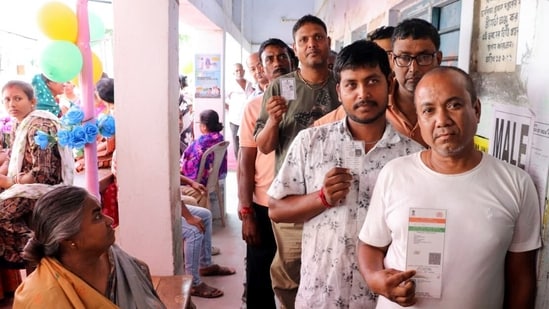
Repolling request made for 77 booths in West Bengal, EC to take call after probe
# WB Polls: EC Probes 77 Repoll Requests
By Staff Reporter, Election Desk, April 30, 2026
On Thursday, the Election Commission of India (ECI) initiated a high-level probe following formal requests to conduct repolling in 77 booths across West Bengal. Stemming from the fiercely contested 2026 State Assembly elections, the complaints are heavily concentrated in the volatile South 24 Parganas district. Specifically, the commission has registered 32 grievances from Falta, 29 from Diamond Harbour, 13 from Magrahat, and three from Budge Budge. Before ordering fresh polls, the EC is meticulously reviewing webcasting footage, presiding officers’ diaries, and micro-observer reports to verify allegations of electoral malpractice, voter intimidation, and technical anomalies. [Source: Original RSS – Hindustan Times | Additional: Election Commission of India Public Protocols].
## The Anatomy of the Electoral Complaints
The 77 polling stations in question have become the focal point of the state’s post-poll scrutiny. According to the preliminary data released by the Chief Electoral Officer (CEO) of West Bengal, the formal requests for repolling span a variety of alleged infractions ranging from electronic voting machine (EVM) tampering to the forceful eviction of opposition polling agents.
To understand the geographical concentration of these complaints, it is vital to look at the statistical breakdown provided to the ECI:
| Constituency Area | Number of Booths Flagged | Primary Nature of Allegations |
| :— | :— | :— |
| **Falta** | 32 | Intimidation, proxy voting, eviction of polling agents |
| **Diamond Harbour** | 29 | Alleged booth capturing, prolonged EVM malfunction |
| **Magrahat** | 13 | Unlawful assembly near booths, voter obstruction |
| **Budge Budge** | 3 | Minor technical glitches, procedural lapses |
**Falta**, reporting the highest number of complaints at 32, has historically been a hyper-sensitive zone during both state and general elections. Local opposition leaders have alleged that their polling agents were forcibly removed from the premises in the early hours of voting, allowing for unchecked proxy voting. Conversely, the complaints from **Budge Budge** appear to be largely administrative, focusing on prolonged EVM battery failures and VVPAT paper jam issues that disrupted the voting process for several hours.
[Source: Original RSS – Hindustan Times | Additional: Historical Election Data from South 24 Parganas].
## High-Stakes Political Crucible in Diamond Harbour
The inclusion of **Diamond Harbour** in this list—with 29 booths under the scanner—elevates the political stakes significantly. Diamond Harbour is not just another constituency; it is a vital political fortress in West Bengal. As the stronghold of the ruling Trinamool Congress (TMC), any allegations of malpractice in this region are immediately amplified on the national stage.
During the 2026 assembly campaign trail, both the Bharatiya Janata Party (BJP) and the Left-Congress alliance designated Diamond Harbour and its adjoining assembly segments as “critical vulnerability areas.” They petitioned the ECI weeks in advance for 100% webcasting and maximal deployment of Central Armed Police Forces (CAPF).
“When you have 29 booths flagged in a high-profile constituency like Diamond Harbour, it is a litmus test for the Election Commission’s neutrality,” notes Dr. Anirban Chattopadhyay, a Kolkata-based senior political analyst and author. “The ruling party views these complaints as a desperate tactic by a losing opposition to delegitimize the mandate, whereas the opposition frames it as undeniable proof of democratic subversion. The ECI’s ultimate verdict here will set a precedent for the remainder of the electoral phases.”
## Election Commission’s Protocol and Probe Mechanism
The decision to order a repoll (often colloquially referred to as countermanding a poll at a specific booth) is not taken lightly by Nirvachan Sadan. The ECI follows a stringent, multi-tiered verification process before invalidating the votes cast by hundreds of citizens.
Once a formal complaint is lodged via the C-Vigil app or through written submissions by candidate agents, the Returning Officer (RO) of the specific constituency is required to submit an immediate factual report.
According to former ECI official R.K. Das, “The Commission relies heavily on digital evidence today. The first thing that will be pulled is the live webcasting footage from the 77 booths. If the footage corroborates allegations of unauthorized individuals lingering near the voting compartment, or if the camera was deliberately obscured, a repoll is almost guaranteed. Furthermore, the ECI cross-references the Presiding Officer’s diary with the reports submitted by the CRPF personnel stationed at the door.”
If the probe reveals that the sanctity of the secret ballot was compromised in Falta, Diamond Harbour, Magrahat, or Budge Budge, the ECI will announce fresh polling dates under Section 58 of the Representation of the People Act, 1951.
## Historical Context of Poll Scrutiny in Bengal
West Bengal has a complex and historically fraught relationship with election-day logistics and security. The state’s political culture is characterized by intense grassroots mobilization, which occasionally spills over into territorial clashes.
During the 2021 assembly elections and the subsequent 2024 general elections, the ECI had to order repolls in several scattered booths across North and South Bengal due to similar complaints of proxy voting and clashes outside polling stations. The ongoing 2026 assembly elections were supposed to benefit from these past lessons. The ECI deployed over 900 companies of CAPF across the state, creating a formidable security blanket.
However, local geography often plays a challenging role. The South 24 Parganas district, featuring dense riverine terrain and fragmented rural settlements, poses distinct logistical nightmares for quick response teams (QRTs). By the time central forces respond to a distress call regarding voter intimidation in remote areas of **Magrahat** (which reported 13 complaints), the perpetrators have often dispersed, leaving behind a compromised electoral process.
[Source: Original RSS – Hindustan Times | Additional: Contextual data regarding CAPF deployment in WB Elections].
## Reactions from the Political Spectrum
As the ECI conducts its internal probe, the political rhetoric in Kolkata has naturally reached a fever pitch.
Opposition leaders have held multiple press conferences at the CEO’s office in Kolkata, demanding that the 77 booths are just the “tip of the iceberg.” They are demanding an immediate repoll, arguing that the presence of state police in the outer perimeters of the polling stations in Falta and Magrahat emboldened local miscreants.
Conversely, the ruling establishment has fiercely defended the integrity of the voting process. Ruling party spokespersons argue that out of thousands of polling booths in the South 24 Parganas district, complaints in a mere 77 booths represent a negligible fraction, indicating an overwhelmingly peaceful election. They have officially requested the ECI to dismiss “frivolous and fabricated” complaints designed solely to stall the democratic process.
## Impact on Voter Turnout and Demographics
When repolling is ordered, the immediate casualty is often voter turnout. Election fatigue is a documented phenomenon in Indian psephology.
Citizens who stood in line for hours under the sweltering April sun are often reluctant to repeat the process just days later. Furthermore, if a repoll is ordered due to verified incidents of violence or intimidation, a palpable climate of fear can suppress the turnout of marginalized and vulnerable voter demographics, particularly the elderly and daily wage earners who cannot afford to lose another day’s income.
However, historical data from West Bengal also shows a counter-trend: the “defiance vote.” In booths where voters felt their democratic right was hijacked, repolling days sometimes witness aggressive, high-density voting as communities mobilize to ensure their voices are accurately recorded under the heavy guard of central paramilitary forces.
If the ECI sanctions the repoll for these 77 booths in Falta, Diamond Harbour, Magrahat, and Budge Budge, the micro-level turnout metrics will be closely analyzed by political strategists to gauge the underlying public mood.
## Conclusion and Future Outlook
The Election Commission’s pending decision on the 77 booths in West Bengal is more than a mere administrative hurdle; it is a critical enforcement of democratic integrity. As India moves deeper into the digital age of elections, the reliance on empirical evidence—CCTV footage, biometric logs, and real-time observer communication—leaves very little room for ambiguity.
If the probe validates the complaints, rapid repolling will likely be scheduled within the week, fortified by an overwhelmingly disproportionate security presence to ensure zero disruptions. If dismissed, the ECI will publish a detailed rationale to maintain transparency and quell opposition outcry.
Ultimately, the events unfolding in Falta, Diamond Harbour, Magrahat, and Budge Budge underscore a broader narrative about Indian democracy: the system is exceptionally vast, deeply complex, but equipped with resilient shock absorbers designed to protect the sanctity of a single citizen’s vote. All eyes now remain fixed on Nirvachan Sadan as West Bengal awaits the final verdict.





