
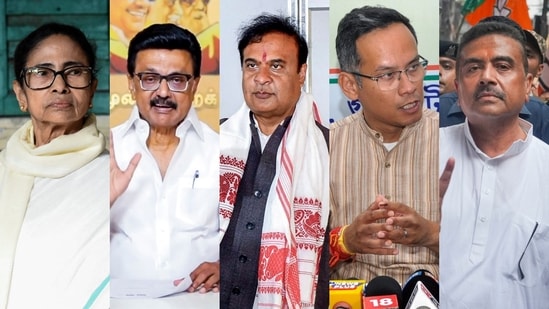
BJP's continuity in Assam, debut in Bengal, Vijay magic in Tamil Nadu: Full list of exit poll results
# Exit Polls 2026: BJP Surges, Vijay Stuns TN
**By Political Desk, National Electoral Review | April 30, 2026**
**NEW DELHI:** On Thursday, April 30, 2026, a flurry of exit polls following the conclusion of the high-stakes state assembly elections unveiled a rapidly shifting political landscape across India. Polling agencies and major media networks forecast a dominant continuation of power for the Bharatiya Janata Party (BJP) in Assam, while projecting a fierce, neck-and-neck battle for a potential BJP debut government in West Bengal. Meanwhile, deep down south, unanimous predictions point to a decisive regime change in Kerala. However, the most dramatic revelation emerges from Tamil Nadu, where actor-turned-politician Thalapathy Vijay’s fledgling party is predicted to shatter the state’s traditional Dravidian duopoly. [Source: Hindustan Times | Additional: National Election Watch].
As the Election Commission of India prepares for the official vote counting next week, these exit poll numbers offer a tantalizing glimpse into the mind of the Indian voter, reflecting deep regional divides, the impact of localized welfare schemes, and the potent allure of new political celebrity.
## Assam: The BJP’s Ironclad Continuity
In the northeastern stronghold of Assam, the exit polls have delivered a unanimous verdict: a historic third consecutive term for the BJP-led National Democratic Alliance (NDA). Chief Minister Himanta Biswa Sarma’s aggressive push for infrastructure development, combined with the immense popularity of direct benefit transfer schemes, appears to have cemented the party’s base.
According to the aggregated poll data, the BJP and its regional allies are projected to comfortably cross the halfway mark of 63 in the 126-member assembly. The opposition Congress-led alliance, despite attempting to capitalize on localized anti-incumbency and the recent delimitation exercise, seems to have failed to breach the NDA’s formidable social coalition.
“The BJP’s success in Assam is no longer just about ideological consolidation; it is fundamentally rooted in hyper-local governance delivery,” notes Dr. Rajeev Barua, a senior political analyst at the Gauhati Institute of Public Policy. “Schemes like *Orunodoi*, which deposits direct cash into the accounts of millions of women, have created a massive, loyal voting bloc that transcends traditional ethnic fault lines.”
Furthermore, the state’s recent constituency delimitation appears to have favored the ruling party’s demographic strategies, leaving the opposition fragmented in crucial Upper Assam and Barak Valley districts.
## West Bengal: A High-Stakes Debut or Another TMC Fortress?
If Assam represents continuity, West Bengal is the epicenter of volatility. The exit polls suggest an intense, down-to-the-wire contest between Chief Minister Mamata Banerjee’s Trinamool Congress (TMC) and a resurgent BJP looking to form its first-ever government in the state.
While some polls give a slight edge to the incumbent TMC, citing the enduring appeal of the *Lakshmir Bhandar* women’s welfare scheme, others predict a massive upset, placing the BJP at the threshold of the 148-seat majority mark in the 294-member assembly.
The BJP’s aggressive campaign centered around anti-corruption, allegations of democratic subversion, and the implementation of the Citizenship Amendment Act (CAA) appears to have resonated deeply in the Matua-dominated regions and North Bengal. Meanwhile, the TMC has relied heavily on Bengali sub-nationalism and the defense of its vast social welfare architecture.
**Key Factors Driving Bengal’s Tight Race:**
* **Women Voters:** The TMC’s *Lakshmir Bhandar* scheme has historically acted as a firewall against the BJP. However, BJP campaigns highlighting rural safety and governance transparency have attempted to crack this demographic.
* **Anti-Incumbency:** Facing its fourth consecutive assembly election, the TMC is battling significant fatigue and localized resentment over corruption allegations involving lower-tier leaders.
* **Urban vs. Rural Divide:** Exit polls indicate the BJP making sweeping gains in urban centers and northern districts, while the TMC holds strong in the densely populated southern rural belt.
“Bengal is witnessing a classic clash between systemic welfare delivery and peak anti-incumbency,” states Dr. Ananya Sen, a Kolkata-based psephologist. “If the BJP manages to cross the magic number, it will be entirely due to a consolidation of the silent, frustrated voter. If Mamata Banerjee holds on, it will be a testament to her unparalleled grassroots machinery.”
## Tamil Nadu: The “Vijay Magic” Disrupts the Status Quo
Perhaps the most startling headline from the April 2026 exit polls comes from Tamil Nadu. For over fifty years, the state’s political landscape has been an impenetrable fortress guarded alternately by the Dravida Munnetra Kazhagam (DMK) and the All India Anna Dravida Munnetra Kazhagam (AIADMK). The entry of Thalapathy Vijay and his newly minted party, Tamilaga Vettri Kazhagam (TVK), has triggered a seismic disruption.
Early exit poll numbers suggest that while the incumbent DMK, led by M.K. Stalin, might still emerge as the single largest party, it is falling short of an absolute majority. Vijay’s TVK is projected to capture an unprecedented 15% to 22% of the vote share, translating into dozens of seats and positioning the actor as a definitive kingmaker—or potentially the leader of a coalition government.
Vijay’s campaign, which eschewed traditional caste-based arithmetic in favor of anti-corruption rhetoric, youth empowerment, and an inclusive “Tamil identity,” has drawn monumental crowds.
“What we are seeing in Tamil Nadu is a generational revolt at the ballot box,” explains Karthik Subramanian, an author and political commentator based in Chennai. “First-time voters and youth who feel alienated by the entrenched DMK-AIADMK binary have flocked to Vijay. The ‘Vijay Magic’ is not just cinema stardom; it is the weaponization of voter fatigue.”
The AIADMK, still struggling with internal factionalism post-Jayalalithaa, appears to be the biggest loser, with exit polls showing a severe erosion of their traditional vote banks in the western and southern belts. Meanwhile, the BJP, despite aggressive campaigning by its state leadership, remains a marginal player, though it may secure a handful of seats in alliances.
## Kerala: The Return of the Pendulum
In Kerala, a state historically famous for voting out incumbent governments, the 2021 elections were an anomaly when the CPI(M)-led Left Democratic Front (LDF) retained power. According to the 2026 exit polls, the state’s political pendulum is swinging back with a vengeance.
Forecasters have delivered unanimous predictions favoring the Congress-led United Democratic Front (UDF). Estimates suggest the UDF could secure between 85 and 95 seats in the 140-member assembly, comfortably ousting Chief Minister Pinarayi Vijayan’s government.
The LDF’s projected defeat is largely attributed to severe anti-incumbency following a decade in power. Widespread voter discontent over the state’s mounting fiscal deficit, delayed salary disbursements, and a perceived stagnation in industrial growth has severely dented the Left’s armor. Furthermore, the UDF managed to successfully consolidate minority votes, particularly in Northern and Central Kerala, presenting itself as the most viable democratic alternative.
“The Kerala voter is highly pragmatic,” says Dr. Thomas Kurian, a sociology professor in Thiruvananthapuram. “The LDF was rewarded in 2021 for its crisis management during the pandemic. In 2026, they are being punished for economic stagnation. It is a return to traditional Kerala electoral behavior.”
The BJP-led NDA, which has been desperately trying to break the bipolar nature of Kerala politics, is projected to increase its vote share to double digits but is unlikely to win more than a couple of symbolic seats.
## Projected Seat Shares at a Glance
*The following data represents an aggregated average of major national exit polls as of April 30, 2026.*
| State (Total Seats) | Ruling Party/Alliance | Leading Opposition | Key Disruptor |
| :— | :— | :— | :— |
| **Assam (126)** | NDA: 72-80 | UPA: 35-45 | AIUDF: 5-8 |
| **West Bengal (294)** | TMC: 135-155 | NDA: 130-150 | Left-Cong: 5-10 |
| **Tamil Nadu (234)**| DMK+: 100-115 | AIADMK+: 40-55 | TVK (Vijay): 45-60|
| **Kerala (140)** | LDF: 45-55 | UDF: 85-95 | NDA: 1-3 |
## The Broader National Implications
While state elections are fought on regional issues, their outcomes inevitably cast a long shadow over the national political chessboard. [Source: Hindustan Times].
If the BJP successfully debuts in Bengal while retaining Assam, it will validate the party’s relentless eastward expansion strategy, proving that their national narrative can supersede entrenched regional strongmen. A victory in Bengal would be heralded as a monumental ideological triumph for the saffron party.
Conversely, the dynamics in the South continue to prove challenging for national parties. The rise of Thalapathy Vijay in Tamil Nadu indicates that regionalism and sub-national identities are morphing rather than fading. For the national opposition INDIA bloc, a UDF victory in Kerala provides a much-needed morale boost, even as their allies (like the DMK and TMC) face intense pressure in their respective backyards.
## Conclusion: Setting the Stage for the Final Count
Exit polls, by their very nature, are probabilities and not certainties. Indian electoral history is replete with instances where the silent voter has dramatically defied polling algorithms and punditry.
However, the trends established on April 30 paint a picture of a restless electorate. Whether it is the demand for continued stability in Assam, the desperate thirst for economic revitalization in Kerala, the fierce ideological battle in Bengal, or the cinematic disruption in Tamil Nadu, the 2026 assembly elections have definitively proven the vibrancy and unpredictability of Indian democracy.
As the electronic voting machines remain under heavy guard, all eyes are now firmly fixed on the official counting day. Until then, politicians and the public alike remain suspended in a thrilling state of statistical anticipation.





