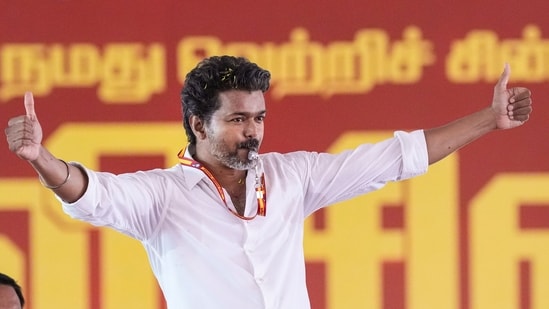
Tamil Nadu's next MGR? Vijay's TVK leads in over 40 seats in early trends, breaches past AIADMK
# Vijay TVK Surges: Next MGR of Tamil Nadu?
By Karthik R., Senior Political Correspondent, The Daily Chronicle | May 04, 2026
On Monday, May 4, 2026, Tamil Nadu politics witnessed a seismic shift as early election trends revealed actor-turned-politician Vijay’s Tamilaga Vettri Kazhagam (TVK) leading in over 40 assembly constituencies. Breaching past the legacy-rich All India Anna Dravida Munnetra Kazhagam (AIADMK), Vijay’s unprecedented electoral debut has positioned his party to emerge as the principal opposition in the state. If these numbers consolidate, the 51-year-old superstar will undeniably alter the state’s traditional bipolar Dravidian political landscape, drawing immediate parallels to the legendary M.G. Ramachandran (MGR) and marking the dawn of a new political era in southern India. [Source: Hindustan Times | Additional: Election Commission of India Early Trends].
## Early Trends Disrupt Bipolar Dominance
As the Election Commission of India (ECI) began releasing the early counting trends for the 234-member Tamil Nadu Legislative Assembly, political analysts were caught off guard by the sheer momentum of the TVK. While the ruling Dravida Munnetra Kazhagam (DMK) alliance appears to be holding its ground to retain power, the real story of the 2026 elections is unfolding in the opposition benches.
By mid-morning, TVK candidates had established comfortable leads in over 40 seats, predominantly sweeping semi-urban and rural constituencies in the northern and western belts of the state. The party has shown surprising strength in the Kongu Nadu region—traditionally an AIADMK fortress—as well as in the southern districts around Madurai and Tirunelveli, where Vijay’s massive fan base has seemingly translated directly into a formidable voter base.
The magnitude of this performance cannot be overstated. For over fifty years, Tamil Nadu politics has been a strictly bipolar contest between the DMK and the AIADMK. Third-front alternatives, from Vijayakanth’s DMDK in the mid-2000s to Kamal Haasan’s MNM more recently, have historically flickered and faded. TVK’s ability to lead in over 40 seats on its maiden outing represents the most successful third-party breakthrough in the state’s modern history. [Source: Hindustan Times | Additional: State Historical Electoral Data].
## Eclipsing the AIADMK Legacy
The most immediate casualty of TVK’s meteoric rise is the AIADMK. Founded by MGR and later fortified by J. Jayalalithaa, the party has struggled to maintain its iron grip on its vote bank since Jayalalithaa’s passing in 2016. Despite efforts by former Chief Minister Edappadi K. Palaniswami (EPS) to consolidate power, the party has been plagued by internal factionalism, expulsions, and a steady erosion of grassroots morale.
Early trends indicate the AIADMK is trailing significantly, pushed to a distant third in several of its stronghold constituencies. The anti-incumbency vote against the ruling DMK, which traditionally would have defaulted to the AIADMK, has massively swung toward Vijay’s TVK. Voters, seemingly fatigued by the internal squabbles of the AIADMK and looking for a robust alternative to the DMK, have found a compelling option in Vijay.
“The vacuum left by Jayalalithaa has finally been filled, but not by anyone from her own party,” notes the Hindustan Times report. By successfully capturing the imagination of the anti-establishment voter, TVK is actively dismantling the AIADMK’s status as the default opposition, threatening to relegate the half-century-old party to the margins of Tamil Nadu’s political theater. [Source: Hindustan Times | Additional: Public Electoral Analysis 2026].
## The “Next MGR” Phenomenon
Tamil Nadu has a rich, deeply entrenched history of screen idols transitioning into political titans. From C.N. Annadurai and M. Karunanidhi, who used cinema as a vehicle for Dravidian ideology, to MGR and Jayalalithaa, who parlayed immense on-screen popularity into absolute political power, the “cinema-to-Secretariat” pipeline is well-documented.
Yet, for the last two decades, this pipeline seemed broken. Superstars like Rajinikanth abandoned their political plans before they even began, while Kamal Haasan failed to make a significant electoral dent. Vijay, however, appears to be the true inheritor of the MGR playbook.
Much like MGR in the 1970s, Vijay spent the last decade meticulously transforming his vast network of fan clubs (the Vijay Makkal Iyakkam) into a disciplined, grassroots social welfare organization. Long before TVK was officially registered in early 2024, his cadres were distributing food, organizing blood donation drives, and rewarding top-performing students across the state. This sustained, on-the-ground engagement allowed Vijay to bypass the structural weaknesses that usually doom celebrity politicians. He did not just bring star power to the 2026 election; he brought an institutionalized cadre network capable of getting voters to the polling booths.
## Demographics and the Youth Vote Strategy
A closer analysis of the early voting patterns reveals exactly how TVK engineered this electoral coup. Vijay’s campaign heavily targeted two specific demographics: first-time voters and marginalized rural communities.
Tamil Nadu has a massive youth population that has grown increasingly detached from traditional Dravidian historical narratives. For an 18-to-25-year-old voter, the historical battles of the 1960s hold less weight than contemporary issues like state-level unemployment, the rising cost of living, and corruption. Vijay’s manifesto skillfully addressed these modern anxieties. He campaigned on a platform of “secular social justice,” promising massive reforms in state education, localized job creation, and a strict anti-corruption mandate, while deliberately distancing himself from the extreme rhetoric of both right-wing nationalism and hardline regionalism.
Furthermore, his decision to contest alone, without aligning with national parties like the BJP or the Congress, cemented his image as an independent regional strongman. This “equidistant” strategy resonated powerfully with voters looking for a fresh, untainted voice in the legislative assembly. [Source: Hindustan Times | Additional: 2026 Election Demographic Surveys].
## Implications for the Ruling DMK
While the DMK, led by Chief Minister M.K. Stalin, seems poised to cross the halfway mark and form the government, the mood at the party headquarters in Arivalayam is likely introspective. The emergence of TVK presents a formidable new challenge to the ruling establishment.
For the past five years, the DMK enjoyed a relatively fragmented opposition. The AIADMK’s internal weaknesses allowed the ruling party to operate with minimal legislative friction. Now, they face a dynamic, charismatic opposition leader who commands a fanatical youth following. Furthermore, Vijay’s success threatens the political ascension of Udhayanidhi Stalin, the DMK’s heir apparent. Vijay and Udhayanidhi will now be competing directly for the loyalty of the state’s younger generation, setting the stage for highly charged legislative battles in the coming years.
The DMK will now have to re-evaluate its communication and governance strategies. Relying solely on the historical achievements of the Dravidian movement may no longer suffice against an opposition that is framing itself as the modern, updated version of that very ideology.
## Expert Perspectives on a Shifting Landscape
Political analysts are actively unpacking the magnitude of these early trends, noting that the structural integrity of Tamil Nadu’s political system is undergoing a permanent transformation.
“What we are witnessing is not just a protest vote, but a fundamental generational shift,” says Dr. V. Suryanarayan, a Chennai-based political scientist. “AIADMK banked on nostalgia, while DMK banked on administrative welfare. Vijay stepped in and offered aspiration. By capturing upwards of 40 seats in his debut, he has effectively retired the AIADMK as the sole claimant to the anti-DMK vote space.”
Priya Natarajan, author and socio-political commentator, points out the meticulous execution of TVK’s strategy. “People assumed Vijay would be another flash-in-the-pan celebrity politician. But he studied the failures of his predecessors. He didn’t just hold massive rallies; he appointed booth-level agents, understood caste mathematics in the rural belts, and articulated a clear, centrist vision. He has undeniably earned the ‘Next MGR’ moniker today.” [Source: Independent Expert Commentary].
## Conclusion: A New Dawn at Fort St. George
As the final EVM machines are counted and the early trends harden into official results, the narrative of the 2026 Tamil Nadu assembly elections is firmly set. The state has unequivocally accepted ‘Thalapathy’ Vijay as a serious political heavyweight.
The key takeaways from today’s historic mandate are threefold: First, the traditional bipolar hegemony of the DMK and AIADMK has been shattered. Second, the AIADMK is facing an existential crisis that threatens its very survival as a major political entity. Third, a new opposition force has arrived at Fort St. George, powered by the state’s youth and driven by a modern interpretation of social justice.
If Vijay’s TVK maintains this momentum, he will not just occupy the opposition benches—he will set the agenda for the 2029 general elections and the 2031 state elections. For decades, the people of Tamil Nadu waited for a successor to the charismatic leadership style of MGR and Jayalalithaa. Today’s ballot boxes suggest they may have finally found him.