
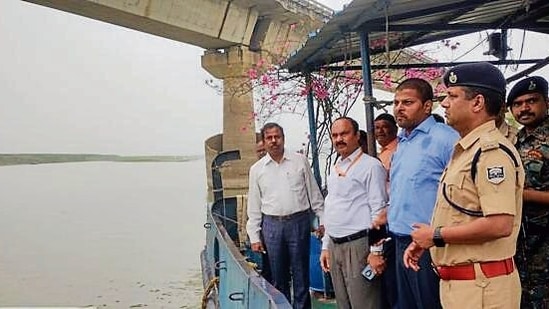
Bhagalpur bridge scare: Slab falls from Vikramshila Setu into Ganga River; no injuries, route diverted
# Bhagalpur Bridge Slab Collapses Into Ganga
**By Staff Reporter, India Infrastructure Desk** | **May 4, 2026**
Panic gripped commuters in Bihar’s Bhagalpur district on Monday morning after a substantial concrete slab from the vital Vikramshila Setu unexpectedly collapsed into the Ganga River below. The incident, which occurred early on May 4, 2026, resulted in no casualties, as traffic was fortuitously light and the massive debris plunged directly into the water. However, the alarming structural failure prompted immediate administrative action, forcing local authorities to completely halt and divert all vehicular traffic connecting the Purvanchal and Seemanchal regions to prevent a potential mass disaster [Source: Hindustan Times].
The sudden failure of a major operational bridge highlights the ongoing infrastructural challenges facing the state of Bihar, reigniting debates over construction quality, routine maintenance, and the safety of millions who rely on these river crossings daily.
## Immediate Aftermath and Traffic Diversions
At approximately 9:30 AM IST, eyewitnesses reported a deafening crack echoing across the river before a segment of the carriageway slab, situated squarely between two foundational pillars, gave way. The slab sheared off its supporting girders and plummeted over 100 feet into the swift currents of the Ganga.
Local police from the Bhagalpur and Naugachia districts were immediately dispatched to the scene. Barricades were swiftly erected on both approaches to the 4.7-kilometer-long bridge, effectively cutting off the primary artery between North and South Bihar.
“We received a distress call from a toll operator and several terrified motorists who narrowly missed the collapsing section,” stated a senior official from the Bhagalpur district administration. “Our first priority was securing the perimeter and ensuring zero loss of life. We have indefinitely suspended all movement on the Vikramshila Setu until a thorough structural audit can be conducted by state engineers.”
To manage the sudden severing of this critical route, the traffic police implemented emergency diversion protocols. Heavy commercial vehicles, passenger buses, and light motor vehicles bound for Purnia, Katihar, and the broader Seemanchal region have been redirected to alternative, albeit significantly longer, routes via the Munger Ganga Bridge and the Rajendra Setu in Mokama. This diversion is expected to add an average of 100 to 150 kilometers to transit journeys, creating immediate logistical nightmares.
## Strategic Significance of Vikramshila Setu
Inaugurated in 2001, the Vikramshila Setu serves as an indispensable economic and geographical lifeline for the region. As a two-lane bridge, it bridges the gap between National Highway 33 (formerly NH 80) on the southern bank in Bhagalpur and National Highway 31 on the northern bank in Naugachia.
For nearly 25 years, this bridge has been the linchpin connecting the culturally and economically distinct regions of Purvanchal and Seemanchal. It facilitates the daily movement of thousands of metric tons of agricultural produce, manufactured goods, and raw materials. Corn, makhana (fox nuts), and jute from the Seemanchal districts rely heavily on this crossing to reach markets in central India and beyond.
The sudden closure of the bridge effectively severs the most direct route for millions of residents. Beyond commercial freight, the Vikramshila Setu is heavily utilized for medical emergencies, allowing patients from rural northern districts to access advanced healthcare facilities in Bhagalpur city. The sudden loss of this thoroughfare threatens to paralyze regional mobility and stifle local economies.
## Structural Vulnerabilities: Why Did the Slab Fail?
Preliminary observations by local engineers suggest that the collapse may have been triggered by severe fatigue in the bridge’s expansion joints or the degradation of the elastomeric bearing pads that cushion the concrete slabs. The Vikramshila Setu has long been plagued by complaints of poor road surface quality, exposed rebar, and dangerous potholes.
Over the past decade, the bridge has endured a traffic volume exponentially higher than its original design capacity. The continuous pounding of overloaded sand-laden trucks, combined with the extreme environmental stresses of the Ganga basin—including severe monsoon flooding, high humidity, and aggressive river scouring around the piers—has vastly accelerated the bridge’s wear and tear.
“What we are looking at is likely a failure of post-construction maintenance,” explained Dr. Arvind Kumar, an independent structural engineer based in Patna. “A bridge slab does not simply vanish without prior warning signs. There would have been micro-fractures, visible sagging, or distress in the structural bearings. The failure to identify and rectify these red flags points to a systemic breakdown in routine infrastructural health monitoring.” [Additional Source: Engineering Analysis based on regional bridge data].
Furthermore, the morphological shifting of the Ganga River imposes uneven hydrodynamic pressure on the bridge’s substructure. While the pillars themselves remain standing, the vibration and shifting loads could have destabilized the horizontal slabs resting upon them.
## A Troubling Pattern: Bihar’s Bridge Infrastructure Crisis
Monday’s terrifying incident is not an isolated event; rather, it is the latest chapter in a deeply concerning narrative of infrastructure failures across Bihar. Over the past five years, the state has witnessed a disproportionate number of bridge collapses, ranging from minor rural crossings to massive multi-crore mega-projects.
The most notorious among these is the Aguwani-Sultanganj bridge, a heavily funded project over the Ganga that suffered catastrophic collapses in both 2022 and 2023. These repeated failures have eroded public trust and drawn intense scrutiny from both the judiciary and the central government.
**Recent Bridge Collapses in Bihar (2022–2026):**
| Year | Location/Bridge Name | Status at Time of Collapse | Primary Cause (Reported/Suspected) |
| :— | :— | :— | :— |
| 2022 | Aguwani-Sultanganj (Bhagalpur) | Under Construction | Design flaw / Pier failure |
| 2023 | Aguwani-Sultanganj (Bhagalpur) | Under Construction | Structural instability / Loose cables |
| 2024 | Supaul (Kosi River) | Under Construction | Inferior material quality |
| 2024 | Araria (Bakara River) | Newly Constructed | Riverbed scouring / Weak foundation |
| 2026 | Vikramshila Setu (Bhagalpur) | Operational (25 years old) | Slab failure / Lack of maintenance |
*Data compiled from public records and state infrastructure reports.*
This recurring theme raises serious questions regarding the efficacy of the Road Construction Department (RCD) and the Bihar Rajya Pul Nirman Nigam Limited (BRPNNL). Critics argue that pervasive corruption, the use of sub-standard construction materials, and a lack of stringent, independent oversight are the root causes of the state’s crumbling infrastructure.
## Expert Analysis: The Engineering Challenge
The construction and maintenance of bridges over major alluvial rivers like the Ganga present unique geotechnical challenges. The riverbed is composed of deep, shifting silt, which undergoes dramatic alterations during the annual monsoon floods.
“The Ganga is a highly dynamic river,” noted Dr. Meenakshi Sinha, a hydrologist and civil engineering consultant. “When you build over it, the piers face immense scouring—the removal of sediment from around the foundation by swiftly moving water. If the foundations shift even marginally, it puts immense shear stress on the superstructure. Regular underwater acoustic profiling and structural health monitoring (SHM) systems using sensors are mandatory for bridges of this scale. Unfortunately, older bridges like the Vikramshila Setu often lack modern SHM retrofits.”
Experts are calling for an immediate, tech-driven audit of all major bridges in the state. Utilizing drones equipped with thermal imaging, laser scanning (LiDAR), and ground-penetrating radar could help detect hidden internal voids or severe corrosion within the concrete before it results in a catastrophic failure like the one witnessed on Monday morning.
## Economic Repercussions of the Closure
The economic fallout of the Vikramshila Setu closure will be immediate and severe. With the route diverted, freight and logistics operators are bracing for a massive spike in operational costs.
“Diverting a fully loaded truck via Munger adds hours to the journey and burns significantly more diesel,” lamented Rakesh Singh, secretary of the regional transport association in Naugachia. “These increased transport costs will inevitably be passed down to the consumer. We expect the prices of daily commodities, vegetables, and essential goods in Bhagalpur and surrounding districts to surge within the week.”
Furthermore, the local agricultural supply chain, which relies heavily on timely delivery, faces severe disruption. Perishable goods stuck in elongated transit routes risk spoilage, threatening the livelihoods of thousands of farmers in the Kosi and Seemanchal belts. Local businesses on both sides of the river, which depend on the daily flow of commuters, are also preparing for a steep drop in revenue.
## Government Accountability and Next Steps
In the wake of the collapse, the Bihar state government faces immense pressure to act swiftly and transparently. A high-level investigative committee, comprising senior engineers from the state RCD and external experts from the Indian Institute of Technology (IIT) Patna, is expected to be constituted to determine the exact cause of the slab’s failure.
Immediate next steps will require a delicate and highly technical repair operation. Engineers must assess the integrity of the adjacent slabs and the supporting piers before any restorative work can begin. Given the complexities of working over a major river, it could take weeks, if not months, to safely replace the slab and reopen the bridge to the public.
In the long term, this incident underscores the urgent need for the completion of the parallel four-lane bridge being constructed adjacent to the Vikramshila Setu. Approved to alleviate the chronic congestion and wear on the older structure, the parallel bridge project must now be expedited to prevent a total logistical collapse in the region.
## Conclusion
The terrifying collapse of a massive concrete slab from the Vikramshila Setu into the Ganga River is a stark wake-up call regarding the fragility of India’s aging infrastructure. While Bhagalpur narrowly escaped a mass casualty event on May 4, 2026, the incident exposes glaring gaps in maintenance, structural auditing, and infrastructural foresight.
As traffic remains indefinitely diverted, the socio-economic impact on the Purvanchal and Seemanchal regions will be profoundly felt. Moving forward, authorities must pivot from a reactive disaster management approach to a proactive, technology-driven maintenance strategy. Ensuring the safety of the millions who traverse these vital bridges daily must transcend political rhetoric and become a strictly enforced engineering mandate.





