
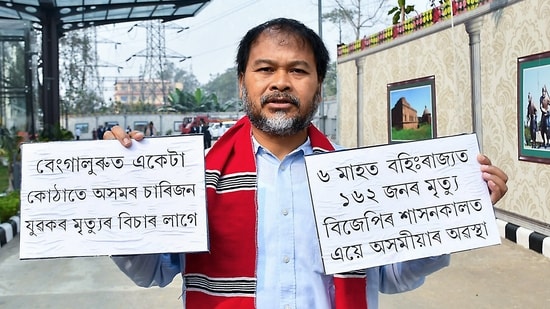
From prison to assembly: Why Akhil Gogoi’s Sivasagar re-election is a litmus test for regionalism
# Gogoi’s Sivasagar Fight: Assam Election Test
**By Senior Political Correspondent** | May 4, 2026
Akhil Gogoi, the firebrand sitting Member of the Legislative Assembly (MLA) and founder of the Raijor Dal, is fiercely campaigning for a second term in Assam’s historic Sivasagar constituency this May 2026. Battling the formidable election machinery of the ruling Bharatiya Janata Party (BJP), Gogoi’s campaign is rooted in the defense of indigenous rights and aggressive regionalism. Emerging from a dramatic 2021 victory achieved entirely from behind bars, Gogoi’s re-election bid is no longer just a localized contest. It has transformed into a definitive litmus test for the survival, relevance, and future trajectory of independent regional politics in India’s Northeast. [Source: Hindustan Times | Additional: Electoral Commission Public Records].
## The Historic 2021 Mandate: From Prison to Parliament
To understand the gravity of the 2026 Sivasagar election, one must look back at the unprecedented events of 2021. Akhil Gogoi made Indian electoral history when he became the first Assamese politician to win a legislative assembly seat from inside a prison cell. Arrested in December 2019 under the stringent Unlawful Activities (Prevention) Act (UAPA) for his role in the anti-Citizenship Amendment Act (CAA) protests, Gogoi spent over a year and a half in incarceration.
During the 2021 assembly elections, he could not hold a single public rally, participate in a roadshow, or speak directly to his constituents. Instead, his campaign was spearheaded by his octogenarian mother, Priyada Gogoi, and passionate student activists from the Krishak Mukti Sangram Samiti (KMSS). Riding on a massive wave of emotional and sub-nationalist support, Gogoi secured the Sivasagar seat by defeating the BJP’s Surabhi Rajkonwar by a decisive margin of over 11,000 votes.
His release in July 2021, following a clearance by the Special NIA Court, marked his transition from a grassroots agitator to a mainstream legislator. Since then, Gogoi has utilized the assembly floor to become one of the most vocal critics of Chief Minister Himanta Biswa Sarma’s administration. However, the 2026 election presents a fundamentally different challenge. This time, Gogoi is fighting not as an imprisoned martyr, but as an incumbent MLA whose legislative record, constituency development, and political alliances are under intense public scrutiny. [Source: Hindustan Times | Additional: Assam Legislative Assembly Archives].
## Sivasagar: The Cultural Heartland of Assamese Identity
The choice of Sivasagar as the battleground for this ideological war is deeply symbolic. Sivasagar, formerly known as Rangpur, was the capital of the mighty Ahom Kingdom, which ruled Assam for six centuries and successfully resisted Mughal expansion. Today, the district is dotted with historical monuments like the Rang Ghar, the Shiva Dol, and the Talatal Ghar—structures that serve as enduring symbols of Assamese pride and sovereignty.
For a party like Raijor Dal, which anchors its ideology in Assamese sub-nationalism and the protection of indigenous land rights, Sivasagar represents the cultural and emotional heart of the state. The demographic makeup of the constituency is equally complex, comprising a significant population of the indigenous Ahom community, along with a substantial number of Tea Tribe communities whose ancestors were brought to Assam by the British in the 19th century.
Gogoi has consistently framed his political narrative around the “threat to Assamese identity” posed by demographic shifts and the centralizing policies of the BJP government in New Delhi. By holding Sivasagar, Gogoi hopes to prove that regionalism remains a potent force capable of withstanding the BJP’s Pan-India Hindutva and development-oriented electoral juggernaut.
## The BJP’s Double-Engine Counter-Strategy
The ruling BJP is acutely aware of the symbolic importance of unseating Akhil Gogoi. For Chief Minister Himanta Biswa Sarma and the BJP high command, wresting Sivasagar from the Raijor Dal would signify the ultimate defeat of the anti-CAA political bloc in Upper Assam.
To achieve this, the BJP has deployed a multi-pronged strategy. The primary weapon in the ruling party’s arsenal is its vast array of direct benefit transfer (DBT) schemes, most notably the ‘Orunodoi’ scheme, which provides monthly financial assistance to women in low-income households. Furthermore, the state government has heavily invested in infrastructure projects in Upper Assam, promoting a narrative of “double-engine” growth—synergy between the central government in New Delhi and the state government in Dispur.
The BJP also accuses Gogoi of practicing “politics of agitation” rather than “politics of development.” BJP leaders have campaigned in Sivasagar arguing that continuous protests and strikes (bandhs) have hindered industrial growth and youth employment in the region. By framing Gogoi as an anti-development agitator, the saffron party hopes to appeal to aspirational young voters and business owners who prioritize economic stability over identity politics.
## Key Electoral Battlegrounds in Sivasagar
The 2026 election in Sivasagar is being fought over several deeply entrenched socio-economic and political issues. Both the Raijor Dal and the BJP have presented sharply contrasting visions for the electorate.
| Key Issue | Akhil Gogoi & Raijor Dal Platform | BJP & Allies Platform |
| :— | :— | :— |
| **Citizenship Amendment Act (CAA)** | Demands complete repeal of the CAA, arguing it violates the 1985 Assam Accord and threatens indigenous demographics. | Defends the CAA as a humanitarian necessity; assures voters that indigenous rights are protected under Clause 6 of the Assam Accord. |
| **Tea Tribe Welfare** | Advocates for a significant hike in the daily minimum wage for tea garden workers, alongside land rights (pattas) for the community. | Highlights government initiatives like free rice, targeted healthcare schemes, and direct cash transfers to tea garden workers’ bank accounts. |
| **Resource Control** | Opposes the privatization of state assets, particularly in the oil and natural gas sectors which have a heavy presence in Upper Assam. | Promotes privatization and central investment as a necessary catalyst for modernizing local industries and generating employment. |
| **Micro-Finance & Debt** | Criticizes micro-finance institutions for predatory lending practices that disproportionately affect rural women in Sivasagar. | Points to state government-led micro-finance loan waiver schemes implemented over the last five years as proof of commitment to women’s welfare. |
## Alliance Politics and the Opposition Blueprint
A critical factor that will determine the outcome of the Sivasagar election is the architecture of opposition alliances. In the 2021 elections, the anti-BJP vote was fractured. The Raijor Dal and the Asom Jatiya Parishad (AJP)—both born out of the anti-CAA movement—fought in an alliance, but they failed to reach a pre-poll seat-sharing agreement with the Congress-led ‘Mahajot’ (Grand Alliance). This fragmentation allowed the BJP to secure victories in several closely contested constituencies.
For the 2026 elections, the political landscape has shifted. The formation of the United Opposition Forum Assam (UOFA), aligned with the broader national INDIA bloc, represents a concerted effort to prevent the division of anti-incumbency votes. Akhil Gogoi has played a pivotal role in negotiating within this forum, advocating for a united front where only one opposition candidate is fielded against the BJP in key constituencies.
However, sustaining this alliance requires delicate political maneuvering. Gogoi must balance his fierce, uncompromising regional identity with the pragmatic compromises required by larger national parties like the Congress. If the opposition alliance holds firm in Sivasagar, ensuring a one-on-one contest, Gogoi’s path to a second term becomes mathematically stronger. Conversely, any rebel candidates or breakdowns in the coalition could provide the BJP with a decisive electoral wedge. [Source: Hindustan Times | Additional: Independent Political Analysis].
## Expert Analysis: The Institutionalization of Dissent
Political analysts view the Sivasagar contest as a microcosm of Assam’s evolving political psyche. Dr. Sanjeeb Baruah, an independent political scientist specializing in Northeast India’s electoral dynamics, notes the transformation in Gogoi’s approach.
“Akhil Gogoi’s 2026 campaign represents the institutionalization of dissent,” explains Dr. Baruah. “In 2021, people voted for a symbol—a man unjustly jailed for raising his voice for Assam. In 2026, they are being asked to vote for a legislator. Gogoi has successfully kept the issues of resource alienation and sub-nationalism alive in the assembly, but he is now fighting against a highly efficient welfare-delivery system engineered by the state government. The Sivasagar election will answer a crucial question: Can ideological regionalism defeat targeted state-sponsored welfarism?”
Furthermore, grassroots workers in Sivasagar report a palpable tension between the emotional appeal of protecting Assamese identity and the practical appeal of government subsidies. “Akhil Da is our voice, he speaks what we feel in our hearts about our land,” says Rupjyoti Phukan, a local merchant in Sivasagar town. “But the ruling party has deep pockets and massive organization. This election is going to be incredibly close.”
## Conclusion: The Litmus Test for Regionalism
As Assam progresses through the critical phases of the May 2026 elections, the spotlight remains firmly fixed on Akhil Gogoi and Sivasagar. The constituency is witnessing a clash of two distinct political philosophies. On one side is the BJP’s narrative of centralized nationalism, aggressive infrastructure development, and direct welfarism. On the other side is Gogoi’s Raijor Dal, fighting to preserve the ethos of the Assam Accord, indigenous sovereignty, and decentralized regional autonomy.
If Akhil Gogoi secures a second term, it will validate his transition from a street agitator to a seasoned statesman, proving that regionalism remains an indomitable force in Assam despite the BJP’s dominance. It would also cement his position as the de facto leader of the state’s indigenous opposition movement. However, a defeat would not only silence one of the BJP’s fiercest critics but also signal a potential twilight for independent, identity-based regional parties in the face of modern, machinery-driven electioneering. Ultimately, the verdict of Sivasagar’s voters will echo far beyond the boundaries of the historic Ahom capital, shaping the political contours of Assam for years to come.





