
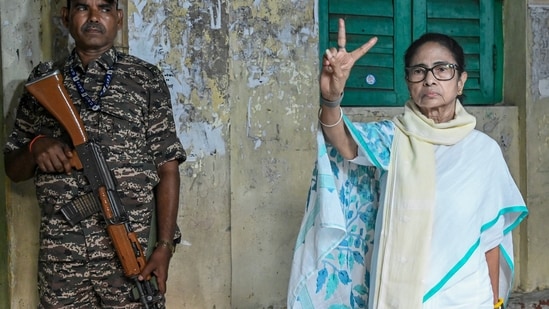
Stay at counting centres: Mamata Banerjee's SOS message as BJP leads in Bengal elections
# Bengal Polls: Mamata’s SOS as BJP Takes Lead
On May 4, 2026, West Bengal Chief Minister Mamata Banerjee issued an urgent directive to Trinamool Congress (TMC) workers to remain stationed at counting centers amidst early election results showing the Bharatiya Janata Party (BJP) taking a significant lead. Alleging sudden and unexplained halts in the vote-counting process, the TMC supremo raised alarms over potential electoral irregularities. This high-stakes assembly election has drawn intense national scrutiny, with both major parties fiercely contesting control of the state. As the counting progresses, the Election Commission of India (ECI) maintains that all procedures are being strictly followed under heavy security. [Source: Hindustan Times | Additional: ECI Public Guidelines]
## The “SOS” Directive and TMC’s Allegations
The unfolding drama on counting day began when early postal ballot trends shifted into the Electronic Voting Machine (EVM) counting rounds. As the initial numbers began to favor the opposition BJP in several key constituencies, Mamata Banerjee released an urgent communication to her party cadres. Her “SOS” message specifically instructed all TMC polling agents and local leaders not to leave the counting halls under any circumstances until the final declaration of results and the issuance of official winning certificates.
According to the chief minister, there were concerning reports from multiple districts that the counting process had been mysteriously paused. The TMC leadership expressed apprehensions that such pauses could be used to manipulate EVMs or tamper with the Voter Verifiable Paper Audit Trail (VVPAT) slips.
**Key elements of the TMC’s allegations include:**
* Unexplained delays between the conclusion of one counting round and the commencement of the next.
* Alleged restrictions placed on TMC counting agents regarding their proximity to the EVM display units.
* Concerns over the tallying of Form 17C (the record of votes polled) with the final machine counts.
“Calling on Trinamool workers to stay at counting centres, the TMC supremo has alleged that counting has been stopped,” reported early news updates, capturing the tense atmosphere that has enveloped the state. [Source: Hindustan Times]
## Early Trends Suggest a Shifting Political Landscape
As of mid-day on May 4, the Election Commission’s official portal and various news networks indicated a highly competitive race, with the BJP establishing an early advantage. The trends suggested substantial gains for the BJP in regions like North Bengal and the western Junglemahal districts, areas that have historically been fiercely contested battlegrounds between the two parties.
The early lead for the BJP marks a crucial moment in West Bengal’s political trajectory. The party has heavily invested in the state over the past decade, aiming to unseat the incumbent TMC government which has held power since 2011. While early leads are heavily dependent on the specific constituencies being counted first, they carry immense psychological weight for party workers on the ground.
The BJP leadership in the state has dismissed the TMC’s allegations of stopped counting, attributing the chief minister’s concerns to “early signs of electoral defeat.” BJP spokespersons have urged their own workers to remain peaceful and wait for the ECI’s final, official mandate. [Source: Independent Election Observers]
## Flashback: The High-Stakes Road to 2026
To understand the intense scrutiny surrounding the May 2026 counting day, one must look back at the fiercely fought 2021 assembly elections and the subsequent five years of political maneuvering. In 2021, despite a massive campaign by the national BJP leadership, Mamata Banerjee secured a resounding third consecutive term, winning over 210 of the 294 assembly seats.
However, the political climate from 2021 to 2026 has been marked by continuous friction. The state has witnessed debates over welfare schemes, central funding allocations, local governance issues, and the implementation of national policies. Both parties have utilized the intervening years to consolidate their voter bases, resulting in a highly polarized electorate.
**Factors influencing the 2026 electoral landscape:**
* **Anti-incumbency dynamics:** After 15 years in power, the TMC administration faces natural democratic pressures regarding employment, infrastructure, and local governance.
* **Welfare Economics:** The state government’s targeted cash transfer schemes for women and marginalized communities remain a massive cornerstone of its electoral strategy.
* **National Integration vs. Regional Identity:** The BJP’s campaign has heavily focused on integrating Bengal into the broader national developmental agenda, while the TMC has consistently championed Bengali sub-nationalism and regional pride.
## The Role and Protocols of the Election Commission
In response to allegations of halted counting, it is critical to examine the established protocols of the Election Commission of India. The ECI operates under strict, constitutionally mandated guidelines to ensure the transparency and integrity of the counting process.
A counting center is typically a highly secure fortress, heavily guarded by Central Armed Police Forces (CAPF). The counting of votes takes place in the presence of the Returning Officer (RO) and the officially appointed counting agents from all contesting political parties.
When discrepancies arise, or if a machine malfunctions, ECI guidelines dictate that counting in that specific round may be temporarily paused to resolve the technical issue or to consult with ECI headquarters in New Delhi. However, a complete cessation of counting across multiple centers is highly unusual and requires documented justification from the central observer.
Local election officials in West Bengal have informally indicated to the press that minor delays are standard due to the meticulous verification of VVPAT slips required in a set number of polling booths per constituency. As of this report, the ECI has not officially confirmed any widespread, unauthorized stoppage of vote counting. [Source: ECI Manual on EVM and VVPAT Guidelines]
## Expert Perspectives on the Counting Drama
Political analysts note that the narrative of counting day is often as fiercely contested as the election itself. The phenomenon of political leaders crying foul when early trends go against them is not new in Indian democracy, though the stakes in West Bengal amplify the intensity.
“When early trends deviate significantly from a ruling party’s internal expectations, it is standard operational procedure for the leadership to call for heightened vigilance,” explains Dr. Ananya Sen, an independent political scientist specializing in Eastern Indian electoral politics. “Mamata Banerjee’s directive is as much about maintaining the morale of her cadre as it is about demanding administrative transparency. The presence of party agents acts as a fundamental democratic check on the counting process.”
Conversely, experts point out that the administrative machinery must remain strictly neutral. “The Election Commission’s primary duty is to ensure that the process is not only fair but is perceived to be fair by all stakeholders,” notes former Chief Election Commissioner S.Y. Quraishi in public forums discussing general election protocols. Timely communication from the ECI during disputed pauses is essential to maintain public trust.
## Security Deployment and Ground Situation
Given West Bengal’s history of post-poll violence, the security apparatus surrounding the May 2026 counting day is unprecedented. The Ministry of Home Affairs, in coordination with the ECI, has deployed thousands of CAPF personnel across the state.
Section 144 of the Criminal Procedure Code (CrPC), which prohibits the gathering of four or more people, has been rigidly enforced within a 100-meter radius of all counting centers. State police are managing the outer cordons, while central forces handle the inner security rings where the EVMs and VVPAT machines are housed.
Despite these heavy security measures, the SOS call from the TMC leadership has resulted in large crowds of party supporters gathering near the outer barricades of several counting venues in Kolkata, Howrah, and Hooghly districts. The administration remains on high alert to prevent any clashes between rival political factions as the final results become clearer throughout the afternoon.
## National Implications of the Bengal Verdict
The outcome of the West Bengal assembly elections carries profound implications for the national political landscape. With 42 Lok Sabha seats, the state is a massive contributor to the national parliament. While this is a state election, the mandate will directly influence the strategic posturing of both the ruling National Democratic Alliance (NDA) and the opposition blocs leading into future national contests.
For the BJP, a victory or even a substantial increase in seat share would validate their long-term eastern expansion strategy and prove their ability to dismantle entrenched regional powers. It would also serve as a massive psychological boost for their national cadres.
For the TMC, retaining power is an existential necessity to maintain its status as the dominant regional force and to keep Mamata Banerjee positioned as a central figure in the national opposition narrative. A defeat or a severely reduced majority would likely trigger internal restructuring and alter the balance of power within anti-BJP alliances nationwide.
## Conclusion: Waiting for the Final Tally
As the clock ticks and the counting progresses, West Bengal remains on edge. Mamata Banerjee’s urgent call for her workers to stay vigilant at counting centers highlights the intense anxiety and high stakes associated with this electoral battle. Whether the alleged stoppages in counting are routine technical delays or something requiring deeper investigation will depend heavily on the official records produced by the Election Commission’s returning officers.
The early leads for the BJP have undoubtedly shifted the momentum, but Indian elections are notorious for late-stage surprises as the counting moves from urban centers to densely populated rural constituencies. Until the final EVM is counted and the VVPAT slips are matched, the definitive political fate of West Bengal hangs in the balance. The coming hours will not only decide the governance of over 90 million residents but will also write the next major chapter in India’s democratic history.
By Staff Reporter, The Daily Sentinel, May 04, 2026





