
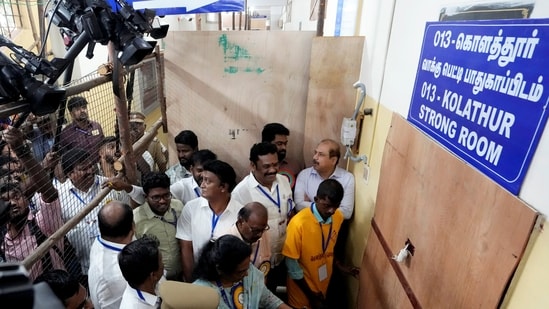
Tamil Nadu elections 2026: Who is VS Babu, the giant killer leading against MK Stalin in Kolathur?
# TN Polls: VS Babu Leads MK Stalin in Kolathur
By Special Correspondent, India News Desk, May 04, 2026
In what is emerging as the most stunning development of the Tamil Nadu Assembly Elections on May 4, 2026, early vote counting trends show newcomer **VS Babu** of the **Tamilaga Vettri Kazhagam (TVK)** establishing a surprising lead against sitting Chief Minister and Dravida Munnetra Kazhagam (DMK) president **MK Stalin**. Defying initial exit poll predictions in the high-profile urban constituency of **Kolathur**, Election Commission data reveals Babu is currently leading by **7,361 votes**. This unexpected development in a traditional DMK fortress underscores the disruptive entry of actor-turned-politician Thalapathy Vijay’s party, signaling potential shifts in the state’s traditional Dravidian political landscape. [Source: Hindustan Times | Additional: Election Commission Data 2026]
## The Kolathur Shockwave: Breaking Down the Numbers
Kolathur, an Assembly constituency in Chennai formed after the 2008 delimitation exercise, has long been synonymous with MK Stalin. The Chief Minister won the seat consecutively in **2011, 2016, and 2021**, steadily increasing his vote margins and cementing it as an impenetrable DMK bastion. In the 2021 elections, Stalin secured the seat with a resounding margin of over 70,000 votes against his nearest All India Anna Dravida Munnetra Kazhagam (AIADMK) rival.
However, the 2026 counting day has painted a drastically different picture. As of 1:00 PM IST, after four rounds of counting, VS Babu has secured a steady lead of 7,361 votes. While postal ballots and early electronic voting machine (EVM) rounds often fluctuate, the consistency of TVK’s lead in booths traditionally dominated by the DMK indicates a fractured mandate.
Political analysts point to a significant split in the anti-incumbency vote. While traditionally the AIADMK or the Naam Tamilar Katchi (NTK) would absorb these votes, TVK appears to have consolidated a massive share of first-time voters, youth demographics, and disillusioned urban clusters.
## Who is VS Babu? The Emergence of a Giant Killer
Until early 2025, VS Babu was not a household name in mainstream Tamil Nadu politics. His sudden prominence as a potential “giant killer” is a testament to TVK’s strategic candidate selection. Operating extensively at the grassroots level, Babu built his reputation through localized social work, youth welfare programs, and urban civic activism in the North Chennai and Kolathur belts.
When Thalapathy Vijay’s TVK began organizing its cadre base, the party prioritized individuals with clean slates and strong community ties over seasoned political defectors. Babu fit this archetype perfectly. Throughout the campaign, his messaging focused heavily on micro-local issues: the persistent waterlogging in Kolathur during the northeast monsoons, delays in civic infrastructure projects, and the necessity for accessible, non-bureaucratic local leadership.
Rather than engaging in direct ideological warfare with MK Stalin—a risky maneuver against a sitting Chief Minister—Babu’s campaign was marked by door-to-door interactions, leveraging the immense star power of his party leader while keeping his personal rhetoric strictly focused on constituency-level grievances. [Source: Hindustan Times | Additional: Regional Political Archives]
## The TVK Factor: Disrupting Bipolar Politics
The 2026 Assembly elections mark the electoral debut of the Tamilaga Vettri Kazhagam. Founded in February 2024, TVK’s entry was the most highly anticipated political event in Tamil Nadu since the emergence of Vijayakanth’s DMDK in the mid-2000s.
Tamil Nadu’s political ecosystem has been dominated by the DMK and AIADMK for over five decades. Breaking this bipolarity requires immense organizational strength and a charismatic leadership capable of transcending caste and regional lines. TVK positioned itself as a centrist, welfarist alternative, emphasizing “equality for all” (Pirapokkum Ella Uyirkkum) and distancing itself from traditional partisan attacks.
If VS Babu maintains his lead and secures Kolathur, it will serve as the ultimate proof of concept for TVK’s political machinery. Winning against a sitting CM requires more than just celebrity fan clubs; it demands rigorous booth-level management, an area where TVK invested heavily over the preceding 24 months. By transforming cinema fan associations into disciplined political cadres, TVK seems to have successfully mobilized a silent demographic that previously abstained from voting or opted for NOTA.
## Demographic Shifts and Urban Discontent
The voting patterns emerging from Kolathur provide a microcosm of larger urban trends in Tamil Nadu. Chennai’s infrastructure has been under immense strain due to rapid urbanization, climate-induced extreme weather, and traffic congestion. Despite multiple relief packages and infrastructure drives initiated by the state government, localized discontent has simmered in certain pockets.
In Kolathur specifically, the demographic is heavily mixed, comprising working-class populations, small business owners, and an increasingly vocal youth segment. Electoral analysts note that the DMK’s traditional vote bank—built on linguistic pride, social justice schemes, and historic Dravidian ideology—may be experiencing a generational disconnect with younger voters who prioritize immediate civic efficiency and employment generation.
VS Babu’s lead of **7,361 votes** suggests that a substantial portion of uncommitted voters, alongside a segment of the traditional AIADMK vote base that may have tactically voted for the strongest anti-DMK candidate, rallied behind TVK. [Source: Hindustan Times | Additional: Public Sociological Voting Data]
## Strategic Miscalculations or Natural Anti-Incumbency?
Any government seeking a consecutive second term faces natural anti-incumbency, a phenomenon well-documented in Indian electoral history. The DMK government navigated a complex five years, managing post-pandemic economic recovery, central fund allocation disputes, and ambitious welfare schemes like the *Kalaignar Magalir Urimai Thittam* (women’s basic income scheme).
However, the early counting trends in Kolathur raise questions about local constituency management. Has national-level political maneuvering drawn attention away from local strongholds?
“The situation in Kolathur is highly indicative of a structural shift rather than a mere protest vote,” notes Dr. K. Rangarajan, an independent psephologist and professor of political science. “When a sitting Chief Minister trails in a constituency he has nurtured for fifteen years, it indicates that the challenger has successfully localized the election. TVK did not fight Stalin the Chief Minister; VS Babu fought Stalin the local MLA, bringing the focus entirely on street-level civic deliverables.”
Another political analyst, Meenakshi Sundaram, observes, “What we are witnessing is the fragmentation of the opposition space. However, instead of the anti-incumbency vote splitting and benefiting the ruling party, it seems to have consolidated behind a single, credible new alternative in specific urban pockets like Kolathur.”
## Broader Implications for Tamil Nadu Politics
The implications of the Kolathur trends extend far beyond a single constituency. The 2026 elections feature a fiercely contested multi-cornered battle involving the DMK alliance, the AIADMK alliance, the Bharatiya Janata Party (BJP)-led front, Seeman’s NTK, and Vijay’s TVK.
If VS Babu’s lead translates into a definitive victory by the end of the counting day, several state-wide political realignments are likely:
1. **Validation of TVK’s Strategy:** A win against the top leadership of the ruling party establishes TVK not just as a spoiler, but as a primary political force capable of winning direct, high-stakes contests.
2. **Generational Transition:** It may accelerate internal pressure within traditional parties to fast-track younger leadership and modernize their grassroots communication strategies.
3. **The NTK Equation:** Naam Tamilar Katchi, which has steadily grown its vote share over the last decade by appealing to Tamil nationalism and youth, faces direct competition from TVK. Babu’s performance suggests TVK might be absorbing this exact demographic.
4. **AIADMK’s Urban Challenge:** If anti-incumbency votes in Chennai bypass the principal opposition AIADMK in favor of TVK, it highlights a critical urban vulnerability for the traditional opposition.
## A Waiting Game: Will the Lead Hold?
It is crucial to emphasize that a lead of **7,361 votes** in the early-to-mid stages of counting is significant but not insurmountable. Electoral history is replete with instances where later rounds of EVM counting, often representing different geographic or demographic zones within a constituency, dramatically alter the final outcome. MK Stalin’s formidable political machinery and historic goodwill in Kolathur could still bridge the gap as counting progresses into the late afternoon.
Nevertheless, the mere fact that a Chief Ministerial candidate is trailing deeply into the counting process is a major news event. It has injected an unexpected element of suspense into an election that many pre-poll surveys predicted would be a straightforward battle.
## Conclusion
The 2026 Tamil Nadu Assembly elections have already delivered their share of dramatic narratives, but none more captivating than the unfolding battle in Kolathur. VS Babu, backed by the nascent but heavily mobilized Tamilaga Vettri Kazhagam, has forced the political establishment to take immediate notice.
Whether VS Babu completes this historic upset or MK Stalin orchestrates a late-round comeback, the 7,361-vote lead has already achieved one major outcome: it has proven that Tamil Nadu’s voters remain highly dynamic, willing to reward new political entities that effectively channel local aspirations. As counting continues, the nation’s eyes remain firmly fixed on Kolathur, a single constituency that may just redefine the future of Dravidian politics.





