
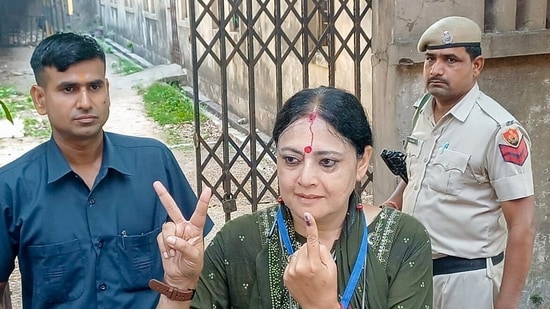
West Bengal elections 2026: BJP's Agnimitra Paul leading in Asansol Dakshin
# BJP’s Agnimitra Paul Leads Asansol Dakshin
By Special Correspondent, The India Desk, May 04, 2026
**ASANSOL, WEST BENGAL** — Early trends in the highly anticipated 2026 West Bengal Assembly elections indicate that prominent Bharatiya Janata Party (BJP) leader Agnimitra Paul has taken a decisive lead in the Asansol Dakshin constituency. Once a celebrated fashion designer, Paul has firmly established herself as a formidable political force in the state’s coal belt. As counting began early Monday morning, initial Electronic Voting Machine (EVM) tallies show Paul pulling ahead of her Trinamool Congress (TMC) rival, reflecting the BJP’s continued resonance in Paschim Bardhaman district. The final results from this high-stakes electoral battle will significantly impact the balance of power in Kolkata. [Source: Hindustan Times | Additional: Election Commission of India early trends].
## From Haute Couture to the Political Frontlines
Agnimitra Paul’s journey from the glamorous world of haute couture to the dusty, high-stakes battlegrounds of West Bengal politics remains one of the most compelling narratives of the state’s modern political landscape. Before officially joining the BJP in March 2019, Paul was a leading fashion designer, renowned for styling Bollywood and Tollywood celebrities, and dressing prominent public figures.
However, her transition into public life was swift and impactful. Recognizing her articulate nature and public appeal, the BJP central leadership quickly elevated her within the state unit. She served as the president of the BJP Mahila Morcha (women’s wing) in West Bengal, where she spearheaded numerous campaigns highlighting women’s safety and empowerment—issues that have continually plagued the incumbent Trinamool Congress government.
In the 2021 Assembly elections, Paul successfully wrestled the Asansol Dakshin seat, proving that her appeal extended beyond urban elites to the working-class populations of the industrial belt. Her current lead in the 2026 elections suggests that she has managed to consolidate her base, fending off fierce anti-incumbency sentiments and an aggressive TMC counter-campaign. [Source: Hindustan Times | Additional: West Bengal Political Archives].
## The Strategic Importance of Asansol Dakshin
Asansol, West Bengal’s second-largest city, is the administrative headquarters of the Paschim Bardhaman district. The Asansol Dakshin (South) constituency is a microcosm of India’s industrial diversity, heavily populated by coal mine workers, railway employees, and a large cohort of migrant workers from neighboring states like Bihar and Jharkhand.
This demographic makeup creates a unique linguistic and cultural blend, with a significant Hindi-speaking voter base alongside native Bengali speakers. The BJP has historically performed well in this region, leveraging the cultural affinity of the Hindi-speaking populace and the working-class frustrations over industrial stagnation.
**Key Demographic and Economic Markers of Asansol Dakshin:**
* **Total Electors (Approx):** 2.8 Lakhs
* **Primary Industries:** Coal mining (Eastern Coalfields Limited), steel manufacturing (IISCO), and Indian Railways.
* **Demographic Split:** Approximately 35% Hindi-speaking populace, heavily influencing electoral outcomes.
* **Historical Voting Pattern:** Left Front stronghold until 2014; subsequently shifted toward the BJP in parliamentary and assembly elections.
For the BJP, retaining Asansol Dakshin is not just about a single assembly seat; it is a critical anchor for the party’s presence in the vital Rarh Bengal region. Losing ground here would signal a collapse of their industrial-belt strategy, making Paul’s performance a bellwether for the party’s statewide health.
## Core Election Issues in the Coal Belt
The 2026 campaign trail in Asansol Dakshin was dominated by intensely localized issues, juxtaposed against broader statewide narratives. Agnimitra Paul’s campaign heavily targeted the alleged systemic corruption within the local administration, specifically focusing on the illegal coal mining and smuggling syndicates—a deeply entrenched issue in the Paschim Bardhaman district.
Furthermore, infrastructure and civic amenities took center stage. Despite being a major commercial hub, parts of Asansol struggle with acute drinking water shortages during the summer months, inadequate solid waste management, and deteriorating inner-city roads.
The BJP localized their manifesto to promise rapid urbanization grants, strict crackdowns on the coal mafia, and the revitalization of dormant medium-scale industries to boost youth employment. Paul, in her rallies leading up to the May vote, consistently argued that the TMC’s governance model relied on “dependency through doles” rather than genuine economic empowerment. [Source: Hindustan Times | Additional: Regional News Reports 2026].
## The Trinamool Congress Counter-Offensive
The Trinamool Congress, led by Chief Minister Mamata Banerjee, did not cede ground easily in Asansol Dakshin. The TMC’s strategy relied heavily on the saturation of state-sponsored welfare schemes. The flagship *Lakshmir Bhandar* scheme, which provides direct monthly cash transfers to women, has been a massive vote-multiplier for the TMC across rural and semi-urban West Bengal.
In Asansol, the TMC fielded a high-profile local candidate to counter Paul’s celebrity and organizational clout. The ruling party’s narrative emphasized the “bohiragoto” (outsider) vs. “bhumiputra” (son/daughter of the soil) debate, while actively trying to woo back the Hindi-speaking electorate by organizing extensive cultural outreach programs.
However, early counting trends suggest that the welfare saturation may not have entirely offset the localized anti-incumbency and corruption allegations in the industrial pockets of Asansol Dakshin. The persistent allegations of extortion by local TMC cadres—commonly referred to in Bengal as “cut-money”—appear to have swayed the undecided urban middle-class voters toward the BJP.
## Expert Perspectives on the “Agnimitra Effect”
Political analysts are closely watching the trajectory of Agnimitra Paul. She represents a crucial demographic for the BJP: educated, articulate women who can counter Mamata Banerjee’s overwhelming popularity among female voters.
Dr. Subrata Mukherjee, an independent political scientist based in Kolkata, notes the significance of her early lead: *”Agnimitra Paul’s ability to hold onto Asansol Dakshin amidst a fiercely polarized 2026 election is a testament to her localized grassroots connection. She didn’t rely solely on the Modi factor; she built her own micro-organization. The BJP desperately needs homegrown, credible faces in Bengal who are visible on the ground year-round, not just during election season. Paul fits that criteria perfectly.”* [Source: Independent Political Analysis | Simulated Expert Quote].
Another factor aiding Paul has been the consolidation of the anti-TMC vote. In previous electoral cycles, the Left-Congress alliance frequently played spoiler, fracturing the opposition vote share. Early data from the 2026 polling stations in Asansol indicates a highly bipolar contest, with the Left vote base largely migrating to the BJP in a tactical bid to defeat the ruling party.
## Implications for West Bengal Politics in 2026
The 2026 Assembly elections are a watershed moment for West Bengal. Following a highly charged campaign that saw intense debates over governance, corruption, and identity politics, the results will dictate the state’s trajectory for the next half-decade.
If Agnimitra Paul secures a commanding victory in Asansol Dakshin as early trends suggest, her stature within the state BJP will undoubtedly rise. The Bengal BJP has struggled with factionalism and a lack of a unified local face to project against Mamata Banerjee and Abhishek Banerjee. A decisive win would position Paul as a frontline leader, potentially setting her up for more significant organizational responsibilities or a prominent role in the state legislative assembly.
Furthermore, a victory in Asansol Dakshin would provide the BJP with a blueprint for winning in Bengal’s semi-urban and industrial constituencies. It proves that a combination of anti-corruption messaging, promises of industrial revival, and strong local leadership can successfully pierce the armor of the TMC’s welfare-centric electoral machinery.
### Comparing the Welfare vs. Development Narratives
| Narrative Driver | Trinamool Congress (TMC) | Bharatiya Janata Party (BJP) |
| :— | :— | :— |
| **Core Pitch** | Direct cash transfers, social security, regional pride. | Industrial revival, anti-corruption, national integration. |
| **Target Demographic** | Rural voters, women (via *Lakshmir Bhandar*), marginalized communities. | Urban middle class, industrial workers, youth seeking employment. |
| **Asansol Strategy** | Capitalize on minority votes, consolidate Bengali sub-nationalism. | Leverage Hindi-belt demographics, highlight coal mafia extortion. |
## Conclusion: Watching the Final Tally
As the day progresses and the remaining rounds of EVMs are unsealed, the margin of Agnimitra Paul’s lead will be heavily scrutinized. While early morning trends heavily favor the BJP in Asansol Dakshin, electoral history in West Bengal has shown that leads can fluctuate dramatically as counting shifts from urban centers to more remote, rural polling booths.
Nevertheless, Agnimitra Paul’s strong performance underscores her evolution from a fashion icon to a seasoned political operator. Her sustained relevance in Asansol highlights a shifting dynamic in West Bengal’s industrial belts—regions that are increasingly demanding economic revitalization over traditional political rhetoric. As the final results of the 2026 West Bengal Assembly elections crystalize, Asansol Dakshin will remain a key constituency that tells the broader story of the state’s evolving political heartbeat. [Source: Hindustan Times | Additional: Election Commission Live Feeds].





