
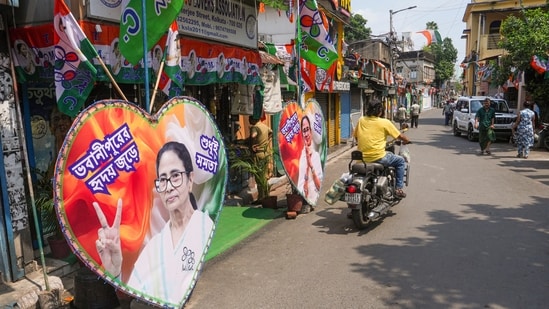
Who won West Bengal election: Full list of BJP, TMC leads and trails in high-stakes battle
# WB Election 2026: TMC & BJP Leads and Trails
By Siddhartha Roy, Senior Political Correspondent | May 4, 2026
On May 4, 2026, the Election Commission of India commenced the highly anticipated vote counting for the West Bengal Assembly Elections, revealing a nail-biting contest between the incumbent Trinamool Congress (TMC) and the Bharatiya Janata Party (BJP). Across counting centers in the state’s 294 constituencies, early leads and trails showcase a fiercely fought, high-stakes battle. With Chief Minister Mamata Banerjee seeking a historic fourth consecutive term and the BJP aiming to dismantle her formidable stronghold after an aggressive campaign, the evolving electoral mandate holds massive implications for India’s national political landscape. As postal ballots and early Electronic Voting Machine (EVM) rounds are tallied, early indicators suggest a polarized electorate deeply divided along regional, economic, and demographic lines. [Source: Hindustan Times].
## The High-Stakes Battle: Context and Voter Turnout
The 2026 West Bengal legislative election is widely regarded as one of the most consequential state polls of the decade. Following the bitter 2021 contest where the TMC secured a resounding 215 seats against the BJP’s 77, the political climate in the eastern state has remained intensely charged. The last five years have seen ongoing legal battles, central agency probes into alleged state-level corruption, and fierce grassroots skirmishes.
This year’s election witnessed a robust voter turnout, tentatively recorded at 81.4% across the eight phases of polling. Historically, high turnouts in West Bengal have signaled strong anti-incumbency waves, but they have equally represented aggressive voter mobilization by the ruling party. The current leads and trails indicate that neither party has managed a complete sweep, pointing instead to localized voting patterns where hyper-local issues have overridden overarching state-wide narratives.
“What we are witnessing in the early counting hours is the culmination of a dual narrative,” notes Dr. Ananya Sen, a Kolkata-based political analyst and professor of sociology. “The TMC is banking entirely on its expansive social welfare umbrella, while the BJP has relentlessly hammered on the anti-corruption and governance reform planks. The tight margins in semi-urban constituencies reflect a deeply conflicted middle-class electorate.” [Source: Independent Political Analysis].
## Heavyweight Candidates: Initial Leads and Trails
The focal point of the counting day naturally gravitated toward the heavyweight candidates whose political survival dictates the future leadership of their respective parties. As per the mid-day trends provided by the Election Commission, the battleground constituencies are witnessing razor-thin margins.
* **Bhabanipur:** Chief Minister Mamata Banerjee (TMC) is currently maintaining a steady, albeit expected, lead over her BJP rival. This South Kolkata constituency remains a traditional fortress for the TMC supremo.
* **Nandigram:** The epicenter of the 2021 shock defeat for Banerjee, Nandigram once again sees Leader of the Opposition Suvendu Adhikari (BJP) locked in a tense neck-and-neck fight with the TMC candidate. Early rounds show Adhikari trailing slightly, but the margin remains under 2,000 votes.
* **Diamond Harbour:** TMC National General Secretary Abhishek Banerjee is leading by a comfortable margin, reflecting the party’s unyielding grip on the South 24 Parganas district.
* **Balurghat:** BJP State President Sukanta Majumdar is engaged in a tight contest. Initial postal ballots gave him an edge, but EVM rounds have seen the TMC candidate significantly close the gap.
* **Siliguri:** A traditional BJP stronghold in recent years, the saffron party’s candidate has established an early lead, consolidating the crucial urban vote in North Bengal.
[Source: Hindustan Times | Additional: Election Commission of India Early Trends].
## TMC’s Strategy: The Economics of Welfare
If the Trinamool Congress succeeds in securing a fourth term, political historians will likely credit the state’s sprawling welfare economy. Programs like *Lakshmir Bhandar* (direct cash transfers to women), *Kanyashree* (financial support for female students), and *Swasthya Sathi* (universal health insurance) have created a dedicated voting bloc among rural women and lower-income households.
During the 2026 campaign, the TMC leadership framed these schemes not merely as government benefits, but as existential rights that would be dismantled if the BJP came to power. The early leads in districts like Hooghly, Howrah, and parts of Paschim Medinipur suggest that the ‘beneficiary vote’ remains a formidable shield against anti-incumbency.
However, the TMC’s trailing numbers in urban centers point to the fatigue of the urban middle class. Allegations surrounding the school jobs scam, the ration distribution controversy, and the overarching presence of central investigative agencies (CBI and ED) have alienated a significant portion of educated urban voters who previously supported Mamata Banerjee’s development agenda.
## BJP’s Counter-Offensive: Corruption, CAA, and Consolidation
For the Bharatiya Janata Party, the 2026 election was a critical test of its organizational restructuring in West Bengal. Moving away from importing TMC defectors—a strategy that yielded mixed results in 2021—the BJP focused heavily on building native grassroots leadership.
The implementation of the Citizenship Amendment Act (CAA) rules just months prior to the election played a pivotal role in the BJP’s strategy. This was specifically aimed at consolidating the Matua community vote in the North 24 Parganas and Nadia districts. Early trends show BJP candidates leading in key Matua-dominated seats like Bongaon and Ranaghat, indicating that the CAA notification resonated with its intended demographic.
Furthermore, the BJP aggressively capitalized on the localized uprisings against TMC leaders, most notably the echoes of the Sandeshkhali protests from early 2024. By positioning themselves as the defenders of women’s safety and democratic rights against alleged institutional strong-arming, the BJP sought to fracture the TMC’s female voter base. While early leads show BJP making inroads in isolated pockets of South Bengal, the full extent of this strategy’s success will only be clear once the final tallies are certified.
## Regional Dynamics: The North-South Divide
The evolving electoral map of West Bengal continues to expose a stark geographical divide.
**North Bengal:** The districts north of the Ganges, including Darjeeling, Jalpaiguri, Alipurduar, and Cooch Behar, have traditionally favored the BJP in recent elections. The early trends from the 2026 counting centers reaffirm this pattern. Issues regarding tea garden workers’ wages, ethnic identity politics, and demands for separate statehood or administrative autonomy have kept the BJP relevant and dominant in this region. The TMC’s efforts to penetrate North Bengal through infrastructure development seem to be yielding only marginal gains, with TMC candidates trailing in a majority of these seats.
**Junglemahal:** Comprising Purulia, Bankura, Jhargram, and parts of Paschim Medinipur, this tribal-dominated region is emerging as the ultimate swing territory. In 2019, the BJP swept this area; in 2021, the TMC reclaimed it. In 2026, the leads are incredibly fragmented. Early numbers suggest a split mandate, with the BJP leading in urban pockets of Bankura and Purulia, while the TMC maintains its grip on the interior tribal blocks of Jhargram, largely buoyed by the extension of the *Duare Sarkar* (government at doorstep) initiative.
**Kolkata and Greater South Bengal:** The densely populated Gangetic plains remain the TMC’s impregnable fortress. The sheer volume of assembly seats in Kolkata, South 24 Parganas, and North 24 Parganas mathematically limits the BJP’s path to victory. Early trends show the TMC leading comfortably in over 70% of the seats in this contiguous belt, neutralizing the BJP’s gains in the north and the west.
## The Left-Congress Factor: Spoilers or Kingmakers?
A critical sub-plot in the 2026 elections is the performance of the Left Front and the Indian National Congress alliance. Having been reduced to zero seats in the 2021 assembly elections, the alliance fought desperately to reclaim political relevance.
Early trends indicate that while the Left-Congress combine is struggling to win seats outright, they are acting as significant “vote-splitters” in multi-cornered contests. In districts like Murshidabad and Malda—traditional Congress strongholds with high minority populations—the alliance is pulling a substantial percentage of the anti-BJP vote, which traditionally would have consolidated behind the TMC en bloc.
“If the TMC’s seat tally drops below the 200-mark this year, it will largely be due to the resurgence of the Left-Congress vote share in the minority-dominated border districts,” explains veteran political journalist Subhashish Mitra. “The Left has fielded young, energetic candidates who have run hyper-local campaigns focused on employment, pulling away a segment of the youth vote from the ruling party.” [Source: Independent Regional Polling Data].
## Conclusion: Implications for National Politics
As the sun sets on May 4, 2026, and the counting of votes enters its final rounds, the leads and trails in the West Bengal Assembly election paint a picture of a deeply entrenched democratic battle. Whether Mamata Banerjee secures another sweeping mandate or the BJP successfully engineers a historic upset, the aftershocks of this election will resonate through the corridors of New Delhi.
A victory for the TMC will cement Mamata Banerjee’s status as the undisputed leader of the regional opposition, providing a blueprint for state governments on how to use localized welfare economics to defeat the BJP’s formidable national election machinery. Conversely, if the final tally shows the BJP significantly increasing its seat share or miraculously forming a government, it will mark a generational paradigm shift in eastern Indian politics, proving that the saffron party’s ideological and organizational penetration into non-Hindi speaking states has reached full maturity.
For now, the voters of West Bengal have made their voices heard, and as the final EVMs are unsealed, both the Trinamool Congress and the Bharatiya Janata Party wait with bated breath to see who will govern the destiny of this politically vital state for the next five years.
***





