
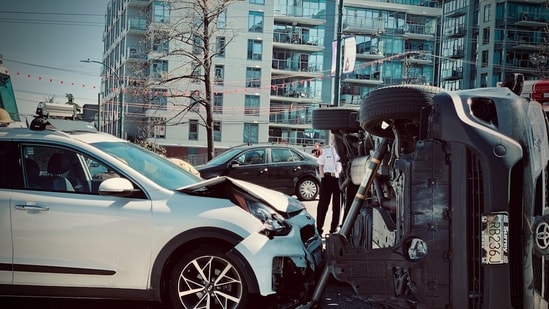
Five killed, seven injured as SUV rams truck in Odisha's Jajpur
# Jajpur SUV Crash: 5 Dead, 7 Injured in Odisha
**By Senior Correspondent, National News Desk, May 04, 2026**
A devastating collision on the national highway network in Jajpur district, Odisha, claimed the lives of **five individuals and left seven others critically injured** early Monday morning. The catastrophic event occurred when a heavily occupied Sports Utility Vehicle (SUV) rammed violently into the rear of a commercial goods truck. Emergency services responded swiftly to the distress calls, initiating a massive rescue operation to extricate passengers trapped within the mangled remains of the vehicle. As local authorities and forensic teams work to determine the exact sequence of events, this tragedy has once again brought the critical issues of highway safety, vehicle overloading, and nocturnal driving risks to the forefront of the national discourse. [Source: Hindustan Times | Additional: MoRTH Safety Guidelines].
## The Incident Unfolds: A Fatal Dawn
The fatal accident transpired in the early hours of **May 4, 2026**, along a notoriously busy stretch of the highway passing through the Jajpur district. According to preliminary reports from the scene, the SUV, which was carrying a total of twelve occupants, was traveling at a high rate of speed when it encountered the truck. Eyewitnesses and early police assessments suggest that the commercial truck was either moving at an extremely slow pace or was parked improperly along the carriageway without adequate reflective hazard warnings—a frequent hazard on Indian arterial routes.
The sheer force of the impact sheared off the front cabin of the SUV, instantly claiming the lives of the driver and four passengers seated in the forward and middle rows. The loud crash alerted nearby residents and passing motorists, who immediately rushed to the scene to offer preliminary assistance. The presence of twelve occupants inside a standard passenger SUV indicates severe vehicle overloading, a factor that invariably compromises a vehicle’s braking efficiency, structural integrity, and electronic stability control mechanisms.
“The sound of the collision was deafening, akin to a localized explosion,” noted a local shopkeeper who operates a nearby roadside eatery and was among the first to alert the authorities. “When we reached the site, the front half of the car was completely wedged underneath the heavy carrier.”
## Rapid Response and Medical Triage
The response from the Odisha State Police and regional emergency medical services was immediate, leveraging the state’s integrated highway trauma response network. Multiple ambulances were dispatched to the site, accompanied by heavy-duty cranes and gas-cutting equipment required to safely dismantle the wreckage and free the trapped survivors.
The **seven injured passengers** were swiftly administered initial first aid to stabilize their vitals before being transported to the District Headquarters Hospital in Jajpur. Three individuals who sustained severe traumatic brain injuries and complex fractures were subsequently transferred via green corridors to the SCB Medical College and Hospital in Cuttack to receive specialized neurosurgical and orthopedic care.
This rapid medical intervention highlights the critical importance of the “Golden Hour”—the first 60 minutes following a traumatic injury where prompt medical treatment significantly increases the chances of survival. Odisha’s pioneering *Rakshak* initiative, a state-run program that trains local roadside eatery owners, mechanics, and volunteers as first responders, played a crucial role in managing the chaotic initial moments following the crash. Volunteers trained under the scheme were reportedly present at the site, applying basic tourniquets and ensuring the airways of the unconscious victims remained clear until professional paramedics arrived.
## Forensic Investigation and Determining Liability
The local police have registered a First Information Report (FIR) under relevant sections of the Bharatiya Nyaya Sanhita (BNS), including sections pertaining to causing death by negligence and rash driving. An elite team of traffic crash investigators has been cordoning off the area to conduct a comprehensive scientific analysis of the crash site.
“Our primary focus is to reconstruct the accident timeline,” stated an investigating officer attached to the Jajpur district headquarters. “We are examining skid marks, the operational status of the truck’s tail lights, and retrieving the electronic control unit (ECU) data from the SUV to determine the exact speed at the moment of impact. Furthermore, we are investigating whether driver fatigue played a role, given that the crash occurred during the early morning hours—a period statistically associated with microsleep episodes among drivers.”
A pervasive issue on Indian highways is the unauthorized halting of heavy commercial vehicles. Due to a severe lack of designated lay-bys, rest stops, and truck terminals, drivers often park their large multi-axle vehicles on the left lane of high-speed corridors. When combined with poorly maintained taillights and the absence of reflective warning triangles, these stationary trucks transform into lethal, invisible concrete walls for fast-approaching vehicles.
## The Physics of Disaster: Overloading and SUV Safety
A crucial element of the Jajpur tragedy is the severe overcrowding of the passenger vehicle. With **twelve individuals crammed into an SUV** typically designed to seat seven or eight, the vehicle’s dynamics were fundamentally altered.
Automotive safety experts consistently warn against the dangers of exceeding a vehicle’s Gross Vehicle Weight Rating (GVWR). When an SUV is overloaded, several critical safety failures become highly probable:
* **Increased Braking Distance:** The kinetic energy of a much heavier vehicle requires significantly more friction and distance to bring to a halt.
* **Compromised Crumple Zones:** Modern vehicles are engineered to absorb impact energy through specifically designed crumple zones. Overloading bypasses these safety margins, transferring lethal kinetic energy directly into the passenger cabin.
* **Tire Blowout Risk:** The additional weight places immense thermal and physical stress on the tires, particularly during high-speed highway transit, leading to a higher risk of sudden decompression and loss of steering control.
* **Seatbelt Scarcity:** With twelve occupants in a seven-seater configuration, it is an undeniable fact that at least five individuals—and likely more—were not wearing seatbelts at the time of the collision, resulting in catastrophic blunt force trauma upon impact.
“The safety ratings of modern SUVs, whether they score four or five stars in crash tests, are entirely contingent upon the occupants wearing seatbelts and the vehicle operating within its specified weight limits,” explained Dr. Ananya Rao, an independent road safety auditor and transportation researcher based in Bhubaneswar. “When you pack twelve people into a family vehicle, you are effectively nullifying every piece of safety technology built into that car.”
## Contextualizing Odisha’s Road Safety Crisis
The Jajpur crash is not an isolated incident but rather a symptom of a broader, systemic crisis afflicting India’s rapidly expanding highway network. According to data historically compiled by the Ministry of Road Transport and Highways (MoRTH) and recent state-level traffic audits leading up to 2026, Odisha has been grappling with a persistently high rate of road fatalities, particularly along National Highway 16 (NH-16), which forms a vital part of the Golden Quadrilateral connecting Kolkata to Chennai.
Despite massive state investments in road widening and surface quality improvements, the corresponding enhancement of road safety infrastructure has lagged. The phenomenon often referred to as the “wide road paradox” dictates that as road surfaces improve and lanes multiply, average vehicle speeds increase dramatically. Without strict enforcement of speed limits through automated camera networks and heavy highway patrolling, the severity of crashes increases exponentially.
The Odisha state government has previously acknowledged these “black spots”—stretches of road approximately 500 meters long where recurrent fatal accidents take place. While mitigation efforts such as installing rumble strips, improving signage, and deploying Highway Patrol Interceptor Vehicles have been initiated, the vast expanse of the state’s road network makes comprehensive enforcement an immense logistical challenge.
## Expert Perspectives on Systemic Reform
Transportation analysts argue that reducing highway fatalities requires a holistic approach that moves beyond simply blaming the driver. The ‘Safe System Approach’, widely endorsed by global transport authorities and the World Health Organization (WHO), posits that human error is inevitable, and therefore the road infrastructure and vehicular safety nets must be designed to ensure that a simple mistake does not result in a death sentence.
“What we are witnessing on routes through Jajpur and similar districts is a fatal intersection of human behavioral flaws and infrastructural deficits,” stated a senior researcher from the Indian Institute of Technology (IIT) regarding national highway engineering. “We must mandate and heavily subsidize the construction of dedicated truck terminals every 50 kilometers. If commercial drivers have safe, well-lit spaces to rest, the hazardous practice of highway shoulder parking will naturally decrease.”
Furthermore, experts are advocating for stricter implementation of commercial transport regulations. Ensuring that truck drivers adhere to strict working hour limits, enforced via electronic logging devices (ELDs) similar to those used in Western countries, would drastically reduce incidents of fatigue-induced highway obstruction.
## Government Interventions and Technological Solutions
In response to the escalating toll of highway crashes, state and central authorities are increasingly turning to technology to bridge the enforcement gap. The integration of Artificial Intelligence (AI) in traffic management is becoming a priority. Advanced AI-powered surveillance cameras are currently being phased in across major Indian highways to automatically detect not just overspeeding, but also irregular lane changes, unfastened seatbelts, mobile phone usage while driving, and illegal parking.
The Motor Vehicles (Amendment) Act has provided the legal framework necessary to impose steep penalties for traffic violations, serving as a robust financial deterrent. However, experts note that the certainty of being caught—rather than the severity of the fine—is the most effective psychological deterrent for habitual traffic offenders.
Simultaneously, campaigns aimed at behavioral change are crucial. Public service announcements emphasizing the deadly consequences of overloading passenger vehicles must penetrate both urban centers and rural hinterlands, targeting the cultural normalization of cramming large extended families or groups of laborers into single vehicles to save on transport costs.
## Conclusion: A Call for Collective Responsibility
The loss of **five lives and the severe injury to seven others** in the Jajpur SUV crash serves as a grim, urgent reminder of the lethal realities present on our highways. As families grieve the sudden and violent loss of their loved ones, the focus must shift from mere statistical reporting to actionable, aggressive safety reforms.
Moving forward, preventing such tragedies will require an uncompromising triad of interventions: rigorous infrastructural improvements providing safe halting spaces for heavy transport; strict, technology-driven law enforcement targeting overloading and overspeeding; and a fundamental shift in civic responsibility regarding vehicle occupancy limits and seatbelt usage. Until the ‘Safe System Approach’ is deeply embedded into the DNA of Indian highway planning and individual driving habits, the tragic echoes of collisions like the one in Jajpur will continue to haunt the nation’s roadways.
*Disclaimer: This report relies on preliminary information provided by local authorities and news syndicates. Investigations into the exact cause of the crash are ongoing, and details may evolve as forensic reports are finalized.*





