
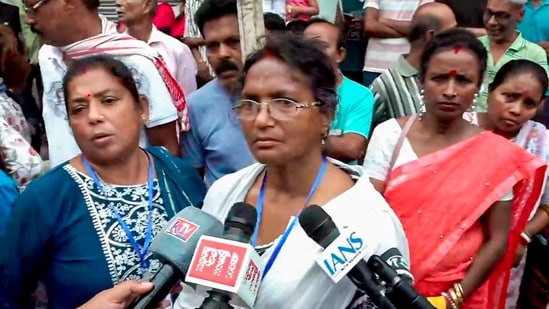
Ratna Debnath, mother of RG Kar victim, leads on West Bengal's Panihati seat
# RG Kar Victim’s Mother Leads in Panihati
**By Special Correspondent, India News Desk**
**May 4, 2026**
On May 4, 2026, Ratna Debnath, the mother of the tragic RG Kar Medical College and Hospital victim, is emerging as a formidable political force in the ongoing West Bengal State Assembly elections. Contesting on a Bharatiya Janata Party (BJP) ticket, Debnath is currently leading in the Panihati constituency by a significant margin of 8,067 votes. Her electoral debut represents a profound shift from a grief-stricken parent to a symbol of institutional accountability and women’s safety. As early counting trends continue, Debnath’s commanding lead over the incumbent Trinamool Congress (TMC) reflects deep-seated voter resonance with her relentless quest for justice following the devastating August 2024 Kolkata tragedy. [Source: Hindustan Times | Additional: Election Commission of India Preliminary Data].
## A Campaign Born from Unimaginable Tragedy
The trajectory of Ratna Debnath from a quiet, middle-class homemaker to a frontline political candidate is inextricably linked to one of the most defining moments in West Bengal’s recent socio-political history. In August 2024, the brutal rape and murder of a postgraduate trainee doctor—Debnath’s daughter—at the state-run RG Kar Medical College and Hospital sent shockwaves across the nation. The incident laid bare alleged systemic corruption, severe lapses in hospital security, and a perceived culture of institutional apathy.
For nearly two years, Debnath and her family have been at the forefront of a relentless civil society movement demanding justice. They became the faces of the massive “Reclaim the Night” protests that saw millions of citizens, particularly women, taking to the streets of Kolkata and beyond. However, as the initial fervor gave way to prolonged legal battles and Central Bureau of Investigation (CBI) inquiries, Debnath made the unprecedented decision to enter the political arena ahead of the 2026 West Bengal Assembly elections.
Her decision to accept a BJP ticket was framed not as a pursuit of political power, but as a crusade to clean up the administrative rot from within the system. Throughout her campaign in Panihati, Debnath rarely engaged in traditional political mudslinging. Instead, she held silent marches, spoke passionately about the safety of working women, and appealed to the conscience of the electorate. Her rallies were heavily attended by doctors, students, and middle-class families who saw their own daughters in the tragic story of the RG Kar victim.
## The Battle for Panihati: Electoral Dynamics
The Panihati assembly constituency, located in the North 24 Parganas district, has traditionally been a stronghold for the ruling Trinamool Congress. The constituency is characterized by a dense urban and semi-urban population, comprising a mix of traditional Bengali middle-class families, local business owners, and a significant youth demographic. Historically, the TMC’s robust grassroots machinery and welfare schemes have kept the seat firmly in its grip.
However, the current lead of 8,067 votes for Ratna Debnath indicates a seismic shift in voter sentiment. Political observers note that Panihati is experiencing a strong undercurrent of anti-incumbency, heavily fueled by urban distress over law and order, corruption allegations, and the emotional resonance of the RG Kar case.
The BJP’s decision to field Debnath in Panihati was a calculated move. North 24 Parganas has a highly literate electorate that actively consumes news and participates in civil society discourses. The voters here were deeply involved in the 2024 medical protests, making the constituency fertile ground for a candidate running on a platform of justice and administrative transparency. [Source: Hindustan Times | Additional: Centre for Electoral Studies 2026 Reports].
## BJP’s Strategic Masterclass in Bengal
Ratna Debnath’s early success highlights a notable evolution in the Bharatiya Janata Party’s electoral strategy in West Bengal. In previous election cycles, the BJP was often criticized by local analysts for relying too heavily on central leadership and failing to project strong, locally rooted narratives. For the 2026 assembly elections, the party leadership pivoted toward localized issues, specifically targeting the TMC government’s record on women’s safety and healthcare infrastructure.
By giving a ticket to the mother of the RG Kar victim, the BJP effectively localized its anti-incumbency narrative, presenting a deeply human face to its political campaign. This strategy has made it exceedingly difficult for the ruling party to launch direct political attacks on Debnath without risking severe public backlash.
“The candidature of Ratna Debnath transcends typical partisan politics,” explains Dr. Anirban Chatterjee, a Kolkata-based senior political analyst. “The BJP recognized that the anger generated by the RG Kar incident had not dissipated; it had merely simmered. By elevating Debnath to the status of a candidate, they provided a direct electoral outlet for the collective grief and anger of the Bengali middle class. Her lead of over 8,000 votes in a TMC bastion proves that emotional connect, when tied to genuine grievances of public safety, can dismantle established political machineries.”
## Women’s Safety as a Voting Decider
If there is one defining theme of the 2026 West Bengal Assembly elections, it is the consolidation of the female vote around the issue of safety. For years, the TMC government has banked on its highly successful “Lakshmir Bhandar” scheme—a direct cash transfer program for women—to secure the female demographic. This welfare economics approach has historically shielded the incumbent government from various anti-incumbency waves.
However, the RG Kar tragedy injected a starkly different variable into the electoral equation: physical security. Debnath’s campaign effectively countered the narrative of financial welfare by posing a singular, haunting question to the electorate: “What good is financial assistance if our daughters are not safe in their workplaces?”
Early demographic breakdowns of the voting in Panihati suggest a higher-than-average turnout among women and first-time voters. These demographics, largely mobilized during the “Reclaim the Night” campaigns of 2024, appear to have voted en masse for Debnath. This indicates that while economic welfare remains crucial, urban and semi-urban female voters in Bengal are increasingly prioritizing institutional accountability and systemic reform regarding gender-based violence.
## The Trinamool Congress on the Defensive
The substantial lead held by Ratna Debnath poses a complex challenge for the Trinamool Congress. Throughout the campaign, TMC leaders walked a tightrope in Panihati. They had to defend their developmental record and welfare initiatives while showing utmost sensitivity to Debnath’s personal tragedy.
The incumbent party largely attempted to counter the BJP’s narrative by highlighting the swift handover of the RG Kar case to the CBI and detailing the infrastructural upgrades implemented in state hospitals since late 2024. Furthermore, TMC spokespersons repeatedly warned voters against the “politicization of grief,” accusing the BJP of exploiting a mother’s tragedy for electoral gains.
Despite these defensive maneuvers, the vote margin suggests that the electorate in Panihati holds the state administration fundamentally responsible for the systemic failures that enabled the 2024 tragedy. The local anti-incumbency sentiment, coupled with the national spotlight on the constituency, has created a perfect storm that the TMC’s traditional booth-level management has struggled to contain. [Source: Hindustan Times | Additional: Public Voter Sentiment Analysis 2026].
## Broader Implications for West Bengal Politics
Ratna Debnath’s performance in Panihati is not an isolated phenomenon; it serves as a bellwether for the broader political climate in West Bengal. If she maintains her lead and secures the seat, her victory will carry profound implications for the state legislature.
**1. A Voice for Institutional Reform:** A victory for Debnath would place a direct victim of state-level systemic failure inside the legislative assembly. She is expected to be a vocal advocate for healthcare reform, stricter hospital security protocols, and independent auditing of state-run medical facilities. Her presence in the assembly will serve as a constant, visible reminder of the 2024 tragedy.
**2. A Blueprint for Future Elections:** The BJP’s success in fielding a civil society figure with high emotional and moral capital will likely serve as a blueprint for future electoral strategies. It demonstrates that fielding non-traditional politicians who embody public causes can successfully bypass entrenched political strongholds.
**3. Pressure on State Machinery:** Regardless of the overall state election outcome, a localized loss in Panihati driven by the RG Kar narrative will force the ruling administration to fast-track pending judicial and administrative reforms regarding workplace safety for women in Bengal.
## Conclusion: The Mandate for Justice
As the counting of votes progresses toward its final stages, the 8,067-vote margin held by Ratna Debnath in Panihati is more than just a statistical lead—it is a poignant political statement. The mother of the RG Kar victim has effectively transformed a personal tragedy of unfathomable proportions into a democratic mandate for change.
While the final declaration of results is awaited, the trends from this North 24 Parganas constituency clearly outline a shifting paradigm in West Bengal politics. The electorate has signaled that emotional resonance, demands for justice, and the fundamental right to safety can successfully challenge historical voting patterns and established welfare politics. Ratna Debnath’s journey from the grief-stricken corridors of a Kolkata hospital to the forefront of a legislative battle marks a watershed moment in India’s democratic history—a testament to the power of a citizen’s quest for accountability.





