
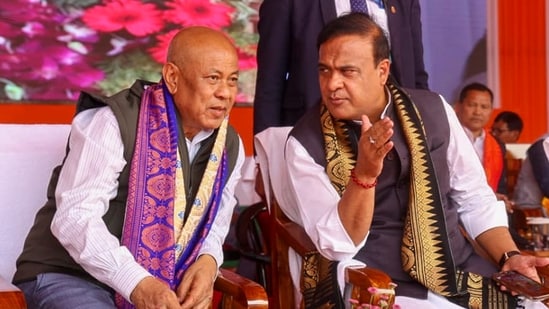
Assam election results: NDA strong in Bodoland as BPF leads majority seats
# Assam Polls: NDA Dominates as BPF Sweeps BTR
**Guwahati, May 4, 2026** — The National Democratic Alliance (NDA) has cemented a decisive and commanding advantage in the Bodoland Territorial Region (BTR) during the 2026 Assam Assembly elections, propelled by a massive grassroots resurgence of the Bodoland People’s Front (BPF). Early counting trends on Monday reveal the BPF leading in a sweeping majority of the region’s legislative seats. In stark contrast, the United People’s Party Liberal (UPPL), which had governed the Bodoland Territorial Council (BTC) for a single five-year term, faces a catastrophic electoral defeat and is currently leading in only one constituency. This critical mandate underscores a dramatic political realignment in Assam’s tribal belt. [Source: Hindustan Times].
## The Resurgence of the Bodoland People’s Front
The most striking narrative emerging from the 2026 Assam election results is the phenomenal political resurrection of the Bodoland People’s Front (BPF) under the seasoned leadership of Hagrama Mohilary. After facing substantial setbacks in both the 2020 Bodoland Territorial Council elections and the 2021 Assam State Assembly elections, the BPF appeared to be a diminishing force. However, intensive grassroots mobilization and a recalibration of their political messaging have yielded spectacular dividends.
Early reports from the Election Commission’s counting centers across Kokrajhar, Chirang, Baksa, and Udalguri indicate that the BPF has successfully consolidated both the indigenous Bodo vote and crucial non-Bodo demographic segments. Mohilary’s campaign heavily emphasized regional autonomy, rapid infrastructure development, and a critique of the incumbent UPPL’s administrative inefficiencies. By portraying the BPF as the original architect of peace and development in the Bodoland region, the party effectively captured the anti-incumbency wave, translating voter dissatisfaction into a formidable electoral sweep.
## UPPL’s Downfall After a Single Term
For the United People’s Party Liberal (UPPL), the 2026 election results represent a stunning collapse. Propelled to power in 2020 on the promise of systemic change and a “corruption-free” Bodoland, the UPPL, led by Pramod Boro, struggled to maintain its political capital over its five-year tenure. The party had historically dethroned the BPF by championing the 2020 Third Bodo Peace Accord, promising total rehabilitation for former insurgents and comprehensive economic packages for the region.
However, governance fatigue quickly set in. As counting progresses, the UPPL is leading in merely a single seat, confirming reports of widespread voter disillusionment. Analysts point to several critical failures: sluggish implementation of the Peace Accord’s economic clauses, internal factionalism, and an inability to balance the complex ethnic equations of the BTR. The very non-Bodo communities that initially supported the UPPL as a stabilizing alternative shifted their allegiance, finding the UPPL’s administrative framework overly bureaucratic and detached from rural realities. [Source: Hindustan Times | Additional: Regional Political Data 2026].
## NDA’s Pragmatic Alliance Engineering
The overarching victory in the Bodoland region belongs strategically to the National Democratic Alliance (NDA), spearheaded by the Bharatiya Janata Party (BJP). The BJP’s political acumen in Assam has long been defined by its flexible and deeply pragmatic approach to regional alliances. Recognizing the surging anti-incumbency against its erstwhile partner, the UPPL, the BJP orchestrated a timely political pivot in the months leading up to the 2026 elections.
By realigning its strategic interests with the resurgent BPF—a former ally that had briefly drifted to the opposition—the NDA ensured that the anti-UPPL vote did not benefit the broader opposition bloc (such as the Congress or AIUDF). This localized adjustment meant that regardless of whether the UPPL or BPF won the internal regional battle, the aggregate seat count would heavily favor the NDA’s pursuit of forming the state government in Dispur. The results reflect the success of this dual-engine strategy: the BJP maintained its dominance in upper and central Assam, while the BPF secured the tribal heartland for the alliance.
## Breakdown of Regional Performance
The electoral map of the Bodoland Territorial Region underscores the comprehensive nature of the BPF’s victory. The region, which spans four critical districts, dictates the political temperature of lower Assam.
**Key District Trends as of Midday, May 4, 2026:**
* **Kokrajhar:** Considered the political epicenter of Bodoland, Kokrajhar witnessed an overwhelming BPF wave. Early margins suggest the BPF candidates are leading by thousands of votes, decisively pushing the UPPL into the margins.
* **Chirang:** Traditionally a swing district, Chirang voters demonstrated a clear preference for the BPF’s grassroots candidates, rejecting the incumbent UPPL leadership over alleged delays in localized infrastructure projects.
* **Baksa & Udalguri:** These ethnically diverse districts, containing significant populations of marginalized communities, tea tribe workers, and non-Bodos, voted strategically. The NDA umbrella facilitated smooth vote transfers between BJP supporters and the BPF, entirely neutralizing the UPPL’s presence.
| Party Affiliation | 2021 Assembly Status | 2026 Current Trends (BTR Seats) |
| :— | :— | :— |
| **BPF (NDA)** | Marginalized | **Leading in Majority** |
| **UPPL (NDA)** | Dominant / Incumbent | **Leading in 1 Seat** |
| **Opposition Bloc** | Minimal | **Trailing** |
## Voices on the Ground and Expert Analysis
Political analysts tracking Assam’s volatile electoral dynamics are not entirely surprised by the cyclical nature of Bodoland politics. Dr. Rajiv Sarma, a senior political scientist based in Guwahati, provided context to the changing tides.
*”The electorate in the Bodoland Territorial Region is highly politically literate and deeply unforgiving of governance inertia,”* Dr. Sarma noted. *”The UPPL rode a wave of absolute euphoria following the 2020 Peace Accord. But euphoria does not build rural roads, nor does it generate localized employment. When Pramod Boro’s administration struggled with the sluggish release of state funds and bureaucratic bottlenecks, Hagrama Mohilary systematically rebuilt his base. The BPF’s victory is a classic textbook case of anti-incumbency being harnessed by a recognizable regional stalwart.”*
On the ground in Kokrajhar, voters echoed these sentiments. *”We gave the UPPL five years to change the system as they promised,”* said Ritesh Basumatary, a local merchant. *”But we saw more internal fighting than actual development. The BPF understands the pulse of the villages better.”*
## Economic and Policy Implications for BTR
The return of the BPF to regional dominance brings significant implications for the economic trajectory of the Bodoland Territorial Region. As the new mandate crystallizes, the BPF will bear the responsibility of fulfilling the uncompleted objectives of the Third Bodo Peace Accord. This includes the delicate task of finalizing the socio-economic rehabilitation of former National Democratic Front of Bodoland (NDFB) cadres, a promise that the UPPL struggled to execute fully.
Furthermore, the BPF will need to negotiate robustly with the BJP-led state government in Dispur to secure the ₹1,500 crore special development package designated for the region. Because the BPF has re-entered the NDA’s strategic fold, fiscal friction between the regional council and the state capital is expected to be minimal. The immediate focus for the incoming BPF leadership will likely be agricultural modernization, the expansion of healthcare facilities in Udalguri and Baksa, and resolving the long-standing issue of land rights for indigenous populations.
The sweeping victory also forces a structural re-evaluation of the UPPL. Reduced to a single seat, the party faces an existential crisis. To survive politically, the UPPL will need to undergo a rigorous leadership review and rebuild its cadres from the ground up, a daunting task in the face of a revitalized BPF and an electorally dominant BJP.
## Conclusion and Future Outlook
The May 2026 election results fundamentally redraw the political map of Assam’s Bodoland Territorial Region. The sweeping comeback of the Bodoland People’s Front serves as a stark reminder of the fragile nature of regional incumbency and the paramount importance of grassroots connectivity. The UPPL’s decimation to a single seat after just one five-year term highlights the high expectations and swift judgments of the BTR electorate.
Simultaneously, the results stand as a testament to the NDA’s formidable coalition management. By accurately reading the ground realities and aligning with the prevailing political winds, the BJP-led NDA has successfully insulated itself from localized anti-incumbency, retaining absolute strength in Bodoland. As the state awaits the final official tallies, the BPF prepares to reclaim the mantle of regional leadership, tasked with delivering sustainable peace, equitable development, and long-term stability to the people of Bodoland.
***
*By Senior Regional Correspondent, India Policy Chronicle, May 04, 2026*





